Manitoba Jurisprudence
Question Bank
Build your understanding of Manitoba pharmacy law with 300 original practice questions, answer explanations and source references.
Connect the rule to the decision. Practise professional responsibilities, safe dispensing and ethical judgement, then explore the source behind each answer. The practice screen is built to feel like the real exam, with NAPRA's drug schedules one click away.
Start with 36 free questions. Free registration. No card required.
- Practice questions
- 300
- Study topics
- 6
- Practice sets
- 18
- One-time purchase
- $69 CAD
Four real questions. The real practice screen.
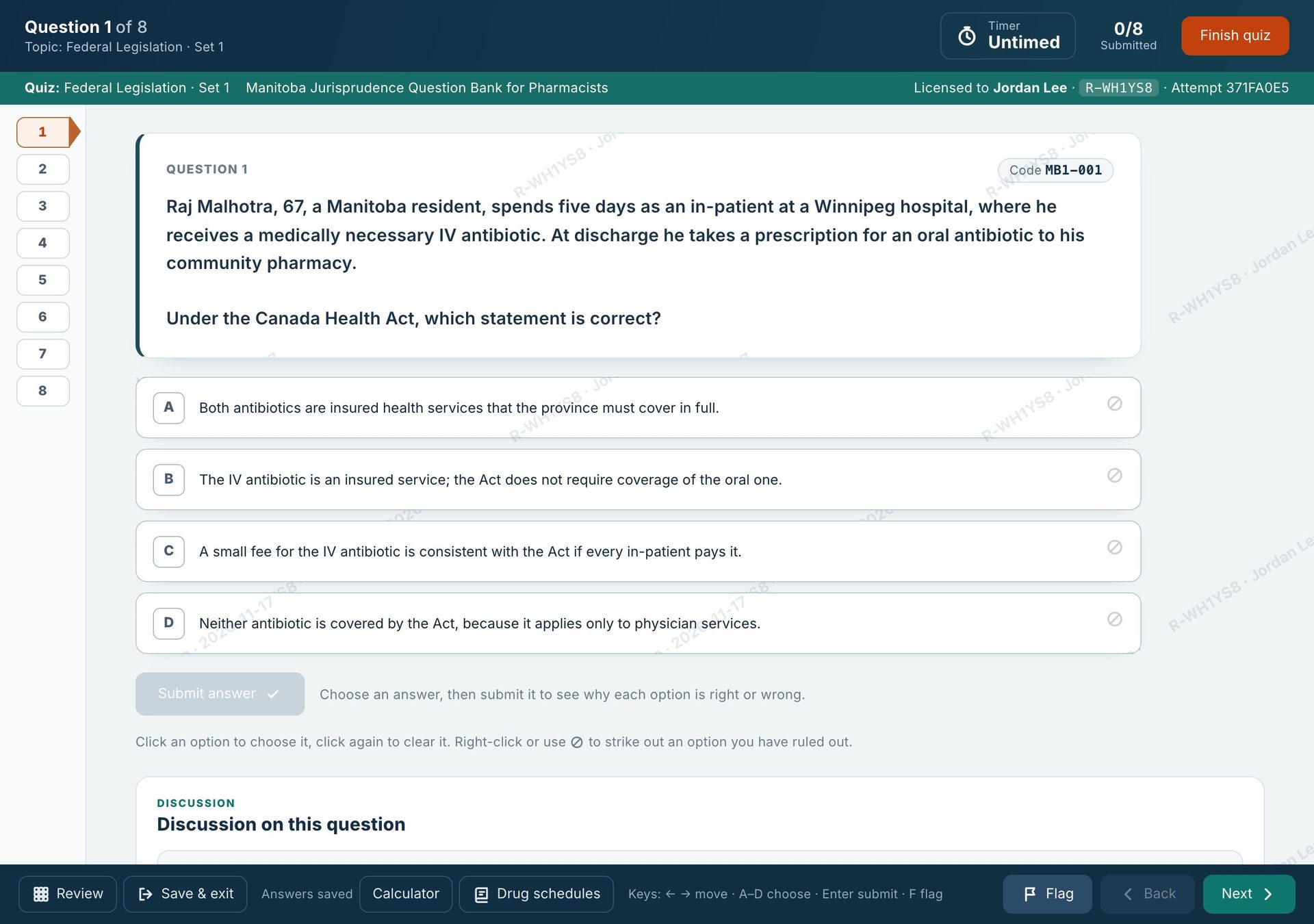
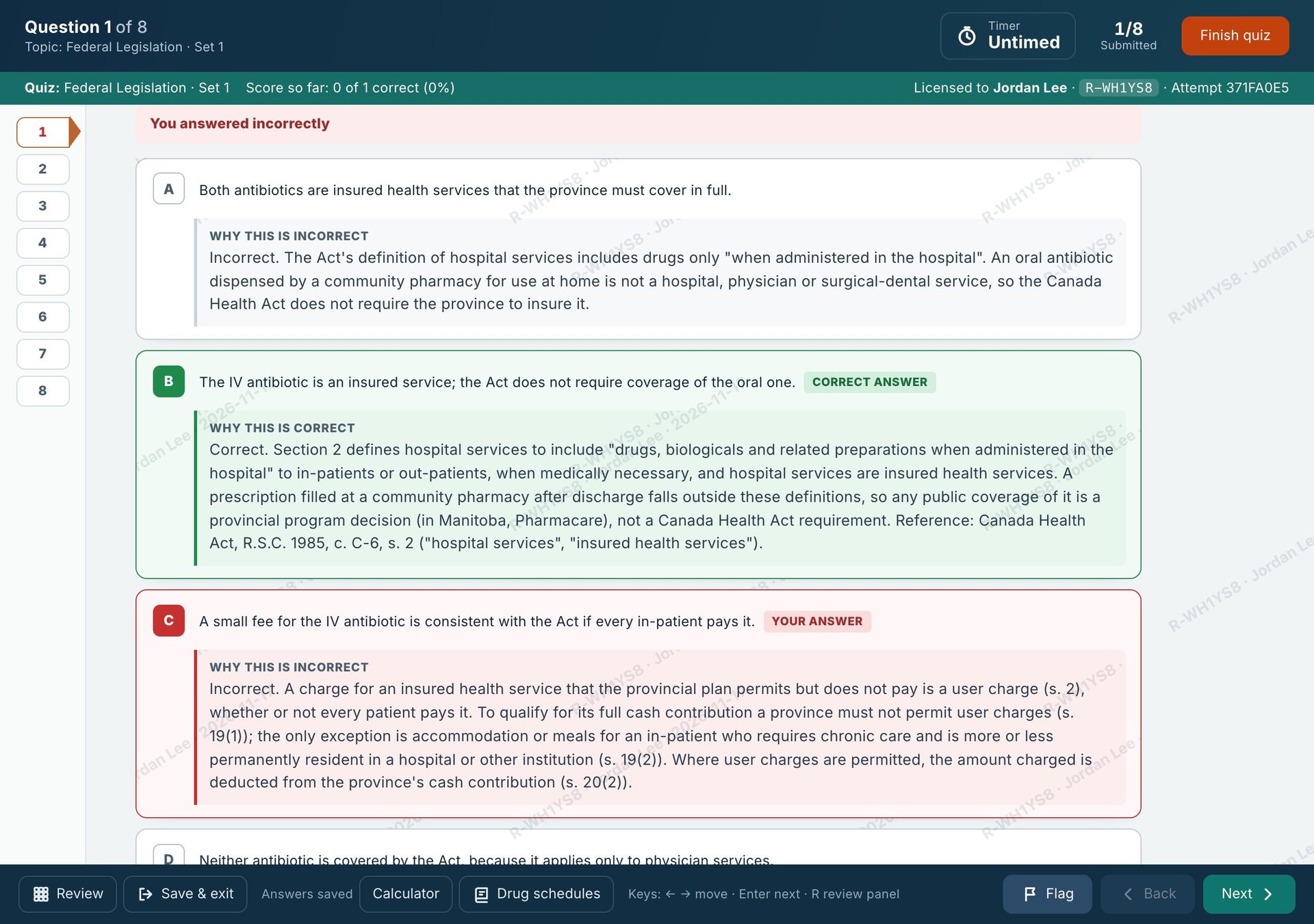
These four come straight from the bank. Choose an answer, submit it, and read why every option is right or wrong, exactly as you will in the practice room.
- 1
- 2
- 3
- 4
Nadia Haddad, 41, asks her community pharmacist in Winnipeg to prescribe a few lorazepam tablets for anxiety on an upcoming overseas flight. She has no current or previous prescription for lorazepam. What should the pharmacist do?
Corydon Avenue Pharmacy in Winnipeg wants to start mailing refills to several long-time patients who have moved to Saskatchewan and Alberta. These patients will not come to the pharmacy in person.
Which statement is correct?
Rosalind Mbeki, a hospital pharmacist in Winnipeg, sits on the board of directors of a provincial association whose mission is to advocate for pharmacists' professional and economic interests. She would like to apply for a pharmacist seat on CPhM Council. What do CPhM's bylaws require?
Raj Malhotra, 67, a Manitoba resident, spends five days as an in-patient at a Winnipeg hospital, where he receives a medically necessary IV antibiotic. At discharge he takes a prescription for an oral antibiotic to his community pharmacy.
Under the Canada Health Act, which statement is correct?
That was 4 of the 36 free questions.
The rest are waiting in the free demo: the first two questions of every one of 18 topic sets, with every explanation, a calculator, and your answers saved. No payment card.
Try these four again
The full practice room adds a Scientific / Engineering mode.
Like what you see? Create a free account and open all 36 free questions →
Try the real question bank before you buy.
Explore 6 topics with the first two questions from every practice set. Work through pharmacy scenarios and discover the reasoning behind every answer.
Create your free account, confirm your email and enrol in the Manitoba demo. Find your saved practice in My learning, then upgrade whenever you’re ready. Each course has its own enrolment.
Built around the way you learn.
From your first case to your next study session.
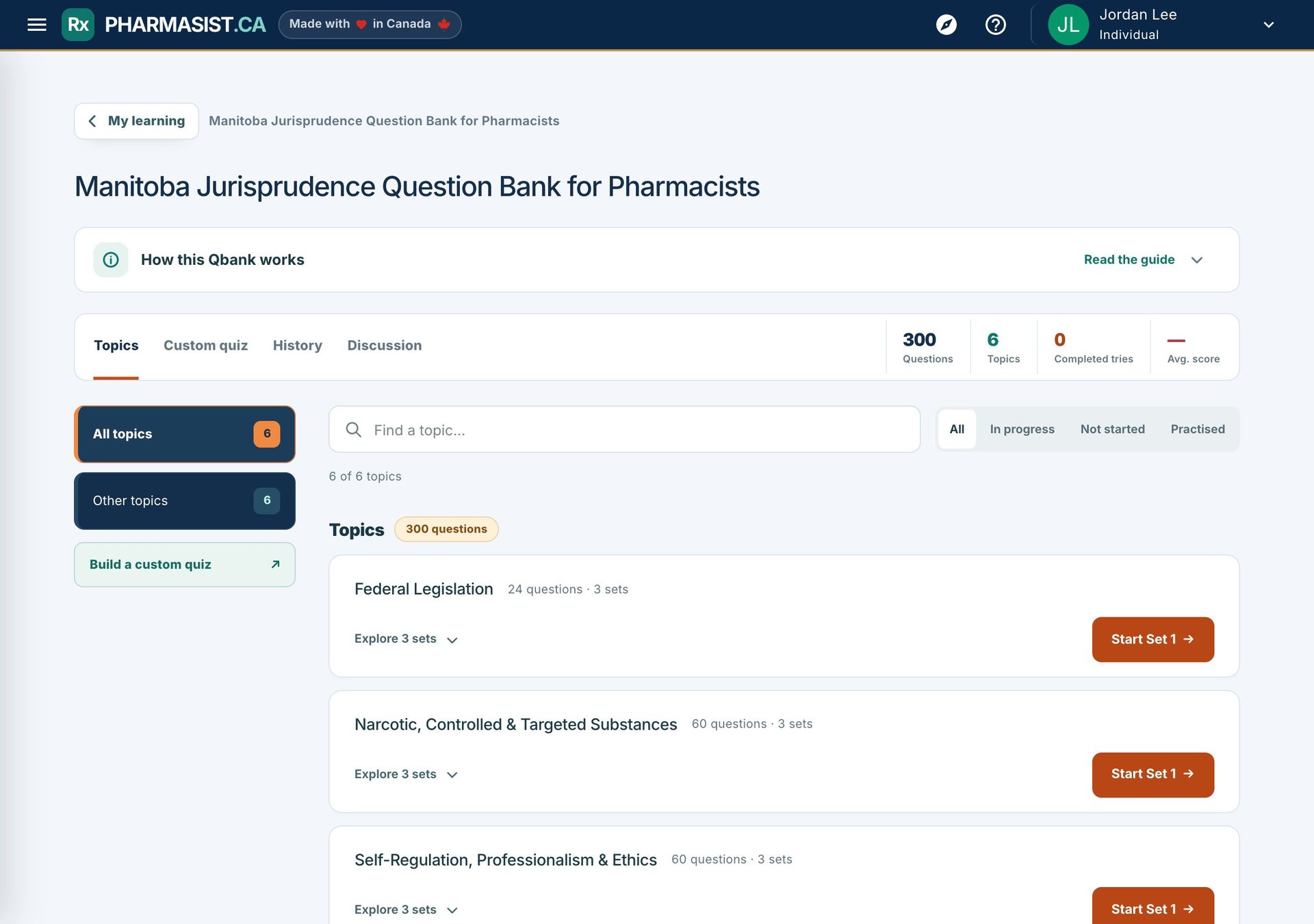
From sign-up to your first question in three steps.
No payment card at any point.
- 1
Create your free account
One Pharmasist account for all your learning. Registration is free.
- 2
Confirm your email
Open the link we send you. If it is not in your inbox, check your spam or junk folder.
- 3
Enrol in the Manitoba demo
36 questions unlock: the first two in each of 18 topic sets, with their explanations and saved attempts.
Each Qbank has its own enrolment
Your account is shared across Pharmasist, but creating it does not enrol you in every demo. Enrol in the bank you want to try; you can enrol in more than one.
Locked numbers show the full set
The question navigator shows every question in a set, so you can see its size. A paid question says “Upgrade to gain full access” until you buy. The demo uses the same 36 questions each time.
Your demo work stays
Saved demo attempts remain in your account when you upgrade. Full access unlocks the remaining questions, and starting a full topic set opens a full-length attempt.
Find it again in My learning
Sign in with your confirmed email, open My learning and choose Continue free demo.
Manitoba Jurisprudence Qbank syllabus
Federal Legislation24 questions · 3 sets
The Canadian health care system, Health Canada drug approval and databases, the Special Access Program, natural health products, medical devices and the NAPRA schedules.
| Practice set | Questions | Free demo |
|---|---|---|
| Set 1 | 8 | 2 |
| Set 2 | 8 | 2 |
| Set 3 | 8 | 2 |
Narcotic, Controlled & Targeted Substances60 questions · 3 sets
The Controlled Substances Regulations in force since October 2026, the Manitoba Prescribing Practices Program (M3P), prescription and dispensing requirements, accountability, losses, destruction and opioid agonist therapy.
| Practice set | Questions | Free demo |
|---|---|---|
| Set 1 | 20 | 2 |
| Set 2 | 20 | 2 |
| Set 3 | 20 | 2 |
Self-Regulation, Professionalism & Ethics60 questions · 3 sets
Self-regulation and the College, the Code of Ethics, professional boundaries and judgment, patient and medication safety, incident reporting and disclosure, complaints and discipline.
| Practice set | Questions | Free demo |
|---|---|---|
| Set 1 | 20 | 2 |
| Set 2 | 20 | 2 |
| Set 3 | 20 | 2 |
Drug & Device Distribution51 questions · 3 sets
Prescription requirements and records, interchangeability, labelling, packaging and delivery, DPIN and Pharmacare, compounding, storage, recalls, returns and disposal.
| Practice set | Questions | Free demo |
|---|---|---|
| Set 1 | 17 | 2 |
| Set 2 | 17 | 2 |
| Set 3 | 17 | 2 |
Pharmacy Operation45 questions · 3 sets
Pharmacy licence types, owner and manager obligations, advertising, closures, facilities and security, and patient privacy under PHIA and PIPEDA.
| Practice set | Questions | Free demo |
|---|---|---|
| Set 1 | 15 | 2 |
| Set 2 | 15 | 2 |
| Set 3 | 15 | 2 |
Pharmacy Professionals & Scopes of Practice60 questions · 3 sets
CPhM registers and licensure, the practice of pharmacy, supervision and delegation, pharmacist prescribing, adaptation and continued care, Schedule II and III products, injections, lab tests and extended practice.
| Practice set | Questions | Free demo |
|---|---|---|
| Set 1 | 20 | 2 |
| Set 2 | 20 | 2 |
| Set 3 | 20 | 2 |
Focus. Practise. Understand. Repeat.
Practise by topic
Choose from 18 topic sets and focus on a part of the syllabus you want to revisit.
6 study topicsBuild timed mixed quizzes
Mix topics in a quiz of up to 100 questions. Add a timer or take the time you need.
Your topics. Your timer.Review every option
Learn why each choice works or falls short, with explanations supported by primary references.
Reasoning beyond the answerResume and track attempts
Continue unfinished sets, revisit answers and use your topic scores to plan what comes next.
Progress that stays with youPractise the way the exam works.
Exam-style sets, a timer, a numbered navigator, flags and a review panel, plus NAPRA's drug schedules beside every question. The same tools in the free demo and in full access.
Every option explained
Each answer choice has its own rationale, so you learn why a choice fits or falls short. The correct answer cites its supporting reference, so you can return to the source, especially when a rule changes.
A calculator on the page
Basic, and a Scientific / Engineering mode with powers, roots, logarithms, trigonometry, DEG/RAD and engineering notation. A study tool: check the exam provider’s rules for exam day.
Timed or untimed, your call
Practise a topic set, or build a custom quiz: choose the topics and question counts, then add a timer or work untimed. Up to 100 questions in one quiz.
Strike out, flag, review
Strike out the options you have ruled out, flag a question to come back to, and open the review panel before you finish.
Leave and come back
Use Save & exit, resume an unfinished set, repeat a set, and review earlier answers in History. Progress is saved to your account while you are online.
Phone, tablet or computer
Any up-to-date browser, no app to install. It needs internet access; it is not an offline PDF or a downloadable question pack.
Tell us when something changes
Guidance and legislation move. If a question looks outdated, send us its code and a current source, and check the effective date in the original.
NAPRA drug schedules, one click away
Every question has a Drug schedules button that opens NAPRA's National Drug Schedules beside the case. Search a drug or browse by letter, filter by schedule, and read each listing's conditions and footnotes without leaving the question.
Practise the way the exam runs
Each 100-question set follows the CPhM blueprint's weights. Add a timer and work one question at a time, with a numbered navigator, flags and a review panel before you finish.
Clear about what this is, and what it is not.
This bank is
- Pharmacist candidates preparing for jurisprudence in Manitoba, including graduates and pharmacists moving from another jurisdiction. It is a self-directed practice bank for the province’s pharmacy legislation, professional obligations and ethical decisions.
- 300 original questions across 6 topics and 18 topic sets, each with answer explanations and source references.
- Self-paced. You learn through questions, explanations and references, and build your own quizzes.
- Independent practice to use alongside the official Manitoba exam and registration information.
This bank is not
- Official or recalled exam questions. These are original Pharmasist practice questions, and Pharmasist is independent of the College of Pharmacists of Manitoba.
- A scheduled class, private tutoring or a separate video course.
- Another province’s bank or PEBC Part I. Provincial laws and professional rules differ, so each is a separate bank with its own enrolment.
- A complete pharmacy technician preparation course. The bank is written for pharmacists.
- Exam registration or a guarantee of a pass. Eligibility, booking, fees, accommodations and results are handled by the exam provider.
Prepare for Manitoba pharmacy practice.
Use the CPhM blueprint and current study resources alongside this bank. The required Pharmacy Jurisprudence Modules and exam registration are separate from this optional practice purchase.
Read. Practise. Revisit.
Start with the official study resources, test your understanding by topic, then build mixed quizzes. Review the current source whenever a legal rule changes.
Pharmasist is an independent practice provider. Registration for the official exam is separate.
Full Manitoba Jurisprudence practice
Get full access to all 300 questions, all 6 topics, referenced answer explanations, custom quizzes and your saved practice history with no scheduled access expiry.
Manitoba Jurisprudence question bank FAQs
How close is the practice screen to the real exam?
It is built to work the way a computer-based exam does: one question at a time, a numbered navigator, flags, a review panel before you finish and a timer you set, and each 100-question set follows the CPhM blueprint's weights. Our screen is not the exam provider's software; check CPhM's information for exam-day details.
Can I look up drug schedules while I practise?
Yes. The Drug schedules button on every question opens NAPRA's National Drug Schedules: search a drug or browse by letter, filter by schedule, and see each listing's conditions and footnotes. A province can schedule a drug differently from NAPRA, so check your province's exceptions too.
Does this replace the required Manitoba jurisprudence modules?
No. CPhM requires completion of the Pharmacy Jurisprudence Modules and approval of the relevant registration documents before exam booking. This optional practice bank does not provide the required module completion statement. Follow the official Manitoba exam and registration information.
Is this suitable for pharmacy technicians?
The bank is written for pharmacists. Some legislation overlaps with technician practice, but it is not sold as a complete technician preparation course. Check the regulator’s technician requirements and use the free demo to assess relevance.
How long should I study, and what score means I am ready?
There is no single study duration or Qbank score that predicts a pass. Start with a few topics, review both incorrect answers and uncertain guesses, then mix topics under time limits. Use trends across fresh attempts to identify gaps; repeated scores can improve through familiarity without demonstrating exam readiness.
How should I use the bank with official references?
Read the regulator’s syllabus and preparation material, practise the related topic, then check the reference behind any unfamiliar answer. The Qbank supports your study; keep the official Manitoba exam and registration information available when planning your preparation.
How do I report a question that seems outdated or incorrect?
Send the question code, the issue you noticed and a current source through the contact our team form. Do not include patient information. Guidance and legislation can change; verify the effective date in the original source. We do not promise a particular update frequency or response time.
Will I be charged automatically again?
No. This is a one-time purchase, with no automatic renewal. Review the access terms shown at checkout before completing your purchase.
What is the refund policy?
Educational purchases are final sale under our purchase and refund policy, subject to applicable consumer rights. A change of mind, non-use or an exam result does not create a voluntary refund entitlement. Try the demo before buying. Contact us about access problems or duplicate or incorrect charges.
What if I paid but the full questions are still locked?
Check that you are signed in with the account used for checkout, then open My learning. If payment was confirmed and access is still locked, contact our team with your account email and order reference. Do not send card details. Creating an account or enrolling in a demo alone does not activate paid access.
Can someone else use my account?
Your access is for your own study. Keep your login private; another learner should create their own account and enrol separately. See the terms of use.
Does buying this bank register me for the official exam or guarantee a pass?
No. Exam eligibility, booking, fees, accommodations and results are handled by the exam provider. Pharmasist registration is separate, and no exam pass is guaranteed. Use the official Manitoba exam and registration information for your application and exam-day requirements.
Something else? Ask our team; you do not need an account.
Your next step,
with a little clarity.
Questions about the Manitoba Jurisprudence question bank, free demo or your access? Send our team a note.