Common Warts (Verruca Vulgaris)
Clinical Snapshot
Common warts (verruca vulgaris) are benign, hyperproliferative skin growths caused by cutaneous infection of keratinocytes with human papillomavirus (HPV) — most often HPV types 2 and 4, and less commonly types 1, 3, 27, 29, and 57.[1] They present as firm, rough-surfaced, dome-shaped or papilliform papules or nodules found most often on the hands, fingers, periungual skin, knees, and elsewhere on the body surface — this chapter covers exactly that presentation, not the sole-of-the-foot (plantar) wart, which behaves differently enough under load-bearing pressure to be managed in its own separate chapter.
Warts are extremely common in school-age children, affecting up to one-third of schoolchildren at any given time, with transmission increasing when a family member or classmate has warts,[2] and they spread by direct skin-to-skin contact and by autoinoculation — scratching or picking a wart can seed the virus into a fresh break in nearby skin or under a fingernail.[1] The single most important expectation-setting fact for patients and parents is that most common warts are self-limited: roughly half resolve spontaneously within about a year, and about two-thirds resolve within 12-24 months even without treatment, with resolution more likely and generally faster in younger children.[2][1] For patients who prefer active treatment over watching and waiting, topical salicylic acid and cryotherapy are the 2 first-line, evidence-based options, and the pharmacist's core value lies in confirming the diagnosis, teaching correct application technique, setting a realistic timeline (this is a weeks-to-months therapy, not a days-to-clear one), and recognizing the minority of patients — an atypical or changing lesion, extensive disease in an immunocompromised patient, or a periungual wart threatening the nail — who need to move beyond self-care.
Recognize the Condition
Typical appearance
A common wart is a firm, well-circumscribed papule or nodule, typically 2 mm to 1 cm across (though lesions can coalesce into larger plaques), with a distinctive rough, papilliform ("cauliflower-like") hyperkeratotic surface. Colour ranges from skin-coloured to grey-brown. Two features reliably distinguish a wart from a corn, callus, or scar on examination: paring away the surface with an emery board or scalpel reveals multiple small red, brown, or black puncta — thrombosed, dilated dermal capillaries — and the wart interrupts and disrupts the normal fine skin (dermatoglyphic) lines running across the area, where a callus or corn simply thickens the skin without erasing those lines.[1][3]

Where they occur, and the variant patterns
- Hands and fingers are the most common site, including periungual warts clustered around or under the nail fold — these are frequently linked to nail-biting or cuticle-picking, are notoriously more resistant to treatment, and can distort nail growth if longstanding.
- Knees and elbows are common in children, often related to repeated minor trauma at these sites.
- Filiform (digitate) warts are a thin, finger-like or frond-like variant, most often seen on the face, eyelids, and neck — the thin projections make these easier to treat but more visible cosmetically.
- Autoinoculation along a scratch can seed a line of new warts (a pseudo-Koebner pattern), and picking at the free edge of a nail can seed a new subungual wart underneath it.
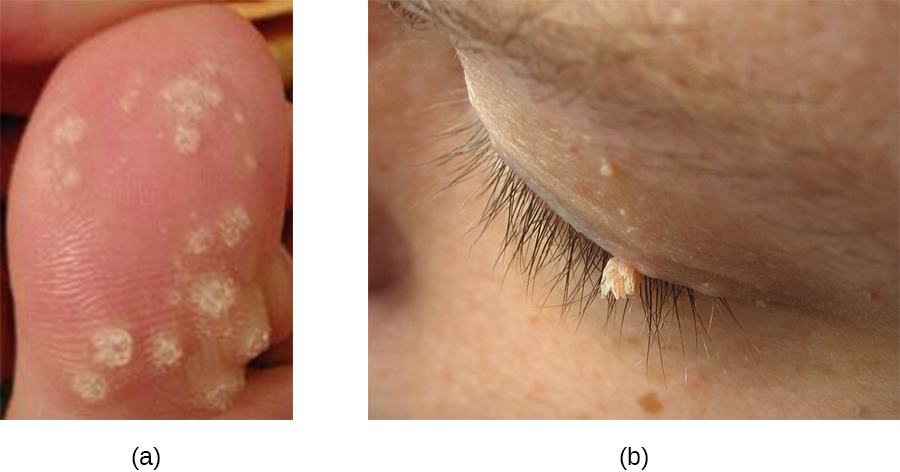
Warts can be single or multiple, and lesions at different stages of growth (some flat, some raised) are common, particularly in children and in anyone who has been autoinoculating from an established wart.
Risk Factors
- School age — warts affect up to about one-third of schoolchildren at any given time, with transmission increasing when a family member or classmate has warts.[2]
- Direct contact with an infected person, or indirect contact with a contaminated surface, particularly where the skin barrier is already broken.[1]
- Nail-biting, cuticle-picking, and other habits that create small breaks in the periungual skin — a major driver of periungual wart formation and of resistance to treatment at that site.
- Frequent minor skin trauma, or occlusive/moist skin conditions such as frequent hand-in-water occupations or atopic dermatitis with a disrupted skin barrier.
- Occupational exposure to raw meat, poultry, or fish — associated with a distinct HPV type (HPV-7, so-called "butcher's warts").
- Immunosuppression — solid-organ transplant recipients, HIV infection, and other causes of cellular immunodeficiency are associated with more numerous, more extensive, and more treatment-refractory warts, with the burden rising as the duration of immunosuppression increases.
- A personal history of warts, or ongoing autoinoculation from an untreated existing wart.
Red Flags & Refer
Most common warts are appropriate for pharmacist-guided self-care, but move to medical assessment — with biopsy considered rather than simply escalating to a stronger destructive therapy — for any of the following:
- A lesion that is rapidly growing, bleeding, ulcerating, or changing in colour or shape, especially a new lesion appearing for the first time in an adult rather than a longstanding childhood wart — non-pigmented (amelanotic) melanoma and squamous cell carcinoma can both mimic an ordinary wart, and this mimicry is a well-documented cause of diagnostic delay.[1]
- A periungual or subungual lesion causing nail plate destruction, splitting, or a change in nail growth — squamous cell carcinoma in situ at this site can closely resemble a resistant periungual wart.
- Diagnostic uncertainty at any point — a lesion that does not fit the typical papilliform, punctate appearance described in Recognize the Condition warrants confirmation, not an empiric trial-and-see approach.
- Immunocompromised patients (transplant recipients, HIV, other cellular immunodeficiency) with extensive, multiple, or rapidly recurring warts — refer earlier rather than working through a standard stepwise OTC trial, since disease is more likely to be refractory and dermatology-directed combination therapy is often needed.
- No response, or worsening, after a full and adherent 6-12 week course of appropriately applied topical salicylic acid — this needs reassessment and escalation, not simply repeating the same regimen.
- Facial warts, or any wart in a cosmetically or functionally sensitive area, being considered for aggressive destructive home therapy — refer for professional management to reduce scarring risk.
Assessment & Diagnosis
History
- Onset, duration, and growth pattern of the lesion(s); ask specifically whether the appearance or size has changed recently.
- Number and location of lesions, and whether new lesions have appeared in a line or cluster near an original one (suggesting autoinoculation).
- Any prior treatment — which product, how it was applied (was the surface pared first?), and for how long — since an incomplete or technically incorrect trial is the most common reason a lesion looks like "treatment failure."
- Household or classroom contacts with similar lesions, nail-biting/picking habits, occupation (e.g., meat/fish handling), and any history of immunosuppression.
Examination
Confirm the typical features described in Recognize the Condition: a firm, papilliform, hyperkeratotic papule that, when gently pared, reveals small thrombosed capillary puncta and shows interrupted skin lines. Examine for periungual or subungual involvement, and note the total number and distribution of lesions. No laboratory testing or imaging is routinely needed — diagnosis is clinical.
Differential diagnosis
| Condition | Features that point away from a common wart |
|---|---|
| Molluscum contagiosum (a poxvirus, not HPV) | Smooth, dome-shaped, pearly papules with a characteristic central umbilication (dimple); no papilliform surface and no thrombosed capillary puncta on paring. |
| Seborrheic keratosis | A waxy, "stuck-on" plaque, typically in adults over 50, unrelated to HPV; the surface is more uniformly greasy-verrucous and the lesion can usually be lifted at the edge. |
| Corn or callus | Thickened skin from friction or pressure at a specific site; normal skin lines pass through the lesion uninterrupted, and paring reveals a smooth, uniform keratin plug rather than punctate capillary dots. |
| Lichen planus (hypertrophic) | Violaceous, flat-topped papules, often with fine white surface streaking (Wickham striae) and other typical sites of involvement (wrists, oral mucosa); usually multiple and symmetric. |
| Squamous cell carcinoma / keratoacanthoma | A rapidly growing, often crateriform or ulcerated nodule, especially in an older adult or a new lesion with no antecedent history of warts; biopsy to confirm.[1] |
| Amelanotic melanoma | A non-pigmented, evolving, non-healing nodule or plaque, particularly on acral skin in an older adult — a well-documented "great masquerader" of benign lesions including warts; biopsy any atypical or changing lesion rather than assuming it is simply a resistant wart.[1] |
Most classic hand, finger, knee, or periungual warts can be diagnosed clinically without further testing. Reserve biopsy for atypical presentations, lesions that are rapidly changing or bleeding, new adult-onset lesions with no clear preceding history of warts, and lesions that fail to respond to an adequate treatment trial.
Treatment Targets
- Set a realistic, evidence-based expectation from the first visit: most common warts resolve on their own, typically within 1-2 years, and watchful waiting is a genuinely reasonable choice for many patients, especially young children.[2][1]
- For patients who choose active treatment, achieve visible clinical clearance with a first-line, evidence-supported option matched to the patient's age, the lesion's location, and their tolerance for discomfort.
- Minimize pain, scarring, and downtime, particularly for children and for lesions on the face or periungual skin.
- Limit spread — to other body sites through autoinoculation, and to other people through direct or indirect contact.
- Recognize early when a lesion needs to move beyond self-care: diagnostic uncertainty, an atypical or changing lesion, or a patient whose immune status makes standard therapy less likely to work.
Choose Initial Treatment
Step 1 — watchful waiting is a legitimate first option
For an otherwise well patient — especially a young child — with a typical, uncomplicated common wart, watchful waiting is a reasonable, evidence-based choice to offer alongside active treatment, not simply a fallback for when nothing else is available: roughly half of warts clear spontaneously by about 1 year, and about two-thirds by 12-24 months, without any therapy at all.[2][1] Discuss both paths and let the patient (or parent) decide based on cosmetic concern, discomfort, and how much the lesion is spreading.
Step 2 — topical salicylic acid: 1st-line active treatment
1st line topical salicylic acid, over-the-counter concentrations typically 17-40%, applied once daily. This needs real technique to work: soak the wart in warm water for 5-10 minutes to soften it, pare down the softened hyperkeratotic surface with an emery board or pumice stone between applications, then apply the salicylic acid to the wart itself (protecting surrounding normal skin with petroleum jelly or a similar barrier), and cover with an occlusive dressing or bandage overnight. In a high-quality randomized trial, daily 40% salicylic acid achieved a 24% cure rate at 13 weeks versus 16% with no treatment (number needed to treat 13), and a Cochrane systematic review found salicylic acid clearly superior to placebo overall (6 RCTs, N=486; number needed to treat 6).[2][4] Set the expectation explicitly: this is a daily therapy sustained for 6-12 weeks, not a one-time application — stopping early, before the full course, is the most common reason salicylic acid appears not to have worked.[3]
Step 3 — cryotherapy: an equally reasonable 1st-line alternative
1st line alternative cryotherapy (liquid nitrogen, clinic- or office-administered) has not been shown to be more effective than salicylic acid overall — one high-quality trial found no difference in cure between the 2 at 12 weeks (both 14% in a mostly recalcitrant population), while another found cryotherapy cured more warts than salicylic acid at 13 weeks (39% vs 24%) with substantially higher patient satisfaction (69% vs 24%) but at the cost of more pain (81% vs 12%) and more blistering (51% vs 9%).[2] Aggressive freezing (a longer freeze-thaw cycle) is more effective than gentle freezing, again at the cost of more blistering, and repeating treatment every 1-2 weeks may clear warts faster and with less recurrence than a longer interval, though with more blistering.[2] OTC home cryotherapy (dimethyl ether/propane spray canisters) is available and convenient, but its coolant only reaches about -20°C versus about -100°C for clinic-applied liquid nitrogen, and it is not clearly established that these lower-powered home products match professionally administered cryotherapy.[2]
Step 4 — combination therapy for a slow responder
Combination salicylic acid plus cryotherapy together may outperform either alone (number needed to treat 8 versus cryotherapy alone, 6 versus salicylic acid alone) and is a reasonable next step for a wart that is responding slowly to a single modality, rather than switching agents entirely.[3]
Step 5 — refractory warts: options that need a referral
Refractory to an adequate trial of salicylic acid and/or cryotherapy refer for cantharidin (an extract of the blister beetle, applied in-office; a vesicant that raises a blister at the treated site over 24-48 hours and is not for home use or self-application), contact immunotherapy (squaric acid dibutyl ester or diphenylcyclopropenone — the patient is first sensitized, then the agent is applied topically to the wart to provoke a local delayed-type hypersensitivity reaction that helps clear the lesion; specialist-administered), or pulsed dye laser, particularly for periungual or flat warts resistant to standard therapy.[1] Imiquimod (an off-label option) has limited supporting evidence — small uncontrolled studies report only 27-30% clearance of recalcitrant warts — and is a reasonable option to discuss with a prescriber rather than a routine first move.[3] Do not use topical fluorouracil (no more effective than salicylic acid, roughly 15-fold more costly, and causes more pain and blistering) or bleomycin and interferons, which current evidence specifically recommends against for nongenital warts.[3]
Non-Pharmacologic Treatment
- Discuss watchful waiting explicitly as a valid option — most common warts clear on their own within 1-2 years, more reliably and often faster in younger children.[2][1]
- Cover exposed warts with a bandage or clothing in shared or communal settings, and avoid direct skin contact with a wart on another person.
- Do not pick, bite, or scratch a wart, and do not share nail clippers, emery boards, razors, or towels — all of these spread the virus by autoinoculation or to other people.
- Keep the surrounding skin barrier intact: manage nail-biting and cuticle-picking habits directly, since periungual skin breaks are a major driver of both new and recurrent periungual warts.
- Duct tape occlusion is a low-risk, low-cost option some patients want to try at home — evidence for it is genuinely mixed (one trial favoured duct tape over cryotherapy, others found no benefit over placebo), but because it is safe and well tolerated, it is reasonable to offer as an adjunct or an alternative for a patient who wants to avoid acids or freezing, while being honest that the evidence does not clearly support it over salicylic acid or cryotherapy.[2][3]
- Pare down thickened, hyperkeratotic wart surface regularly with an emery board or pumice stone (a different one than used on normal skin/nails), whether or not the patient is also using an active topical therapy — this alone improves comfort and helps any concurrent treatment penetrate.
- Set the treatment timeline explicitly at the first visit — weeks to a few months for either salicylic acid or cryotherapy — so the patient does not stop a genuinely working therapy prematurely.
Special Populations
Pediatrics
Children are the population in which common warts are most prevalent and most likely to resolve on their own, so watchful waiting deserves equal billing with active treatment at every pediatric visit.[2] When active treatment is chosen, salicylic acid is generally preferred for young children because it can be applied painlessly at home by a caregiver, while cryotherapy is generally reserved for older children and adults given the pain of the freeze and the multiple visits typically needed.[3] Cantharidin is a useful in-office option specifically because its application itself is painless (the blister forms afterward), making it easier for young children to tolerate than cryotherapy.
Pregnancy and breastfeeding
Topical salicylic acid applied to a small, localized area (the typical way it is used for a hand or knee wart) has minimal systemic absorption and is generally considered acceptable; avoid extensive body-surface-area application given the theoretical risk of systemic salicylate exposure. Cryotherapy is a local, non-systemic procedure and is a reasonable option in both pregnancy and breastfeeding. Cantharidin, imiquimod, contact immunotherapy, and fluorouracil all have limited pregnancy-specific safety data — favour salicylic acid or cryotherapy first, and involve the prescriber directly if one of these is genuinely needed.
Immunocompromised patients
Transplant recipients, patients with HIV, and others with cellular immunodeficiency develop more numerous, more extensive, and more treatment-refractory warts than immunocompetent patients, and the disease burden rises with the duration of immunosuppression. Conventional first-line therapy (salicylic acid, cryotherapy) is less reliably effective in this group.[1] Treat actively rather than defaulting to watchful waiting, and use a lower threshold to refer early for dermatology-directed combination therapy (for example, cantharidin combined with other agents, or contact immunotherapy) rather than working through a prolonged standard OTC trial first.
Older adults
A wart-like lesion appearing for the first time in an older adult, without a preceding history of warts, deserves a higher index of suspicion for a mimicking malignancy — squamous cell carcinoma, keratoacanthoma, or amelanotic melanoma (see Red Flags/Refer and Assessment/Diagnosis) — rather than being treated empirically as a straightforward wart.
Monitoring & Follow-Up
Reassess a salicylic acid course at the end of a full, adherent 6-12 week trial rather than at the first sign of slow progress — this is a genuinely slow therapy, and premature discontinuation is the most common reason it appears to fail.[3] At follow-up, confirm the patient has actually been soaking and paring the wart before each application (not simply applying the product over intact hyperkeratotic skin) and using an occlusive dressing, since technique gaps are more often the problem than the drug itself.
For a patient undergoing cryotherapy, review response and tolerability at each visit, typically every 1-3 weeks, and adjust the freeze-thaw intensity and interval based on both clearance and blistering.[2] Watch for local adverse effects of any home keratolytic therapy — irritation, chemical burn to surrounding skin, or unexpected pain — and stop or de-escalate if these occur.
For patients choosing watchful waiting, no active monitoring visit is required, but confirm the patient knows to return if the lesion changes character, grows rapidly, bleeds, or simply has not resolved within about 2 years, which should prompt reassessment of the diagnosis rather than continued waiting.[1]
Common Errors to Avoid
- Applying salicylic acid directly over intact, unpared hyperkeratotic skin — paring the surface first is what allows the acid to actually reach and treat the wart.
- Stopping salicylic acid after 1-2 weeks because "nothing is happening" — a genuine trial needs 6-12 weeks of daily use.[3]
- Presenting watchful waiting as if it were a lesser or default option rather than a legitimate, evidence-based choice with a real cure rate over time.
- Reflexively reaching for topical fluorouracil, bleomycin, or interferon — none of these outperform salicylic acid or cryotherapy for nongenital warts, and current evidence specifically recommends against bleomycin and interferons here.[3]
- Using aggressive home destructive treatment (strong acids, unsupervised freezing) on the face or periungual skin, where scarring risk is higher and professional treatment is safer.
- Missing an atypical, rapidly changing, or new adult-onset lesion by assuming it is simply a stubborn wart rather than considering biopsy.
- Under-referring an immunocompromised patient with extensive or refractory warts by working through a full standard stepwise trial before involving dermatology.
- Not counselling on autoinoculation and transmission (nail-biting, shared nail tools, covering the lesion) alongside whichever active treatment is chosen, leaving an ongoing source of new lesions unaddressed.
Clinical Decision Algorithm
Drug Tables
How to use this table: Doses are adult doses and require patient-specific confirmation (renal/hepatic function, weight, allergy history). Pediatric dosing is weight-based per the current product monograph unless stated. Drug pricing is intentionally omitted. Select any drug name to open its complete Pharmasist Drug Database page.
Keratolytics (Topical, Self-Applied)
First-line active treatment for most common warts. Requires soaking and paring the wart surface before each application for full effect.
| Drug | Dosage | Adverse effects | Drug interactions | Comments |
|---|---|---|---|---|
| Salicylic acid | OTC concentration: 17-40%, applied once daily for 6-12 weeks | Local irritation, burning; chemical burn to surrounding normal skin if not protected | None clinically significant given minimal systemic absorption at typical localized use | Soak 5-10 minutes, pare the softened surface, apply to the wart only (protect surrounding skin), and cover overnight. A genuine trial needs 6-12 weeks of daily use. |
Cryotherapy
An equally reasonable 1st-line alternative to salicylic acid; no more effective overall, but gives higher patient satisfaction at the cost of more pain and blistering.
| Drug | Dosage | Adverse effects | Drug interactions | Comments |
|---|---|---|---|---|
| Liquid nitrogen (clinic-administered) | Interval: Every 1-3 weeks until resolved | Pain, blistering, occasional permanent hypopigmentation or scarring | None | Aggressive (longer) freeze-thaw cycles are more effective than gentle freezing; a 1-2 week treatment interval may clear warts faster and with less recurrence than a longer interval, at the cost of more blistering. |
| OTC home cryotherapy (dimethyl ether/propane spray) | Use: Per product directions, typically every 1-2 weeks | Local pain, blistering, skin irritation | None | Reaches only about -20°C versus about -100°C for clinic-applied liquid nitrogen; comparative effectiveness against professional cryotherapy is not well established. |
Office-Administered / Specialist Refractory-Wart Therapies
Reserve for warts that have not responded to an adequate, adherent trial of salicylic acid and/or cryotherapy.
| Drug | Dosage | Adverse effects | Drug interactions | Comments |
|---|---|---|---|---|
| Cantharidin | Use: In-office application only | Delayed blistering at the application site 24-48 hours later, which can be painful once formed | None | A vesicant applied in-office only, not for home use. Application itself is painless, making it useful in young children who cannot tolerate cryotherapy. |
| Contact immunotherapy (SADBE or diphenylcyclopropenone) | Use: Specialist-administered sensitization, then topical application | Local dermatitis at the treated site (the intended mechanism), pruritus | None | The patient is first sensitized, then the agent is applied topically to the wart to provoke a local delayed-type hypersensitivity reaction. Specialist-administered; useful for extensive or immunocompromised-patient disease. |
| Imiquimod | Use: Per prescriber direction | Local irritation, erythema; flu-like symptoms with extensive application | None clinically significant at localized use | Off-label for common warts; limited evidence (27-30% clearance of recalcitrant warts in small uncontrolled studies) — a specialist-directed option, not routine first-line. |
| Pulsed dye laser | Use: Specialist-administered | Local pain, purpura, occasional blistering | None | Targets the dilated capillaries supplying the wart. An option for periungual or flat warts resistant to standard therapy. |
Agents Not Recommended for Nongenital Warts
Listed to state explicitly that these should not be first choices, not as routine options.
| Drug | Dosage | Adverse effects | Drug interactions | Comments |
|---|---|---|---|---|
| Topical fluorouracil | Use in common warts: Not a preferred agent — use salicylic acid or cryotherapy first | Pain, blistering, local irritation — more than salicylic acid | None | No more effective than salicylic acid and roughly 15-fold more costly. |
| Bleomycin (intralesional) | Use in common warts: Not recommended — do not use | Pain, local tissue necrosis, nail dystrophy if used periungually | None | Current evidence specifically recommends against use for nongenital warts. |
| Interferons | Use in common warts: Not recommended — do not use | Systemic flu-like symptoms, injection-site pain | None | Current evidence specifically recommends against use for nongenital warts. |
References
- Wart — StatPearls Publishing (Al Aboud AM, Nigam PK). StatPearls, last updated August 14, 2023
- What works best for nongenital warts? — Canadian Family Physician, Tools for Practice (adapted from the Alberta College of Family Physicians' PEER evidence program) (Finley C, Korownyk C, Kolber MR). Can Fam Physician 2016;62(12):997
- Treatment of Nongenital Warts — American Family Physician, FPIN's Clinical Inquiries (Feigenbaum AL, Ainsworth C, St Anna L). Am Fam Physician 2011;84(11):1290-1291
- Topical treatments for cutaneous warts — Cochrane Database of Systematic Reviews (Kwok CS, Gibbs S, Bennett C, Holland R, Abbott R). Cochrane Database Syst Rev 2012;(9):CD001781
Professional reference only. Apply clinical judgment and verify patient-specific decisions against current authoritative guidance and product information.