Corns and Calluses
Clinical Snapshot
A callus is diffuse, poorly demarcated hyperkeratotic thickening of the stratum corneum that develops wherever skin is subjected to repeated low-grade friction or pressure — a genuinely protective adaptation, usually painless, and usually the same colour as the surrounding skin. A corn (clavus) is a more focal, sharply circumscribed hyperkeratotic lesion with a compacted keratin core that presses into the dermis; because that core sits directly over sensory nerve endings, corns are frequently painful, especially with direct perpendicular pressure.[1] Corns are further split into 2 clinically distinct patterns: the hard corn (heloma durum), the most common type, which forms over a bony prominence — classically the dorsolateral fifth toe or an interphalangeal joint — and the soft corn (heloma molle), which forms between adjacent toes (most often the fourth web space) where trapped moisture keeps the compressed skin macerated and white rather than hard.[1] Foot involvement from corns and calluses is common, reported in roughly 14-48% of the population depending on the series, with a female predominance linked to narrow, tapered footwear and rising prevalence with age as the protective plantar fat pad thins.[1]
This is a genuine, guideline-endorsed self-care condition for most patients: correcting the footwear or biomechanical driver, offloading the pressure point with padding, and mechanically reducing the thickened skin resolve the great majority of cases without a prescription.[2] The pharmacist's single highest-value contribution in this chapter is not choosing a keratolytic — it is recognizing, before recommending anything, whether the patient in front of them has diabetes, peripheral neuropathy, or peripheral arterial disease, since self-treatment and self-debridement carry a real ulceration and infection risk in that population and change the plan entirely (see Red Flags/Refer).[1]
Recognize the Condition
The 3 patterns to recognize
Callus (tyloma)
Diffuse, flat-to-mounded thickening with a poorly defined border and no central core, typically on the plantar surface (under a metatarsal head or the heel) or the medial/lateral border of the foot. Usually painless and the same colour as, or slightly yellower than, surrounding skin.[1][3]
Hard corn (heloma durum)
The most common corn pattern — a small, sharply circumscribed, cone-shaped lesion with a hard translucent central core, typically over a bony prominence such as the dorsolateral fifth toe, the dorsum of an interphalangeal joint, or a plantar metatarsal head. Can look red on light skin, or purple, brown, or black on dark skin, and is frequently painful with direct pressure.[1][2]
Soft corn (heloma molle)
Forms in a web space — most often between the fourth and fifth toes — where 2 adjacent bony condyles compress the skin between them. Trapped moisture keeps the lesion macerated and whitish rather than hard, which also makes it more prone to secondary maceration, fissuring, and infection than a hard corn.[1]
A less common pattern, the seed corn, presents as multiple small, painless keratotic plugs scattered within a plantar callus in a non-weight-bearing area and is generally an incidental finding rather than a symptomatic complaint.[1]

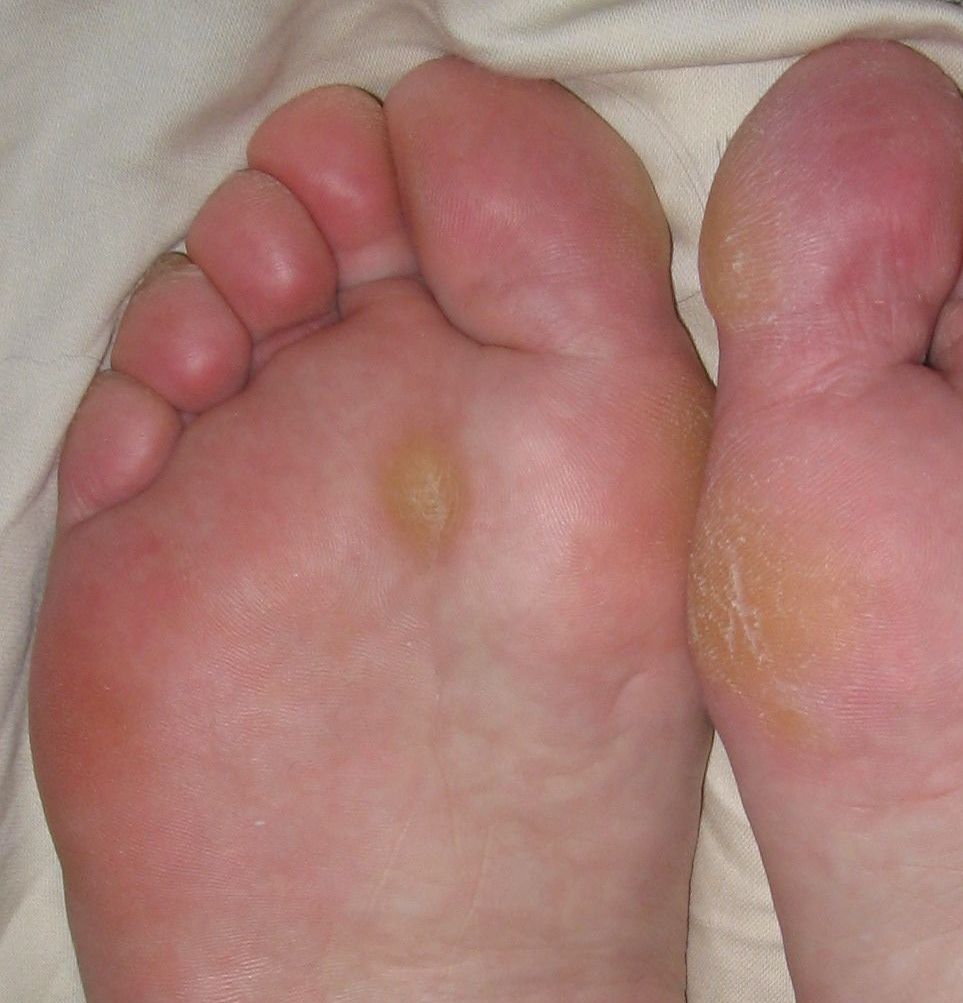
Distinguishing a corn or callus from a plantar wart — a genuinely useful bedside test
Corns, calluses, and plantar warts can look similar at a glance, but 2 simple bedside findings reliably separate them once the overlying hyperkeratotic surface is gently pared:
| Finding | Corn / callus | Plantar wart (verruca) |
|---|---|---|
| Skin lines (dermatoglyphs) | Preserved — the normal ridge pattern of the skin runs continuously across and through the lesion. | Disrupted — the wart interrupts and deviates the surrounding ridge pattern. |
| Central appearance after paring | A sharply outlined, yellowish-to-tan translucent keratin core, with no bleeding. | Small black or reddish-brown dots (thrombosed capillaries, sometimes called "seeds") that may bleed with more aggressive paring. |
| Pain on direct vs. lateral pressure | Pain reproduced by direct perpendicular pressure onto the lesion (from the compacted core pressing on the nerve-rich dermis below). | Pain reproduced by squeezing the sides of the lesion toward the centre (lateral compression); direct perpendicular pressure is often less painful. |
[1] Confirming this distinction matters clinically: a lesion treated as a corn that is actually a wart (or vice versa) will not respond as expected, and a wart specifically needs a management approach that a corn does not.
Risk Factors
- Ill-fitting footwear — a toe box that is too narrow or too short, or a shoe that lets the foot slide and rub with every step — is the most common and most correctable driver.[4][2]
- High heels, which shift and concentrate weight-bearing pressure onto the forefoot and metatarsal heads.
- Foot deformities that create new or exaggerated bony prominences and altered pressure points, including bunions (hallux valgus), hammertoes and claw toes, and other biomechanical gait abnormalities.[4]
- Advancing age, through atrophy of the protective subcutaneous fat pad on the sole and forward displacement of the metatarsal heads.[1]
- Female sex — a higher reported prevalence, largely attributed to narrow, tapered, or pointed-toe footwear styles.[1]
- Obesity and excess body weight, which increase plantar pressure with every step.[1]
- Repetitive athletic activity or occupations involving prolonged standing, walking, or running.[1]
- A hereditary keratotic disorder in a patient with corns in atypical, non-weight-bearing locations (seed corns) — consider this when the distribution does not fit a simple friction/pressure pattern.[1]
Red Flags & Refer
The single most important scope-of-practice decision in this chapter happens before any product is recommended — screen every patient requesting corn or callus treatment for diabetes, peripheral neuropathy, and peripheral arterial disease. Any of the following changes the plan from "recommend self-care" to "refer for professional assessment and debridement," and specifically means do not recommend a salicylic acid keratolytic and do not recommend self-debridement with a blade, pumice stone, or file:
- Diabetes mellitus — impaired sensation and impaired circulatory feedback mean a patient may not feel early tissue damage, and a keratolytic acid or an inadvertent nick from self-debridement can progress to a diabetic foot ulcer, infection, or, in severe cases, a limb-threatening complication before it is even noticed.[1][5]
- Peripheral neuropathy of any cause (diabetic or otherwise) — reduced protective sensation means excessive trimming or acid exposure can cause real tissue damage without the pain that would normally prompt a patient to stop.[1]
- Peripheral arterial disease or other significant circulatory compromise — reduced blood flow impairs healing, so even a minor break in the skin from debridement or a keratolytic can become a non-healing wound.[5][1]
- Signs of infection — spreading redness, warmth, swelling, purulent drainage, malodour, or fever — need prompt assessment rather than continued self-care.
- Any break in the skin, ulceration, or a lesion that is not healing as expected.
- Diagnostic uncertainty — a lesion that does not fit the corn/callus pattern on the pare-test described in Recognize the Condition (possible plantar wart, poroma, gout tophus, or another lesion) should be assessed rather than treated empirically.[1]
- No improvement, or worsening, after a full and adherent course of appropriate self-care (see Treatment Failure/Next Step) — this needs professional debridement and assessment for an underlying biomechanical cause, not simply repeating the same OTC product.
Assessment & Diagnosis
History
- Ask specifically about footwear (fit, heel height, how long the current pair has been worn) and about occupational or athletic activities involving prolonged standing, walking, or running.
- Screen for diabetes, peripheral neuropathy, and peripheral arterial disease before recommending any self-care product — this determines the entire management pathway (see Red Flags/Refer).
- Ask about pain characteristics: direct perpendicular pressure reproducing the pain points toward a corn; lateral squeezing reproducing the pain points toward a plantar wart.[1]
- Ask about prior self-treatment — which product, how it was applied, and for how long — since incorrect technique (applying acid to normal surrounding skin, or stopping before the full course) is a common cause of an apparent "treatment failure."
Examination
Confirm the lesion's location and morphology against the patterns in Recognize the Condition — a diffuse, poorly demarcated, coreless area of thickening supports a callus; a small, sharply circumscribed lesion with a central core supports a corn; note whether it is over a bony prominence (hard corn) or macerated within a web space (soft corn). Gently paring the surface (or asking a colleague/prescriber to do so where scope permits) and checking for preserved skin lines and the absence of black thrombosed-capillary dots supports a corn or callus over a plantar wart.[1]
Differential diagnosis
| Condition | Features that point away from a corn/callus |
|---|---|
| Plantar wart (verruca) | Disrupted skin lines, central black dots (thrombosed capillaries) after paring, pain on lateral compression rather than direct pressure — see the comparison table in Recognize the Condition. |
| Eccrine poroma | A vascular-appearing, sometimes bleeding papule or nodule, most often on the sole, that does not resolve with pressure offloading. |
| Gout tophus | A firm, sometimes chalky-white nodule, typically with a history of gout, often at the first metatarsophalangeal joint or another joint rather than purely at a friction point. |
| Lichen planus (hypertrophic) | Violaceous, pruritic plaques, often with lesions elsewhere (wrists, mucosa) rather than isolated to a single pressure point. |
| Interdigital (Morton) neuroma | Pain and paresthesia between the toes without a visible hyperkeratotic lesion — a neurologic rather than dermatologic process. |
| Hereditary keratoderma | Diffuse or patterned thickening not confined to typical friction points, often with a family history and onset unrelated to footwear. |
Investigations
Most corns and calluses are diagnosed on history and inspection alone; no laboratory testing or imaging is routinely needed. Dermoscopy can help confirm the diagnosis when uncertainty remains after the bedside pare-test.[1] Weight-bearing radiographs are reasonable when a significant underlying bony deformity (a prominent metatarsal head, a severe hammertoe, or advanced hallux valgus) is suspected as the driver and surgical correction is being considered.[1] If diabetes has not already been established or ruled out in a patient presenting with recurrent or atypical corns/calluses, a fasting glucose is a reasonable screen, since this red-flag population overlaps directly with the group who should not self-treat.[1]
Treatment Targets
- Identify and correct the underlying friction or pressure source — footwear, gait, or a structural deformity — since treating the lesion without addressing its cause invites prompt recurrence.
- Reduce the hyperkeratotic tissue safely to relieve pain and pressure.
- Screen every patient before recommending self-care, and route diabetes, peripheral neuropathy, and peripheral arterial disease patients to professional assessment rather than OTC keratolytics or self-debridement.
- Prevent complications — maceration, fissuring, secondary bacterial infection, and, in at-risk patients, ulceration.
- Set realistic expectations: most corns and calluses recur if the underlying friction/pressure source is not corrected, regardless of how effectively the lesion itself is treated.
- Recognize and refer promptly when self-care fails, when the diagnosis is uncertain, or when signs of infection or skin breakdown develop.
Choose Initial Treatment
Step 1 — screen before recommending anything
Diabetes, peripheral neuropathy, or peripheral arterial disease do not recommend a salicylic acid keratolytic and do not recommend self-debridement (blade, pumice stone, file, or emery board) — refer for professional foot care instead; footwear and padding advice remains appropriate, but active debridement and acid-based products do not.[1][5] No red flags present proceed with standard self-care below.
Step 2 — non-pharmacologic measures are first-line for everyone
Correcting footwear, offloading the pressure point with padding, and gentle mechanical debridement resolve the great majority of uncomplicated corns and calluses without any pharmacologic product being needed at all — see Non-Pharmacologic Treatment for the specific technique.[2]
Step 3 — add topical salicylic acid if non-pharmacologic measures alone are inadequate
1st line OTC pharmacologic option, no red flags topical salicylic acid, chosen by formulation and lesion type: a 12-17.6% salicylic acid collodion (liquid/paint-on) for smaller or irregularly shaped lesions, or a 12-40% salicylic acid plaster/pad (with the medicated disc cut or centred to match the lesion size) for a corn small enough to fully cover with the pad.[3][1] Technique that determines whether this is used safely soak the affected foot in warm water for 5-10 minutes first to soften the tissue, dry thoroughly, then apply the product only to the corn or callus itself — protect the surrounding normal skin, for example with a thin layer of petrolatum around the lesion before applying a collodion, since salicylic acid does not distinguish dead from living skin and will damage healthy skin it contacts.[3][1] Repeat once or twice daily (collodion) or every 48 hours (plaster/pad) for up to 14 days; gently pare or file away the softened, whitened tissue between applications rather than leaving it to build up.[3]
Alternative keratolytic a 20-50% urea cream is a reasonable alternative or adjunct, particularly for diffuse plantar callus rather than a discrete corn, and is gentler on surrounding skin than salicylic acid.[3]
Do not use liquid nitrogen (cryotherapy) for a corn or callus — it damages the surrounding normal skin without helping the underlying lesion resolve, unlike its role in wart treatment.[1]
Step 4 — if self-care fails or the biomechanical cause cannot be corrected
Persistent or recurrent lesions despite an adequate trial of footwear correction, padding, and either mechanical debridement or salicylic acid warrant referral for professional scalpel paring/debridement and assessment of the underlying structural cause; refractory hard corns over a hammertoe, or persistent soft corns in a tight fourth web space, may ultimately need a podiatric or orthopedic procedure (for example, arthroplasty for a hammertoe-related corn) when conservative measures are exhausted.[1]
Non-Pharmacologic Treatment
- Footwear correction is the single most important non-pharmacologic measure. Choose shoes with a toe box wide and deep enough that toes are not squeezed or overlapped, and a heel low enough to avoid concentrating pressure on the forefoot; a useful practical check is roughly a finger's width (about 1.25 cm) of space between the longest toe and the front of the shoe.[2]
- Protective padding offloads pressure directly from the lesion: a soft pad with a hole cut to fit around a corn, moleskin over the sore area, a latex foam or gel insole, or a silicone toe sleeve/interdigital spacer for a soft corn between the toes.[2]
- Mechanical debridement with a pumice stone, callus file, or emery board — soak the foot for 5-10 minutes first, then gently work a pumice stone over wet skin (or a file/emery board over dry skin) to reduce the thickened tissue; repeat roughly weekly rather than daily, and stop with any sign of irritation or bleeding.[2][1]
- Never cut a corn or callus with a razor blade, knife, or scissors at home — this is genuinely dangerous and a recognized cause of infection, and is specifically discouraged in patient-facing guidance for exactly this reason.[2]
- Where a specific biomechanical driver is identified (a bunion, a hammertoe, or an abnormal gait pattern), an orthotic or referral for biomechanical assessment addresses the root cause rather than only the resulting lesion.[4]
- Keep the feet clean and dry, and change socks daily, particularly if managing a soft corn prone to maceration between the toes.
Special Populations
Diabetes, peripheral neuropathy, and peripheral arterial disease
This is covered in full in Red Flags/Refer and Choose Initial Treatment, and is the central safety point of this chapter: do not recommend salicylic acid or self-debridement in any patient with diabetes, peripheral neuropathy of any cause, or peripheral arterial disease. Reduced sensation means tissue damage may not be felt until it is advanced, and reduced circulation impairs healing — together these turn a routine self-care lesion into a real ulceration and infection risk. Refer for professional foot care and podiatry involvement instead; footwear and padding counselling remain appropriate and valuable in this group.[1][5]
Pregnancy
Corns and calluses are managed the same way in pregnancy, with an emphasis on the non-pharmacologic measures (footwear, padding, gentle mechanical debridement) as first-line given the very limited systemic-exposure data for topical salicylic acid used over a small area in pregnancy; if pharmacologic treatment is genuinely needed, use the smallest effective area and duration and involve the prescriber or pharmacist in that specific decision rather than defaulting to it.
Breastfeeding
Topical salicylic acid applied to a small skin area carries minimal systemic absorption and is not expected to be a concern in breastfeeding; non-pharmacologic measures remain first-line regardless.
Pediatrics
Favour non-pharmacologic management (correct-fitting footwear as the child's foot grows, padding, gentle debridement) as first-line. If a keratolytic is genuinely needed, use it under caregiver supervision with careful attention to surrounding-skin protection and duration — young children are at higher risk of salicylate toxicity with excessive or prolonged topical salicylic acid exposure relative to their body size, so avoid large treatment areas or prolonged unsupervised use.
Older adults
Age-related atrophy of the protective plantar fat pad and a higher prevalence of foot deformities make calluses and corns more common and more likely to recur in this group.[1] Screen carefully for diabetes, neuropathy, and circulatory compromise before recommending self-care, since these conditions are also more prevalent with advancing age, and consider a lower threshold for podiatry referral given higher fall risk when a painful plantar lesion affects gait.
Immunocompromised patients
Apply the same caution as for diabetes/PAD — impaired wound healing and a higher infection risk argue against self-debridement or keratolytic self-treatment; involve a prescriber or podiatrist for anything beyond footwear and padding advice.
Monitoring & Follow-Up
For patients using topical salicylic acid, reassess at the end of the planned course (up to 14 days) — confirm the lesion has softened and reduced in size, and check specifically for irritation or damage to the surrounding normal skin, which suggests the protective barrier technique needs to be revisited rather than that the product has failed.[3]
Common Errors to Avoid
- Recommending a salicylic acid keratolytic or self-debridement to a patient with diabetes, peripheral neuropathy, or peripheral arterial disease without screening for these conditions first — this is the single most consequential error in this chapter.
- Applying salicylic acid to the entire foot or a wide area around the lesion rather than protecting normal surrounding skin — salicylic acid does not distinguish dead from living tissue.
- Treating a plantar wart as a corn (or vice versa) without checking skin-line continuity and the presence or absence of black thrombosed-capillary dots after gentle paring.
- Recommending a keratolytic or pumice stone without addressing the footwear or biomechanical cause — the lesion will simply recur.
- Using a razor blade, knife, or scissors for home debridement, or endorsing a patient's request to do so.
- Using liquid nitrogen (cryotherapy) on a corn or callus — it damages surrounding normal skin without treating the underlying lesion.
- Continuing the same self-care regimen past 14 days without reassessment, rather than escalating to professional debridement when an adequate trial has not worked.
- Missing a hereditary keratotic disorder in a patient with corns in atypical, non-weight-bearing locations rather than the usual friction points.
Clinical Decision Algorithm
Drug Tables
How to use this table: Doses are adult doses and require patient-specific confirmation. Screen for diabetes, peripheral neuropathy, and peripheral arterial disease before recommending any product in this table — see Red Flags/Refer. Select any drug name to open its complete Pharmasist Drug Database page.
Topical Keratolytics
Reserve for patients without diabetes, peripheral neuropathy, or peripheral arterial disease. Always soak and dry the foot first, and protect surrounding normal skin from acid contact.
| Drug | Dosage | Adverse effects | Drug interactions | Comments |
|---|---|---|---|---|
| Salicylic acid, 12-17.6% collodion (liquid) | Adults: Apply 1-2 times daily for up to 14 days | Local irritation, burning, stinging; will damage any normal skin it contacts | None clinically significant with correctly limited topical use; systemic salicylate toxicity is a risk with excessive area/duration, especially in children | Apply 1 drop at a time to the lesion only until covered; let dry to a white film before covering with footwear/socks. |
| Salicylic acid, 12-40% plaster/pad | Adults: Apply, leave 48 hours, remove and debride, repeat for up to 14 days | Local irritation, burning; skin damage if placed over normal skin | None clinically significant with correctly limited topical use | Cut the medicated pad to size so only the lesion is covered; gently debride softened tissue between applications. |
| Urea cream, 20-50% | Adults: Apply once or twice daily per product directions | Local irritation (uncommon); generally gentler on surrounding skin than salicylic acid | None clinically significant with topical use | A reasonable alternative or adjunct for diffuse plantar callus rather than a discrete corn. |
Skin-Barrier Adjunct
Not a treatment for the lesion itself — protects healthy surrounding skin during salicylic acid therapy.
| Drug | Dosage | Adverse effects | Drug interactions | Comments |
|---|---|---|---|---|
| Petrolatum (plain white petrolatum) | Adults: Apply as a protective barrier immediately before each treatment | None significant | None significant | Apply a thin layer to the normal skin surrounding the corn/callus before each salicylic acid application. |
References
- Corns — StatPearls [Internet] (Al Aboud AM, Yarrarapu SNS). StatPearls Publishing, Treasure Island (FL); last updated July 24, 2023
- Corns and Calluses: What You Need to Know — Canadian Pharmacists Association. CPhA Patient Infographic, accessed 2026
- Calluses and Corns — Merck Manual Professional Edition (Dinulos JGH, Geisel School of Medicine at Dartmouth). Merck Manual Professional Edition, last reviewed February 2025
- Corns — Canadian Federation of Podiatric Medicine. CFPM Foot Health, accessed 2026
- Corns and Calluses — American Podiatric Medical Association. APMA Foot Health, accessed 2026
Professional reference only. Apply clinical judgment and verify patient-specific decisions against current authoritative guidance and product information.