Drug Allergy
Clinical Snapshot
Drug allergy is an immune-mediated adverse reaction to a medication, and it is only one small slice of the much larger category of adverse drug reactions — most of which are not allergic at all. An adverse drug reaction can be a predictable, dose-related side effect (nausea from an antibiotic), a non-immune intolerance (headache, GI upset), a pharmacologic effect mistaken for allergy (non-allergic flushing or pruritus from direct opioid-triggered mast cell degranulation, or the dry cough from an ACE inhibitor), or a true, immune-mediated drug allergy — and only the last of these is a genuine, reproducible immunologic response to the specific drug.[1] Confusing these categories is the single biggest driver of the problem this chapter exists to fix.
Approximately 1 in 10 people carry a documented penicillin or beta-lactam allergy label — yet when properly evaluated, up to 98% of those patients are found to tolerate penicillin without any reaction at all.[2] Most "penicillin allergic" patients were never truly allergic in the first place: the label usually reflects a childhood viral rash, a treatment side effect, a family history, or a remote, poorly characterized reaction that was never reassessed. An inaccurate label is not a harmless precaution — it is a real driver of broader-spectrum, more toxic, and costlier antibiotic use, worse infection outcomes, and antimicrobial resistance (see Red Flags & Referral). Correctly separating true allergy from everything else — and safely removing ("delabeling") the label when it does not hold up — is one of the most genuinely high-value, pharmacist-actionable interventions in this platform.
This chapter focuses on beta-lactam (particularly penicillin) allergy specifically, because it is by far the most common drug allergy label and the one with the clearest evidence-based pathway for direct pharmacist action — but the underlying framework (Gell-Coombs classification, risk stratification, SCAR recognition, structure-based cross-reactivity, and desensitization when a drug is truly needed) applies to drug allergy generally.
Recognize the Condition
The Gell-Coombs classification — a practical starting framework
Drug hypersensitivity reactions are classically organized using the Gell-Coombs classification of 4 immune mechanisms; modern understanding has refined this framework further, but it remains a genuinely useful starting point for predicting timing, phenotype, and — critically — whether re-exposure or desensitization is ever an option.[1]
| Type | Mechanism | Typical timing | Example phenotype |
|---|---|---|---|
| Type I | IgE-mediated; antigen cross-links IgE on mast cells/basophils, triggering degranulation | Immediate — minutes to about 1 hour after exposure | Urticaria, angioedema, bronchospasm, anaphylaxis |
| Type II | Cytotoxic; drug-specific IgG or IgM binds a cell-surface antigen, activating complement or cell-mediated cytotoxicity | Days to weeks | Drug-induced hemolytic anemia, thrombocytopenia, neutropenia |
| Type III | Immune complex-mediated; complement activation from circulating drug-antibody complexes | Typically 1-3 weeks after exposure | Serum sickness-like reaction (fever, rash, arthralgia) — classically described with cefaclor |
| Type IV | Delayed, T-cell mediated; several subtypes drive different clinical phenotypes | Days to several weeks after exposure | Simple maculopapular exanthem through to the severe cutaneous adverse reactions below |
True allergy vs. intolerance vs. side effect — the distinction that changes everything
Before assuming a reported "allergy" is real, characterize exactly what happened. The features below are the actual substance of a risk-stratifying drug allergy history, and are what a validated tool like PEN-FAST turns into a score (see Assessment & Diagnosis).[2][3]
What actually happened — and why it matters
Timing relative to the dose
Immediate reactions (within about 1 hour, sometimes up to 6 hours) suggest an IgE-mediated (Type I) mechanism. Delayed reactions (days to weeks) suggest a T-cell mediated (Type IV) mechanism instead — a distinction that changes both the diagnostic approach and the safety of any future challenge.[1]
Morphology
Hives that are individually raised, itchy, and migrate/resolve within 24 hours point toward true (IgE-mediated) urticaria. A fixed, non-blanching, symmetric maculopapular (morbilliform) rash — especially one appearing well into or after a course of amoxicillin in a child with a concurrent viral illness — is a common, usually benign, non-IgE-mediated exanthem rather than a lifelong allergy (see Special Populations).[1]
Severity and treatment required
Did the reaction require treatment (an antihistamine, a corticosteroid, epinephrine, or an emergency department visit), or did it simply resolve with drug discontinuation? A reaction serious enough to need treatment carries materially higher risk on the PEN-FAST tool.[3]
What it was NOT
Nausea, vomiting, diarrhea, headache, or a metallic taste are intolerance or side effects, not allergy — a personal or family history of these does not raise the risk of a true drug allergy beyond baseline, and the drug can simply be prescribed.[2]
Severe cutaneous adverse reactions (SCARs) — recognize these, because the rules that follow are absolute
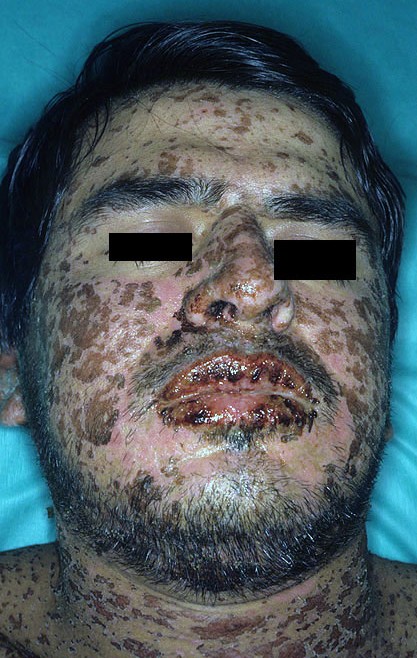
A small but critical minority of Type IV reactions are severe cutaneous adverse reactions — SCARs — which are genuinely life-threatening, and which change every downstream decision in this chapter: a SCAR is never a candidate for direct challenge, and never a candidate for desensitization (see Red Flags & Referral).[1]
| SCAR | Typical onset | Key features |
|---|---|---|
| SJS / TEN (Stevens-Johnson syndrome / toxic epidermal necrolysis — a single disease spectrum) | 1-3 weeks after starting the drug | Fever and a flu-like prodrome, then painful erythematous/purpuric macules and blistering with skin detachment (SJS: under about 10% of body surface area; SJS/TEN overlap: 10-30%; TEN: over about 30%) and mucosal involvement (oral, ocular, genital) in the large majority of cases. Mortality is substantial and rises sharply with the percentage of skin detachment.[1] |
| DRESS (drug reaction with eosinophilia and systemic symptoms) | Classically delayed — often 2-8 weeks after starting the drug | Fever, facial edema, a widespread morbilliform-to-exfoliative rash, lymphadenopathy, and eosinophilia or other hematologic abnormalities, with multi-organ involvement — most often hepatitis, but also nephritis, pneumonitis, or myocarditis. Symptoms can worsen for days after the drug is stopped and can relapse for weeks afterward.[4] |
| AGEP (acute generalized exanthematous pustulosis) | Rapid — typically within 1-2 days of exposure | Widespread, sterile, non-follicular pustules on an erythematous base, fever, and neutrophilia; usually resolves within about 2 weeks of stopping the drug, but is still treated as a SCAR for re-exposure purposes.[1] |
Risk Factors
- A prior reported drug reaction that was never formally characterized or evaluated — the single most modifiable "risk factor" in this chapter, since most such labels do not reflect true allergy.[2]
- True IgE-mediated reactions can wane over time: many patients labeled penicillin-allergic in childhood lose detectable IgE sensitization within about 10 years, part of why a remote, non-severe reaction is treated as lower risk (see Assessment & Diagnosis).[2][3]
- Repeated or intermittent courses of the same beta-lactam — more sensitizing exposures create more opportunity for true sensitization to develop, particularly with parenteral dosing.[1]
- A concurrent viral infection (classically Epstein-Barr virus, but also other common childhood viral illnesses) at the time an aminopenicillin (amoxicillin or ampicillin) is given — the well-documented mechanism behind the childhood "amoxicillin rash," which is usually a benign viral exanthem rather than a true drug allergy.[1]
- Route of administration — parenteral (especially intravenous) dosing carries a higher risk of a severe immediate reaction than the equivalent oral dose.[1]
- Multiple, unrelated drug allergy labels ("multiple drug allergy syndrome") — a marker of a more complex history that generally warrants formal allergy assessment rather than a simple direct challenge.[1]
- Age — allergy labels are disproportionately assigned in childhood or early adulthood and then simply carried forward, unquestioned, for decades; the label's age is itself a reason to reassess, not a reason to avoid the drug indefinitely.[2]
- A specific genetic predisposition to certain SCAR phenotypes with certain drugs — best documented outside beta-lactams (e.g., carbamazepine and HLA-B*15:02) — a reminder that some patients carry a real, individual susceptibility to a severe reaction that has nothing to do with the drug class as a whole.[1]
Red Flags & Refer
Any history of a severe cutaneous adverse reaction (SJS/TEN, DRESS, or AGEP) — however long ago — is an absolute, non-negotiable contraindication to direct oral challenge, skin testing performed with intent to challenge, or desensitization with the culprit drug. Refer directly to allergy/immunology; do not attempt any of these in a primary care, community pharmacy, or general hospital-ward setting.[1]
- Any history of blistering, skin detachment, or mucosal (oral/ocular/genital) involvement with a drug reaction.
- Fever with a widespread rash, facial edema, or lymphadenopathy occurring 2 or more weeks into or after a drug course — evaluate for DRESS; check a CBC with differential (looking for eosinophilia) and liver enzymes.[4]
- Widespread sterile pustules with fever within a day or two of starting a drug — evaluate for AGEP.
- A history of anaphylaxis, laryngeal edema, or any reaction requiring epinephrine — needs formal allergy skin testing before any future beta-lactam course; see the Anaphylaxis chapter for acute-reaction management if a reaction is occurring now.
- Any drug-induced cytopenia (hemolytic anemia, thrombocytopenia, neutropenia) or a Type III serum sickness-like reaction (fever, rash, arthralgia 1-3 weeks after exposure) — refer for formal evaluation rather than assuming a future course is safe.
Complications of an inaccurate or unmanaged drug allergy label
The harm here runs in both directions, and pharmacists are positioned to prevent both.
- From the label itself: patients labeled penicillin-allergic are more often treated with broader-spectrum, more toxic, and costlier alternative antibiotics (vancomycin, fluoroquinolones, clindamycin) — driving longer hospital stays, higher rates of Clostridioides difficile infection, and a well-documented association with MRSA and vancomycin-resistant enterococcus colonization; suboptimal, non-beta-lactam surgical prophylaxis in a penicillin-labeled patient also raises surgical-site infection risk.[2][5]
- From a genuinely missed or mismanaged true reaction: unrecognized anaphylaxis can progress to airway obstruction, shock, and death; continued exposure during an unrecognized SCAR sharply worsens outcomes — TEN carries substantial mortality that rises with the percentage of skin detachment, and DRESS carries a real risk of permanent organ damage (particularly hepatic) even after the acute reaction resolves.[1][4]
Assessment & Diagnosis
The history is the test — take it systematically
For the large majority of patients carrying a beta-lactam allergy label, a structured history is what actually establishes risk — not a laboratory test. Characterize the index reaction's timing (how soon after the dose, and how long ago in the patient's life), morphology (what it actually looked like), severity (what treatment, if any, it required), and specifically screen for any SCAR feature (see Recognize the Condition and Red Flags & Referral) before considering any risk score.[2][5]
PEN-FAST — a validated bedside risk-stratification tool
PEN-FAST is a simple, validated clinical decision rule that converts the history above into a probability of a true, currently relevant penicillin allergy.[3]
| Criterion | Points |
|---|---|
| Penicillin allergy reported by the patient | Not scored (entry criterion) |
| Five years or fewer since the reaction | 2 |
| Anaphylaxis/angioedema, or a severe cutaneous adverse reaction | 2 |
| Severe reaction requiring Treatment (e.g., an ED visit, an epinephrine dose, a corticosteroid) | 1 |
- 0 points — very low risk (about 0.6% probability of a positive allergy test)
- 1-2 points — low risk (about 5%)
- 3 points — moderate risk (about 20%)
- 4-5 points — high risk (about 50%)
A cutoff under 3 points was externally validated with a negative predictive value above 96%, supporting its use to identify patients appropriate for a direct oral challenge without preceding skin testing.[3]
A critical safety caveat: do not let a low composite PEN-FAST score override a SCAR history. The SCAR criterion is scored identically to the simple "reaction within 5 years" criterion, so a patient with a remote SCAR can still land in a "low" or "moderate" numeric category. Current guidance treats any SCAR history as an absolute contraindication regardless of the total score — apply the Red Flags & Referral rule first, and only apply PEN-FAST to a patient with no SCAR history at all.[1]
The Canadian (CSACI) risk framework, in parallel
CSACI's own position statement describes an equivalent, practically identical low-risk profile — appropriate for direct oral challenge without preceding skin testing — for a nebulous or remote (more than 10 years ago) history, and explicitly notes that a patient with only intolerance-type symptoms (nausea, vomiting, diarrhea), or no personal reaction history at all but avoidance based on a family history or a positive screening test, carries no increased risk of true allergy beyond baseline and can simply be prescribed the drug.[2]
Formal skin testing — the pathway for higher-risk patients
Patients who do not meet low-risk criteria — a PEN-FAST score of 3 or more, an unclear or inconsistent history, or a reaction within the last 5 years that required treatment — should be referred for formal penicillin skin testing (percutaneous, followed by intradermal testing if the percutaneous test is negative) by an allergist, generally followed by a supervised graded oral challenge if the skin test is negative.[2][1] A positive skin test confirms current IgE-mediated sensitization and means the drug should be avoided outright, or reserved for desensitization if truly needed (see Choose Initial Treatment).
Delayed-reaction (Type IV) testing
For a benign delayed maculopapular rash without SCAR features, patch testing and delayed intradermal reading are sometimes used by an allergist to support a benign phenotype, but these are specialist-directed tests, not something to pursue outside formal allergy referral — and are never appropriate in a patient with SCAR features (see Red Flags & Referral).[1]
Serum tryptase
A tryptase drawn during a suspected immediate reaction (rising within 15 minutes to 3 hours, peaking at 1-2 hours) can support an IgE/mast-cell-mediated mechanism retrospectively, exactly as in anaphylaxis of any cause — see the Anaphylaxis chapter for the full protocol. A normal tryptase does not rule out a true reaction.[1]
Treatment Targets
- Distinguish true, immune-mediated drug allergy from intolerance, a side effect, or another non-immune adverse reaction — an accurate label is the actual goal, not simply removing every label.
- Risk-stratify every patient carrying a beta-lactam allergy label using a structured history (and PEN-FAST where applicable) before deciding on a pathway.
- Safely delabel low-risk patients through a direct oral challenge, restoring first-line access to penicillins and narrower-spectrum cephalosporins.
- Identify and permanently protect patients with a true SCAR history from any future re-exposure, including desensitization.
- Refer higher-risk or unclear presentations for formal allergy skin testing rather than guessing.
- Apply current, side-chain-based cross-reactivity understanding rather than the outdated flat "10% cross-reactivity" teaching when choosing a cephalosporin or another beta-lactam for a labeled patient.
- Provide safe, monitored access to a truly needed drug through rapid desensitization when a confirmed IgE-mediated allergy exists and no adequate alternative is available.
- Update every record — the chart, the pharmacy dispensing system, and the patient's own understanding — the moment a label is confirmed, refined, or removed.
Choose Initial Treatment
Risk-stratify first — then match the pathway to the risk
Every patient with a reported beta-lactam allergy needs a structured history before any decision is made. Low risk, no SCAR history proceed directly to a direct oral amoxicillin challenge — skin testing first adds no meaningful safety margin in this group and only delays delabeling.[2][3] Moderate-to-high risk refer for formal skin testing, with a supervised graded oral challenge to follow if negative. Any SCAR history (SJS/TEN, DRESS, AGEP) neither challenge nor skin testing is appropriate — refer to allergy/immunology and document permanent avoidance.[1]
Direct oral amoxicillin challenge — the low-risk pathway, in detail
This is the single most pharmacist-actionable intervention in this chapter.
Before starting
Confirm eligibility
No SCAR history, no anaphylaxis/angioedema history, and either a PEN-FAST score under 3 or a CSACI-defined low-risk profile (nebulous/remote history, or an intolerance-only history). Confirm the patient is not currently on a systemic antihistamine that could mask a mild reaction.[2][3]
Have rescue supplies immediately available
Epinephrine and diphenhydramine on hand, and a clear plan for who calls emergency services, before the first dose is given — exactly as for any supervised drug challenge.[1]
Obtain informed consent
Explain the purpose (confirming tolerance, not "testing for allergy" in a way that implies risk of a severe reaction), the small residual chance of a mild reaction, and what delabeling will mean for future prescribing.
The challenge itself
Two validated approaches exist, and either is acceptable depending on local protocol:
- Single-step: a full therapeutic oral dose of amoxicillin (typically 250-500 mg in an adult), observed for a minimum of 60 minutes.[2]
- Graded (2-step): 10% of a therapeutic dose first; if no symptoms after 30-60 minutes, give the remaining 90%, followed by a minimum 60-minute observation period after the final dose.[2]
No objective symptoms (hives, angioedema, wheeze, hypotension) during the full observation period means the challenge is negative — remove the penicillin/beta-lactam allergy label immediately, from the chart, the pharmacy dispensing system, and any patient-held record, and counsel the patient on what this means going forward.[2][5] A pharmacist-led direct oral challenge program in a Canadian tertiary care hospital demonstrated this is a genuinely feasible, pharmacist-driven service, not solely an allergist-led one.[6] In fact, a careful history and interview alone — with no challenge needed at all — is sufficient to delabel the large majority of patients who turn out to have only ever had an intolerance or a family-history-based avoidance; one Canadian pharmacist-led program delabeled roughly 80% of referred patients through the interview step alone.[5]
Cross-reactivity with other beta-lactams — what the evidence actually shows
The traditional teaching that cephalosporins carry roughly a 10% cross-reactivity risk with penicillin is now understood to be a substantial overestimate, largely explained by older studies confounded by manufacturing cross-contamination between penicillin and early cephalosporin production lines.[7] Current evidence shows that clinically meaningful cross-reactivity is driven mainly by similarity of the R1 side chain, not by the shared core beta-lactam ring or by drug class as a whole — the overall rate of true cross-reactive IgE-mediated reaction is low, well under 2% even in patients who are skin-test positive to penicillin, and under 1% in patients who were not skin tested at all.[7]
- Same/similar side chain as amoxicillin (cefadroxil, cefprozil) — meaningfully higher cross-reactivity risk; avoid without individualized allergy input in a confirmed amoxicillin-allergic patient.[7]
- Same/similar side chain as ampicillin (cephalexin) — similar caution applies in a confirmed ampicillin/amoxicillin-allergic patient.[7]
- Structurally dissimilar side chain (cefazolin is the clearest example — it shares no side chain with any penicillin) — current evidence supports giving these directly, even to a patient with a confirmed penicillin allergy, without a graded challenge in most cases; a supervised first dose or allergist input remains reasonable after a severe index reaction.[7][1]
See Drug Tables for a practical grouping of commonly used cephalosporins by their side-chain relationship to amoxicillin/ampicillin.
Desensitization — when the drug is truly needed despite a confirmed IgE-mediated allergy
Confirmed Type I (IgE-mediated) allergy, drug essential, no adequate alternative rapid drug desensitization can provide temporary tolerance for the current course. The procedure exposes the patient to progressively increasing doses of the drug — typically over 15-20 steps across several hours — under continuous monitoring in a setting equipped for anaphylaxis, gradually inducing a state of temporary mast cell/basophil hyporesponsiveness rather than curing the underlying allergy.[1]
Desensitization is absolutely contraindicated in any patient with a SCAR history (SJS/TEN, DRESS, AGEP) — these are T-cell mediated reactions that desensitization protocols are not designed to prevent, and re-exposure of any kind risks a life-threatening recurrence.[1]
Tolerance from desensitization is temporary and course-specific — it typically lasts only as long as the drug is continuously present in the body, and is generally lost within about 24-48 hours of the last dose. If therapy is interrupted, or a subsequent course is needed later, the full desensitization procedure must be repeated; it does not "cure" the allergy or confer any lasting tolerance.[1]
Non-Pharmacologic Treatment
- The moment a label is delabeled, refined, or confirmed, update every relevant record — the chart/EHR allergy field, the community and hospital pharmacy dispensing system, and any patient-held record or medical-alert item — a delabeling that lives only in a clinic note is functionally useless the next time the patient presents somewhere else.[5]
- Counsel the patient in plain language on what actually happened and why: e.g., "what you had as a child was a side effect or a viral rash, not an allergy, and you can safely take penicillin-type antibiotics now" — patients who understand the distinction are far less likely to self-report the old label at a future visit.
- For a patient with a confirmed true allergy, provide clear, specific written documentation of exactly which drug(s) to avoid — and, importantly, which related drugs remain safe based on side-chain cross-reactivity — rather than a blanket "avoid all antibiotics" instruction that unnecessarily narrows future options.
- For a patient with a confirmed SCAR, ensure the culprit drug and any structurally related drugs are flagged as an absolute, permanent contraindication across every system, and recommend medical-alert identification (bracelet or wallet card).[1]
- Never encourage or perform an unsupervised home rechallenge — even a "low risk" challenge should only be done with rescue medication immediately available and a clear escalation plan.
- Encourage patients with an old, never-formally-assessed allergy label to raise it at any future pharmacy or clinic visit — this is a genuinely reasonable thing for a patient to proactively ask about, and pharmacists are well positioned to open that conversation themselves.
Special Populations
Children
A morbilliform rash appearing during a course of amoxicillin given for a presumed bacterial infection is very often actually a viral exanthem, especially when the concurrent illness is due to Epstein-Barr virus — the classic, well-documented mechanism behind many childhood "penicillin allergy" labels that persist, unquestioned, into adulthood.[1] The same risk-stratification and direct oral challenge approach used in adults has been validated in children and is generally the preferred first step for a low-risk pediatric history rather than automatic avoidance for years.[2]
Pregnancy
An inaccurate penicillin allergy label is a particularly consequential problem in pregnancy, since penicillin is the preferred, most effective agent for intrapartum group B streptococcus prophylaxis and several other obstetric indications, and the usual non-beta-lactam alternatives are less effective and carry their own resistance concerns. The same risk-stratified evaluation approach applies in pregnancy; there is no reason to defer an appropriate low-risk direct challenge or a clinically indicated referral for skin testing simply because the patient is pregnant, and doing so proactively — well before labour — is far preferable to discovering an unresolved label during an acute intrapartum presentation.[1]
Hospitalized and older adults
Allergy labels in hospitalized and older patients are disproportionately old, self-reported without any supporting documentation, and directly shape perioperative and empiric antibiotic selection at exactly the moments when getting it right matters most. Pharmacist-led inpatient delabeling programs using structured risk stratification (including PEN-FAST) and direct oral challenge have been demonstrated as feasible and effective in Canadian hospital settings, and represent one of the clearest applications of antimicrobial stewardship pharmacy practice in this platform.[6][5]
Patients with cystic fibrosis or another condition requiring recurrent antibiotic courses
Patients who need frequent or lifelong antibiotic courses accumulate a disproportionate lifetime exposure to broad-spectrum alternatives if a beta-lactam label is never reassessed — accurate delabeling (or, where a true allergy is confirmed, a clear map of which structurally distinct beta-lactams remain safe) is especially valuable in this group, and desensitization may need to be repeated with some regularity if a confirmed true allergy exists and the drug remains the best option for recurrent courses.[1]
Multiple drug allergy labels
Patients who carry several unrelated drug allergy labels represent a more complex history and generally warrant formal allergy referral rather than a simple direct challenge, since the history itself is harder to risk-stratify reliably.[1]
Monitoring & Follow-Up
After a negative direct oral challenge, no further monitoring beyond the standard observation period is needed — the priority shifts entirely to making sure the delabeling actually sticks across every system and every future encounter (see Non-Pharmacologic Treatment).[5]
- After a positive/reactive challenge or skin test: document the confirmed reaction precisely (timing, morphology, severity, treatment given) so the next clinician has an accurate, specific record rather than a bare "penicillin allergy" flag.
- After desensitization: monitor closely throughout every dose-escalation step, and clearly communicate to the entire care team that tolerance is temporary and course-specific — a subsequent, even closely spaced, course of the same drug needs its own repeat desensitization unless dosing has been genuinely continuous.[1]
- After a confirmed SCAR: arrange dermatology and/or allergy/immunology follow-up; DRESS in particular can flare or relapse for weeks after the culprit drug is stopped and needs interval monitoring of liver enzymes and other affected organ systems even after the acute presentation appears to be resolving.[4]
- Build in periodic reassessment: any allergy label that has never been formally evaluated is a reasonable, low-effort thing to flag for review at essentially any future pharmacist encounter, not something that needs a dedicated visit to address.
Common Errors to Avoid
- Accepting a decades-old, undocumented "penicillin allergy" label at face value without ever asking what actually happened.
- Treating nausea, vomiting, diarrhea, or headache as if it were an allergic reaction.
- Assuming every cephalosporin cross-reacts with penicillin based on the outdated flat "10% cross-reactivity" teaching, rather than reasoning from side-chain similarity.[7]
- Attempting a direct oral challenge, a skin test intended to lead to challenge, or desensitization in any patient with a history of SJS/TEN, DRESS, or AGEP.[1]
- Defaulting to vancomycin, a fluoroquinolone, or clindamycin for a "penicillin-allergic" patient without ever risk-stratifying the actual history first.
- Assuming a successful desensitization confers lasting tolerance — it does not, and a subsequent course generally needs its own repeat procedure.[1]
- Starting a direct oral challenge without epinephrine and diphenhydramine immediately available.
- Mislabeling a child's viral-illness-associated aminopenicillin rash as a lifelong drug allergy without ever revisiting it.[1]
- Delabeling a patient's chart without also updating the pharmacy dispensing system and any patient-held record — an incomplete update is why the same label so often reappears at the next encounter.[5]
- Discharging a patient after a confirmed reaction without a clear, specific written record of exactly what happened and what remains safe to use.
Clinical Decision Algorithm
Drug Tables
How to use this table: Doses are adult doses and require patient-specific confirmation (renal/hepatic function, weight, allergy history). Pediatric dosing is weight-based per the current product monograph unless stated. Drug pricing is intentionally omitted. Select any drug name to open its complete Pharmasist Drug Database page.
Direct Oral Challenge Agents
Used to actively confirm tolerance in a risk-stratified low-risk patient — this is a diagnostic/delabeling procedure, not empiric antibiotic therapy. See Choose Initial Treatment for the full protocol and eligibility criteria.
| Drug | Dosage | Adverse effects | Drug interactions | Comments |
|---|---|---|---|---|
| Amoxicillin | Single-step challenge: 250-500 mg PO single dose, observed 60 minutes Graded challenge: 10% of a therapeutic dose, then the remaining 90% after 30-60 minutes if no symptoms, then observe 60 minutes | GI upset; an objective allergic reaction is uncommon in a correctly selected low-risk patient | None specific to the challenge itself | The primary direct oral challenge agent for low-risk beta-lactam allergy delabeling. |
| Penicillin V | Adults: 500 mg PO single dose, observed 60 minutes | GI upset; an objective allergic reaction is uncommon in a correctly selected low-risk patient | None specific to the challenge itself | Alternative challenge agent when the index reaction was specifically to a non-aminopenicillin beta-lactam. |
Anaphylaxis Rescue and Desensitization-Premedication Drugs
Must be immediately available before any direct oral challenge or desensitization dose step begins — not agents to gather after a reaction starts.
| Drug | Dosage | Adverse effects | Drug interactions | Comments |
|---|---|---|---|---|
| Epinephrine | Anaphylaxis during a challenge/desensitization: IM, anterolateral thigh | Transient tremor, pallor, anxiety, palpitations at standard IM dosing | Caution with a concurrent beta-blocker (may blunt response) — not a reason to withhold | The only treatment that reverses anaphylaxis; see the Anaphylaxis chapter for full weight-based dosing and administration. |
| Diphenhydramine | Adults: 25-50 mg PO/IV per product monograph | Sedation, anticholinergic effects | Additive sedation with other CNS depressants | Adjunct for a mild cutaneous reaction, and a standard premedication component before rapid desensitization — never a substitute for epinephrine in a reaction meeting anaphylaxis criteria. |
| Famotidine | Premedication: 20 mg PO/IV per protocol | Headache | None significant at standard doses | H2-blocker component of some rapid desensitization premedication protocols, given alongside an H1-antihistamine per the treating allergist's protocol. |
Beta-Lactams Commonly Used in a Confirmed or Labeled Penicillin Allergy — Grouped by Side-Chain Cross-Reactivity Risk
Cross-reactivity is driven by R1 side-chain similarity, not by the shared beta-lactam ring or by drug class as a whole. See Choose Initial Treatment for the full explanation.
| Drug | Dosage | Adverse effects | Drug interactions | Comments |
|---|---|---|---|---|
| Cefazolin | Adults: Standard indication-based dosing | Hypersensitivity (uncommon) | None significant at standard doses | Shares no side chain with any penicillin — current evidence supports direct use in most confirmed penicillin-allergic patients, including for surgical prophylaxis. |
| Ceftriaxone | Adults: Standard indication-based dosing | Hypersensitivity, biliary sludging | Do not co-administer with calcium-containing IV solutions | Side chain distinct from amoxicillin/ampicillin — generally low cross-reactivity risk; individualize for a patient with a severe index reaction. |
| Cephalexin | Adults: Standard indication-based dosing | GI upset, hypersensitivity reactions | None significant at standard doses | Shares its side chain with ampicillin — use with caution, or avoid without individualized allergy input, in a confirmed ampicillin/amoxicillin allergy. |
| Cefadroxil | Adults: Standard indication-based dosing | GI upset, hypersensitivity reactions | None significant at standard doses | Shares an identical side chain with amoxicillin — the clearest example of a genuinely higher cross-reactivity-risk pairing; avoid without individualized allergy input in a confirmed amoxicillin allergy. |
| Cefprozil | Adults: Standard indication-based dosing | GI upset, hypersensitivity reactions | None significant at standard doses | Also shares its side chain with amoxicillin — same caution as cefadroxil. |
Adjunct Therapy for a Confirmed Severe Cutaneous Adverse Reaction
Initiated and dosed by the treating specialist (dermatology/allergy) for a confirmed SCAR — not part of any challenge or desensitization premedication bundle, and not pharmacist-initiated.
| Drug | Dosage | Adverse effects | Drug interactions | Comments |
|---|---|---|---|---|
| Dexamethasone | Per specialist protocol: Individualized to the specific SCAR and its severity | Hyperglycemia, mood change, adrenal suppression with prolonged use | Multiple CYP3A4-mediated interactions | Adjunct in confirmed DRESS or another SCAR, individualized to severity and organ involvement by the treating specialist. |
References
- Drug allergy: A 2022 practice parameter update — Journal of Allergy and Clinical Immunology, Joint Task Force on Practice Parameters (AAAAI/ACAAI/JCAAI) (Khan DA, Banerji A, Blumenthal KG, et al.). J Allergy Clin Immunol 2022;150(6):1333-1393
- Practical guide for evaluation and management of beta-lactam allergy: position statement from the Canadian Society of Allergy and Clinical Immunology — Allergy, Asthma & Clinical Immunology (Jeimy S, Ben-Shoshan M, Abrams EM, Ellis AK, Connors L, Wong T). Allergy Asthma Clin Immunol 2020;16:95
- Development and validation of a penicillin allergy clinical decision rule — JAMA Internal Medicine (Trubiano JA, Vogrin S, Chua KYL, et al.). JAMA Intern Med 2020;180(5):745-752
- Diagnosing and Managing Drug Reaction With Eosinophilia and Systemic Symptoms (DRESS) Amidst Remaining Uncertainty — Journal of Allergy and Clinical Immunology: In Practice (Wei BM, Fox LP, et al.). J Allergy Clin Immunol Pract 2025;13(5)
- Beta-lactam Allergy Delabeling Guideline and Toolkit — BC Provincial Antimicrobial Clinical Expert Group (PACE), BC Centre for Disease Control. BCCDC PACE Toolkit, 2021
- Feasibility and impact of pharmacist-led penicillin allergy delabelling using the PEN-FAST scoring tool in a Canadian tertiary care hospital — Antimicrobial Stewardship & Healthcare Epidemiology (Kamaliddin C, Driver A, Druken R, Rennert-May E, Rajakumar I). Antimicrob Steward Healthc Epidemiol 2026
- Cross-reactivity in β-lactam allergy — Journal of Allergy and Clinical Immunology: In Practice (Zagursky RJ, Pichichero ME). J Allergy Clin Immunol Pract 2018;6(1):72-81.e1
Professional reference only. Apply clinical judgment and verify patient-specific decisions against current authoritative guidance and product information.