Hair Loss (Alopecia)
Hair Loss (Alopecia)
References
- Androgenetic Alopecia: Pathogenesis, Evaluation, and Management — Canadian Diabetes & Endocrinology Today (Muntyanu A). Can Diabetes Endocrinol Today 2026;4(1):34-41
- A Canadian Consensus on Androgenetic Alopecia: Approach and Management — Journal of Cutaneous Medicine and Surgery (Landells I, Chow E, Gupta AK, Jasso Olivares JC, Thuraisingam T, Ahluwalia R, et al.). J Cutan Med Surg 2025;29(5_suppl):5S-14S
- Telogen Effluvium — StatPearls [Internet], StatPearls Publishing (Hughes EC, Syed HA, Saleh D). StatPearls, updated 2024-05-01
- Bare Realities: Uncovering the Life-Altering Impacts of Alopecia Areata — Canadian Dermatology Today (Muntyanu A). Can Dermatol Today 2025;6(2):5-8
- Alopecia — Canadian Dermatology Association. Canadian Dermatology Association, patient information
- Summary Safety Review - Finasteride and Dutasteride - Assessing the Potential Risk of Sexual Dysfunction — Health Canada, Drug and Health Products Portal. Health Canada Summary Safety Review, 2026
- Summary Safety Review - Finasteride - Assessing the Potential Risk of Suicidal Thoughts and Behaviour (Suicidality) — Health Canada, MedEffect Canada. Health Canada Summary Safety Review, December 17, 2015
- Adverse Sexual Effects of Treatment with Finasteride or Dutasteride for Male Androgenetic Alopecia: A Systematic Review and Meta-analysis — Acta Dermato-Venereologica (Lee S, Lee YB, Choe SJ, Lee WS). Acta Derm Venereol 2019;99(1):12-17
- Minoxidil: mechanisms of action on hair growth — British Journal of Dermatology (Messenger AG, Rundegren J). Br J Dermatol 2004;150(2):186-194
Clinical Snapshot
Hair loss (alopecia) most often reflects one of three genuinely distinct processes, and telling them apart is the single most useful thing a pharmacist can do at first presentation. Androgenetic alopecia (AGA) — often called male-pattern or female-pattern hair loss — is a common, non-scarring condition in which genetically susceptible hair follicles progressively convert from thick terminal hairs into fine, short vellus-like hairs, driven by local follicular sensitivity to dihydrotestosterone (DHT) rather than, in most patients, any abnormality of circulating hormone levels.[1] It affects up to 80% of men and 50% of women over a lifetime, and its prevalence and severity both increase with age.[1] A genuinely Canadian, Delphi-based consensus statement — the first Canada-specific guidance for this condition — puts prevalence at 40-50% of Canadian men and women by age 50 and identifies only two Health Canada-approved medications for it: oral finasteride (for men) and topical minoxidil (for both sexes).[2][1]
Telogen effluvium (TE) is a diffuse, reactive shedding that follows a triggering physiologic or psychological stressor — typically by about 2-3 months, though the reported range is 1-6 months — as a wave of hair follicles is pushed prematurely out of the growth (anagen) phase and into the resting (telogen) phase together; when those hairs later release, the patient notices a sudden increase in daily shedding.[3] It is usually self-limited and carries a genuinely good prognosis once the trigger is identified and addressed.[3]
Alopecia areata (AA) is a fundamentally different disease: an autoimmune process that attacks hair follicles directly, producing patchy, and sometimes total, hair loss, affecting roughly 2% of the population over a lifetime.[4] It needs dermatology-led immune-modulating treatment, not the OTC/self-care pathway this chapter otherwise centres on, and it carries a genuinely severe, well-documented psychosocial burden that deserves to be taken seriously regardless of the fraction of scalp involved.[4] This chapter also briefly covers traction alopecia and other less common causes, and the pharmacist-relevant list of medications that can trigger or worsen diffuse shedding.
Recognize the Condition
Androgenetic alopecia — pathophysiology and pattern
AGA is a polygenic, androgen-dependent condition. Dihydrotestosterone (DHT), produced from testosterone via the enzyme 5α-reductase, is the key driver: local DHT levels and 5α-reductase activity are measurably higher in balding scalp than in non-balding scalp from the same patient, and DHT also promotes perifollicular fibrosis and reduced vascular support around the follicle, further impairing hair growth over time.[1] Genetic predisposition is central — genome-wide association studies implicate variants in androgen-receptor signalling (particularly in men) along with loci governing hair-follicle development and cycling — and, importantly, most patients, especially women, have entirely normal circulating androgen levels: AGA reflects increased local follicular sensitivity to androgens, not systemic androgen excess, and AGA alone is not a reliable marker of a hormonal disorder.[1]
The two sexes present differently. Male-pattern hair loss (MPHL) is characterized by frontotemporal recession and vertex thinning, graded using the Hamilton-Norwood scale (stages I through VII, with additional "A" variants for a pattern of loss that runs front-to-back without a distinct vertex component).[1]

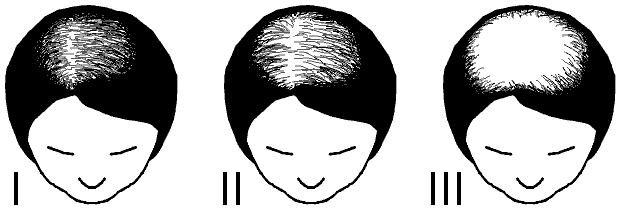
Female-pattern hair loss (FPHL) predominantly affects the mid-scalp and vertex, with the frontal hairline relatively preserved; thinning extends anteriorly along the central part, producing the characteristic "Christmas tree" pattern, and the degree of central-part widening tracks with severity. A minority of women show a more extensive pattern with frontotemporal recession resembling MPHL. FPHL is most often graded using the three-grade Ludwig scale, though the five-stage Sinclair scale is also used; no single system has been universally adopted.[1] A history of increased shedding (i.e., telogen effluvium) can precede, or coexist with, a new FPHL diagnosis.[1]
Telogen effluvium — triggers and the medication-induced list
TE is triggered by a wide range of physiologic and psychological stressors: acute febrile illness or severe infection, major surgery or severe trauma, the postpartum period (a sharp postpartum drop in estrogen), crash dieting or a significant recent weight loss, low protein or iron intake, hypothyroidism, and significant psychological stress.[3] A specific, pharmacist-relevant sub-list is medication-induced: anticoagulants (warfarin, heparin, and the direct oral anticoagulants), typically 3-4 months after starting; systemic retinoids (isotretinoin, acitretin), in a dose-dependent pattern — high-dose acitretin (over 50 mg/day) has been reported to cause TE in more than 60% of patients; beta-blockers, most consistently propranolol, metoprolol, and atenolol; and valproic acid, which causes hair loss in roughly 10-11% of users in a dose-dependent fashion, plausibly through chelation of zinc and selenium and reduced biotin recycling that deprives the follicle of substrate for keratin synthesis.[3] Other reported culprits include ACE inhibitors, lithium, antithyroid drugs (including propylthiouracil), carbamazepine, oral contraceptive discontinuation, and immunizations.[3] Chemotherapy belongs on a pharmacist's medication-induced hair-loss checklist too, but through a genuinely different, faster mechanism — direct cytotoxic damage to actively dividing anagen-phase follicles (anagen effluvium), producing abrupt, diffuse loss within days to a couple of weeks rather than the delayed, 2-3-month pattern of true telogen effluvium; the distinction matters because it changes how quickly to expect the shedding to appear relative to the causative exposure.
Alopecia areata — a distinct autoimmune disease
AA is an autoimmune disease targeting hair follicles that can develop at any age and in any gender or ethnicity. The localized/patchy subtype accounts for roughly 70% of cases; alopecia totalis (complete scalp hair loss) or universalis (complete body hair loss) account for 15-25%; nail changes (pitting, trachyonychia) occur in about 30% of patients and are associated with a worse prognosis.[4] The Severity of Alopecia Tool (SALT) grades extent from 0-100% of scalp involvement, with a score above 50% generally considered severe disease and an indication for systemic therapy — though this scalp-based measure correlates only loosely with a patient's own experienced burden, and patient-rated severity is actually a better predictor of quality-of-life impact than either SALT or physician assessment.[4] AA carries a well-documented, severe psychosocial burden that is genuinely distinct from — and generally worse than — that of AGA: more than 75% of patients report some quality-of-life impairment and up to a third report extremely severe effects, 30-68% of adults experience clinically significant anxiety or depression, and receiving an AA diagnosis itself is associated with a 30-38% higher risk of new-onset depression.[4] This is precisely why AA cannot be managed as "just" a cosmetic self-care presentation — see Red Flags/Referral.
Traction alopecia and other causes
Traction alopecia results from chronic mechanical tension on hair follicles from tight hairstyling practices — tight braids, weaves, extensions, or ponytails sustained over a long period — and characteristically produces marginal thinning concentrated along the hairline or wherever tension is greatest, sparing other areas early on. It is reversible if the causative tension is stopped early, but chronic, longstanding traction can progress to permanent, scarring follicular damage.[5] Other, less common causes include scarring (cicatricial) alopecias, which present with scalp symptoms such as burning or pruritus and perifollicular erythema or scaling on close inspection and lead to permanent follicular destruction if not caught early, and trichotillomania, a compulsive hair-pulling behaviour distinct from any of the conditions above.[5]
Risk Factors
- Family history of pattern hair loss — AGA has a strong polygenic hereditary basis.[1]
- Advancing age — AGA prevalence and severity both rise with age; in women, prevalence rises from about 12% by age 29 to 25% by age 50 and 41-50% by age 70 and older, and in men, moderate MPHL is reported in 48% of those aged 18-49, rising to 53% of those aged 40-49.[1]
- Polycystic ovary syndrome (PCOS) and other hyperandrogenic states in women — FPHL prevalence among women with PCOS is reported at roughly 20-30%, and conversely the pooled prevalence of PCOS among women with FPHL is estimated at about 32%, though the strength of a causal association is inconsistent across studies and should be interpreted cautiously.[1]
- Metabolic syndrome — a meta-analysis found a significantly higher prevalence of metabolic syndrome in AGA patients than controls, an association that appears stronger in women, in early-onset disease, and in patients of African ethnicity.[1]
- A recent significant physiologic or psychological stressor — acute illness, major surgery, childbirth, crash dieting or significant weight loss, or major psychological stress — for telogen effluvium.[3]
- Iron deficiency (low ferritin) and hypothyroidism — correctable, pharmacist-relevant contributors to telogen effluvium.[3]
- A recently started or dose-changed medication from the list in Recognize the Condition — an anticoagulant, a systemic retinoid, a beta-blocker, valproic acid, or another implicated agent.[3]
- A personal or family history of another autoimmune condition (e.g., thyroid disease) — alopecia areata is itself an autoimmune process and clusters with other autoimmune disease.[4]
- Chronic tight hairstyling practices (braids, weaves, extensions, tight ponytails) — traction alopecia.[5]
Red Flags & Refer
The following point away from routine androgenetic alopecia self-care and toward medical evaluation or dermatology referral:
- Patchy, well-demarcated round or oval hair loss, especially with nail pitting or other nail changes — suggests alopecia areata, a distinct autoimmune disease needing dermatology-led immune-modulating therapy, not OTC minoxidil as primary treatment.[4]
- Signs of scarring — scalp burning or pruritus, perifollicular erythema, scaling, or a shiny/smooth patch with no visible follicular openings — suggests a scarring (cicatricial) alopecia or advanced traction alopecia; refer promptly, since the follicular destruction is permanent and the window to intervene is time-limited.[5]
- Rapid, diffuse shedding with no identifiable trigger in the preceding 1-6 months, particularly in a patient who is otherwise unwell — warrants medical workup (thyroid, iron studies, and other systemic causes) rather than reassurance alone.[3]
- Signs of an underlying systemic or endocrine cause — significant unexplained weight loss, fatigue, heat or cold intolerance, or other features of thyroid dysfunction.[1]
- In women, early-onset or rapidly progressive patterned hair loss accompanied by hirsutism, acne, menstrual irregularity, infertility, galactorrhea, or virilization — evaluate for hyperandrogenism (PCOS, congenital adrenal hyperplasia, or an androgen-secreting tumour) rather than treating as routine FPHL.[1]
- New or progressive hair loss in a child or before puberty — pediatric AGA is uncommon, and new hair loss in this group warrants medical evaluation rather than an assumption of pattern hair loss.[1]
- Any significant psychological distress associated with hair loss, of any type — screen directly and offer support resources; this is a real and well-documented burden, not a purely cosmetic concern.[4]
Assessment & Diagnosis
History
- Onset and tempo — gradual and patterned (favours AGA), diffuse and relatively acute (favours TE), or patchy/circumscribed (favours AA) — and family history of pattern hair loss.
- For suspected TE: a systematic screen for a trigger roughly 1-6 months earlier — acute illness, surgery, childbirth, crash dieting or significant weight loss, major psychological stress — and a complete medication review against the list in Recognize the Condition.[3]
- In women: menstrual history and screening for hirsutism, acne, infertility, galactorrhea, or virilization when hair loss is early-onset or rapidly progressive.[1]
- Hairstyling practices (tight braids, weaves, extensions) for traction alopecia, and dietary history (restrictive or crash dieting, iron intake) for TE.
- Direct screening for psychosocial impact — embarrassment, avoidance of social situations, anxiety, or low mood — regardless of the presumed type of hair loss.[4]
Examination
- Pattern recognition and staging using the Hamilton-Norwood (men) or Ludwig (women) scale for suspected AGA.[1]
- The hair pull test — gently pulling a small grasp of roughly 40-60 hairs; extracting 4 or more hairs supports active, ongoing shedding as seen in acute TE.[3]
- Scalp inspection for scarring signs (erythema, scaling, loss of visible follicular openings) and for the round/oval patches, exclamation-point hairs, or black dots of alopecia areata.
- Nail exam — pitting or trachyonychia supports alopecia areata and is associated with a worse prognosis.[4]
When investigation is needed — and when it is not
The diagnosis of AGA is primarily clinical, based on patterned thinning, gradual progression, and follicular miniaturization; trichoscopy, where available, can support the diagnosis (variation in hair-shaft diameter, an increased proportion of single-hair follicular units, yellow dots representing sebum/keratin-filled follicular openings), and scalp biopsy is rarely needed, reserved for genuine diagnostic uncertainty or suspicion of a scarring alopecia, alopecia areata, or chronic TE.[1] Routine hormonal testing is not required in men with typical MPHL, and AGA alone is not, by itself, a reliable marker of a hormonal disorder.[1] Endocrine evaluation should be considered specifically for early-onset or rapidly progressive/severe hair loss in women, or when accompanied by hirsutism, acne, menstrual irregularity, infertility, galactorrhea, virilization, or features of thyroid disease — initial investigations may include total and free testosterone, DHEA-S, 17-hydroxyprogesterone, and prolactin, with further testing guided by clinical suspicion.[1] For suspected TE, a genuinely useful and correctable-cause-oriented workup includes a CBC, ferritin (with iron saturation, which is more sensitive than ferritin alone when inflammation is present and can falsely normalize it), and TSH — iron deficiency and thyroid dysfunction are both common, correctable contributors, and this is a real, high-value pharmacist counseling point when a patient describes diffuse shedding with no other identified cause.[3]
Treatment Targets
- For androgenetic alopecia: slow or halt further progression — the realistic, achievable goal — and restore density where possible, understanding that this is genuinely not typically a cure and that continued therapy is required indefinitely to maintain any benefit gained.
- Start AGA therapy as early as reasonably possible once the diagnosis is confirmed, since available treatments are more effective at preventing further progression than at reversing established miniaturization or fibrosis.
- For telogen effluvium: identify and address the underlying trigger or correctable deficiency, and set realistic expectations that most cases resolve spontaneously, typically within about 6 months, once the trigger is removed or corrected.
- Recognize alopecia areata promptly as a distinct disease and refer for dermatology-led, immune-modulating treatment rather than attempting OTC self-care.
- Set an honest, explicit timeline for any pharmacotherapy (a minimum of 3-6 months before judging response) so patients do not discontinue prematurely due to a predictable initial shedding phase or simply not seeing results fast enough.
- Counsel matter-of-factly and non-judgmentally on sexual and mood-related adverse effects of 5-alpha-reductase inhibitors, so patients raise concerns early rather than silently discontinuing and disengaging from follow-up.
- Take the real psychosocial impact of hair loss seriously across all three conditions, and screen for it directly rather than treating hair loss as a purely cosmetic concern.
Choose Initial Treatment
Confirm the diagnosis before starting therapy
Confirm the pattern is genuinely androgenetic (patterned, gradual, non-scarring) before recommending OTC minoxidil or discussing prescription therapy — telogen effluvium and alopecia areata need a different first move (see below and Non-Pharmacologic Management).
Androgenetic alopecia — stepwise approach, by sex
A Canadian Delphi-consensus panel reached full agreement (100%) on oral finasteride, oral minoxidil, oral dutasteride, platelet-rich plasma, and topical minoxidil, and near-full agreement (91%) on topical finasteride, as genuinely effective AGA interventions, and set out the following stepwise approach.[2][1]
Men (MPHL)
1st line
1st line 5% minoxidil foam or solution, twice daily, plus oral finasteride 1 mg once daily — the only two Health Canada-approved options, and the combination is the panel's first-line recommendation.[2][1]
2nd line
2nd line topical finasteride 0.25% daily, low-dose oral minoxidil 1.25-5 mg daily (off-label), oral dutasteride 0.5 mg 2-3 times weekly (off-label), low-level laser therapy, or platelet-rich plasma.[2]
3rd line
3rd line saw palmetto, aminexil, topical ketoconazole, or other adjuncts (topical caffeine, botulinum toxin, topical cetirizine, dutasteride mesotherapy) — lower-tier evidence, genuinely beyond typical pharmacist-initiated counseling.[2]
Women (FPHL)
1st line
1st line 5% topical minoxidil once daily — the only Health Canada-approved option for women.[2][1]
2nd line
2nd line oral spironolactone 100-200 mg daily ± oral minoxidil, or off-label oral finasteride/dutasteride ± oral minoxidil — the latter reserved mainly for selected postmenopausal women, or premenopausal women only with reliable contraception, given teratogenic risk.[2][1]
3rd line and other options
3rd line procedural therapies — platelet-rich plasma, laser, or mesotherapy. Other cosmetic/adjunct options (aminexil, nutraceuticals, herbal products) with lower-tier evidence.[2]
Telogen effluvium
1st line identify and address the underlying trigger or correctable deficiency in coordination with the prescriber — this is the actual treatment, not a preliminary step before starting a drug. Adjunct in select persistent cases topical or oral minoxidil can be considered, though most cases resolve with trigger correction and reassurance alone and do not need it.[3]
Alopecia areata
Do not manage with OTC minoxidil as primary or sole therapy — refer to dermatology for topical, intralesional, or systemic immune-modulating treatment appropriate to extent and severity.[4]
Non-Pharmacologic Treatment
- Set an explicit, realistic timeline for any AGA therapy at the outset — genuine response is not expected before about 3-6 months, and continued therapy is required indefinitely to maintain any gains; this single piece of counseling probably prevents more premature, unnecessary discontinuations than anything else in this chapter.[1]
- Minoxidil application technique: apply to a dry scalp (not wet hair), spread evenly across the thinning area rather than concentrating on one spot, allow it to dry fully (roughly 2-4 hours) before styling, using other hair products, or lying down on a pillow, and wash hands immediately after application. Avoid contact with the eyes or with broken or irritated skin, and take care to avoid transferring product to a partner, child, or pet through direct scalp contact, pillows, or hats — inadvertent contact can cause unwanted hair growth wherever it lands.[1]
- For telogen effluvium: correct the identified trigger — iron repletion if ferritin is low, thyroid management if dysfunction is found, avoidance of crash or severely restrictive dieting, a medication change coordinated with the prescriber if a causative drug is implicated, and stress-management resources where relevant — most cases resolve spontaneously as the hair cycle re-synchronizes, generally within about 6 months.[3]
- Gentle hair care during active shedding or thinning: avoid chronic tight hairstyles (braids, weaves, tight ponytails, extensions) that add traction, minimize excessive heat or chemical processing, and avoid vigorous brushing.[5]
- Camouflage options — root concealer powders or fibres, volumizing techniques, and wigs or hairpieces for patients who want them — are a legitimate part of care, not a lesser substitute for "real" treatment; be aware these carry a genuine practical and financial burden that is well documented in alopecia areata and applies more broadly to visible hair loss of any cause.[4]
- Psychosocial support: given the well-documented mental-health burden hair loss carries — most severely in alopecia areata, but relevant across all three conditions — screen directly for its impact rather than waiting for the patient to raise it, and refer for counseling or mental-health support when significant distress is identified.[4]
- Procedural options, explicitly beyond typical pharmacist-counseling scope and appropriate to raise as a referral rather than something to initiate: hair transplantation (follicular unit transplantation/extraction) as the definitive option for stable-pattern AGA with adequate donor density; low-level laser therapy devices, with only near-consensus (55% panel agreement), i.e., genuinely modest evidence; and platelet-rich plasma and microneedling, most supported as adjuncts to first-line pharmacotherapy rather than as standalone treatment — refer interested patients to dermatology or a hair-restoration specialist for all of these.[2]
Pharmacologic Treatment Options
| Drug / intervention | Role | Dose / use | Important adverse effects | Teaching points |
|---|---|---|---|---|
| Minoxidil Preferred | First-line, both sexes — OTC, no prescription needed | Women: 5% foam/solution once daily. Men: 5% foam or solution twice daily (2% solution twice daily is an older, lower-strength alternative for either sex). | Scalp irritation/contact dermatitis; unwanted facial or body hypertrichosis with spillage or contact transfer; an initial shedding phase in the first weeks of use | A vasodilator that prolongs the anagen (growth) phase — not an androgen-pathway drug. Benefit is not sustained if discontinued, and response is not expected before 3-6 months; set this expectation before the patient starts. |
| Finasteride Preferred | First-line, men (MPHL) — Health Canada-approved; off-label, selected women | 1 mg PO once daily | Decreased libido, erectile dysfunction, ejaculatory dysfunction, mood-related symptoms; lowers PSA | 5-alpha-reductase type II inhibitor, blocks conversion of testosterone to DHT. Counsel matter-of-factly and non-judgmentally on sexual/mood effects; confirm baseline PSA is flagged for men undergoing prostate cancer screening. |
| Dutasteride Alternative | Second-line, men — off-label for hair loss (approved only for BPH in Canada) | 0.5 mg PO 2-3 times weekly | Similar sexual/mood adverse-effect profile to finasteride; also lowers PSA | Inhibits both type I and type II 5-alpha-reductase; outperformed finasteride for hair count in head-to-head trial data without a significant difference in sexual adverse events, but has a longer half-life/washout. |
| Spironolactone Alternative | Second-line, women (FPHL) — off-label | 100-200 mg PO daily; allow 6-12 months before assessing response | Menstrual irregularity, breast tenderness, fatigue, postural hypotension, hyperkalemia | Competitive androgen-receptor antagonist. Contraindicated in pregnancy (risk of feminization of a male fetus) — confirm reliable contraception in patients of childbearing potential. |
| Minoxidil (low-dose oral) Alternative | Second-line, both sexes — off-label (oral minoxidil is approved only for hypertension in Canada) | 1.25-5 mg PO once daily | Hypertrichosis (~24%); transient shedding, typically peaking around 4 weeks and resolving by about 12 weeks; dose-dependent peripheral edema, tachycardia/palpitations, and orthostatic symptoms | An option when the topical formulation is not tolerated or adherence is a barrier; monitor for fluid retention and cardiovascular symptoms, particularly at higher doses. |
Special Populations
Women / female-pattern hair loss
Topical minoxidil (5% once daily) is first-line, on-label therapy.[2] Systemic antiandrogens (spironolactone, or off-label finasteride/dutasteride) are second-line, off-label options reserved mainly for selected postmenopausal women or premenopausal women with reliable contraception, given the teratogenic risk to a male fetus.[1] FPHL coexists with PCOS often enough (roughly 20-30% of PCOS patients) that a menstrual and hyperandrogenism history is worth taking in any woman with early-onset or rapidly progressive hair loss, though the strength of the causal association remains inconsistent across studies and does not, by itself, justify routine hormonal testing in a typical FPHL presentation.[1]
Men on a 5-alpha-reductase inhibitor and prostate cancer screening
Both finasteride and dutasteride lower prostate-specific antigen (PSA) levels. Confirm that any clinician ordering PSA for prostate cancer screening in a man taking either drug is aware of this and is applying the appropriate correction when interpreting the result.[1]
Pregnancy and breastfeeding
Systemic antiandrogen therapies — finasteride, dutasteride, and spironolactone — are contraindicated in pregnancy due to the risk of fetal abnormalities (specifically feminization of a male fetus for the antiandrogens), and finasteride/dutasteride tablets should not be handled by a pregnant woman or a woman who may become pregnant, particularly if a tablet is broken or crushed, given the risk of absorption through the skin.[1] Safety data for topical minoxidil in pregnancy and breastfeeding are limited; since AGA treatment is elective and non-urgent, many clinicians recommend deferring it until after pregnancy and breastfeeding are complete, and this is a reasonable point to raise with the prescriber or the patient's obstetric provider rather than deciding unilaterally.
Older adults
AGA prevalence and severity both continue to rise with age, and a new presentation in an older adult still deserves the same differential (AGA vs. TE vs. AA vs. a systemic cause) rather than an automatic assumption of "just aging."[1] Review the full medication list for a TE contributor, since polypharmacy accumulates with age, and assess fall risk carefully before starting spironolactone, given its postural-hypotension potential.
Adolescents and children
AGA is uncommon before or during early puberty; new patchy or diffuse hair loss in a child or adolescent warrants medical evaluation rather than an assumption of pattern hair loss, and finasteride, dutasteride, and spironolactone are generally not used in this age group.[1]
Renal and hepatic impairment
Spironolactone's mineralocorticoid-antagonist activity carries a genuine hyperkalemia risk — use caution or avoid in significant renal impairment, and be alert to additive risk with a concurrent ACE inhibitor, angiotensin receptor blocker, or potassium supplement.[1] Finasteride and dutasteride are primarily hepatically metabolized; use with caution in significant hepatic impairment.
Monitoring & Follow-Up
Take baseline photographs before starting any AGA therapy, and repeat them at 3-6 months for an objective comparison — day-to-day patient perception of shedding or regrowth is notoriously unreliable and is not a substitute for a side-by-side comparison.[1] Confirm adherence at each follow-up specifically; missed doses of twice-daily minoxidil or daily finasteride are among the most common reasons for a perceived treatment failure that is actually an adherence problem.
- Ask directly (not only wait to be told) about sexual side effects with finasteride or dutasteride, and about menstrual changes, breast tenderness, or dizziness with spironolactone — patients frequently do not volunteer these unprompted.[6]
- Also ask directly about new or worsening low mood; finasteride's Canadian product labelling lists depression as a known side effect, and while Health Canada's own safety review found the evidence too limited to confirm or exclude a specific link to suicidality, that same review encourages patients to promptly report any new or unexpected mood symptoms to their doctor or pharmacist.[7]
- For men on finasteride or dutasteride undergoing prostate cancer screening, confirm the ordering clinician is aware of the drug and is adjusting PSA interpretation accordingly.[1]
- For spironolactone, monitor for hyperkalemia and postural symptoms, particularly with concurrent ACE-inhibitor, ARB, or potassium-sparing therapy, or in renal impairment.
- For telogen effluvium, confirm the identified trigger has genuinely been addressed (e.g., iron repletion actually occurred, a causative drug was actually changed with the prescriber) and follow up around 3-6 months to confirm the expected recovery rather than simply assuming it.[3]
- Reinforce that AGA therapy has no fixed "end date" the way a short antibiotic course does — maintenance is indefinite, and it is worth revisiting this explicitly, since adherence often lapses once a patient sees initial improvement.
Treatment Failure / Next Step
- No visible improvement in AGA after a full 6-12 month trial of first-line therapy taken with confirmed good adherence: re-confirm the diagnosis is genuinely androgenetic and not an overlapping or alternate cause — chronic telogen effluvium, early alopecia areata, or an unaddressed thyroid or iron-deficiency contribution — before escalating or abandoning therapy.
- Adherence confirmed adequate but response still inadequate: step up per the guideline-endorsed second-line options (topical finasteride, low-dose oral minoxidil, or oral dutasteride for men; spironolactone ± oral minoxidil for women) rather than simply discontinuing.[2]
- Bothersome sexual side effects on finasteride or dutasteride: discuss dose adjustment, switching between finasteride and dutasteride, or a supervised trial off therapy with the prescriber — do not let the patient quietly self-discontinue and disengage from follow-up.
- Telogen effluvium not improving by about 6 months despite an identified and corrected trigger: reinvestigate — repeat relevant labs, reconsider chronic TE or an underlying androgenetic or autoimmune process, and consider dermatology referral.[3]
- Any patchy, scarring, or rapidly progressive pattern discovered at any point during AGA or TE management: stop the self-care pathway and refer — this is outside the scope of first-line pharmacotherapy regardless of how far treatment has already progressed.
- Persistent, significant psychological distress despite hair regrowth or stabilization: refer for counseling or mental-health support — quality-of-life impact does not always track objective hair measures directly.[4]
Common Errors to Avoid
- Recommending OTC minoxidil for patchy or scarring hair loss without first confirming the pattern is genuinely androgenetic — a genuinely different disease that needs dermatology referral, not delayed self-care.
- Not warning patients about the expected initial shedding phase with minoxidil — a predictable, transient event that otherwise leads to early, unnecessary discontinuation.
- Treating minoxidil or finasteride as a fixed-course therapy — both require indefinite continued use to maintain any benefit; counsel this explicitly at the start, not after gains are already lost.
- Judging treatment failure at 4-8 weeks — genuine response takes a minimum of 3-6 months; judging too early leads to inappropriate early discontinuation or unnecessary escalation.
- Reassuring every patient with diffuse shedding as "just telogen effluvium" without asking about a real trigger or checking basic labs (ferritin, TSH) when no clear trigger is reported.
- Missing iron deficiency as a correctable, common contributor to telogen effluvium, particularly in a menstruating woman — a single ferritin (with iron saturation) is genuinely worth checking.
- Overlooking a recently started or dose-changed medication (an anticoagulant, a retinoid, a beta-blocker, valproic acid, or another agent from the list) as the cause of new diffuse shedding.
- Recommending finasteride, dutasteride, or spironolactone without confirming pregnancy status and reliable contraception in a woman of childbearing potential, or without counseling a male patient with a pregnant partner about tablet-handling precautions.
- Not asking directly about sexual or mood-related side effects with a 5-alpha-reductase inhibitor — patients frequently do not volunteer these unprompted, and Health Canada's own review found this risk substantial enough to add an explicit product-monograph warning.
- Presenting hair loss, of any type, as "only cosmetic" — the psychosocial burden is real and well-documented, most severely in alopecia areata, and dismissing it undermines the therapeutic relationship.
Clinical Decision Algorithm
Drug Tables
How to use this table: Doses are adult doses and require patient-specific confirmation (renal/hepatic function, weight, allergy history). Pediatric dosing is weight-based per the current product monograph unless stated. Drug pricing is intentionally omitted. Select any drug name to open its complete Pharmasist Drug Database page.
OTC Topical Therapy — Androgenetic Alopecia (Both Sexes)
Available without a prescription in Canada. A vasodilator that prolongs the anagen (growth) phase and increases follicular shaft diameter rather than acting on the androgen pathway — response takes 3-6 months, and benefit is not sustained if discontinued.
| Drug | Dosage | Adverse effects | Drug interactions | Comments |
|---|---|---|---|---|
| Minoxidil 5% foam/solution | Men: 5% foam or solution, applied twice daily Women: 5% foam or solution, applied once daily | Scalp irritation/contact dermatitis, unwanted hypertrichosis with spillage/contact transfer, initial shedding in the first weeks (expected, transient) | None significant at standard topical doses | Men: twice daily. Women: once daily. First-line, on-label, for both sexes. |
| Minoxidil 2% solution | Adults: 2% solution, applied twice daily | Scalp irritation/contact dermatitis, unwanted hypertrichosis with spillage/contact transfer | None significant at standard topical doses | An older, lower-strength alternative to the 5% formulation for either sex. |
Prescription 5-Alpha-Reductase Inhibitors — Male Pattern Hair Loss
Reduce conversion of testosterone to dihydrotestosterone (DHT), the key mediator of follicular miniaturization in androgenetic alopecia. Counsel matter-of-factly and non-judgmentally on sexual and mood-related adverse effects; both agents lower PSA.
| Drug | Dosage | Adverse effects | Drug interactions | Comments |
|---|---|---|---|---|
| Finasteride | Adults (men): 1 mg PO once daily | Decreased libido, erectile dysfunction, ejaculatory dysfunction, mood-related symptoms (including depression, per Canadian product labelling) | None clinically significant at standard doses | Health Canada-approved, 1 mg daily, for male pattern hair loss. Health Canada is adding an explicit sexual-dysfunction warning to the Canadian product monograph following its own safety review. |
| Dutasteride | Adults (men): 0.5 mg PO 2-3 times weekly (off-label regimen) | Similar sexual/mood adverse-effect profile to finasteride | None clinically significant at standard doses | Off-label for hair loss in Canada (approved only for benign prostatic hyperplasia). Inhibits both type I and type II 5-alpha-reductase; outperformed finasteride for hair count in head-to-head trial data. |
Off-Label Systemic Therapy — Female Pattern Hair Loss and Adjuncts
Second-line, off-label options, generally added after an adequate trial of topical minoxidil or when systemic antiandrogen therapy is otherwise appropriate. Confirm pregnancy status and reliable contraception before starting any of these agents in a patient of childbearing potential.
| Drug | Dosage | Adverse effects | Drug interactions | Comments |
|---|---|---|---|---|
| Spironolactone | Adults (women): 100-200 mg PO daily | Menstrual irregularity, breast tenderness, fatigue, postural hypotension, hyperkalemia | Additive hyperkalemia risk with an ACE inhibitor, ARB, or another potassium-sparing agent | Competitive androgen-receptor antagonist. Contraindicated in pregnancy (fetal feminization risk). Allow 6-12 months before assessing response. |
| Minoxidil (low-dose oral) | Adults: 1.25-5 mg PO once daily | Hypertrichosis (~24%), transient shedding (typically peaking at 4 weeks, resolving by about 12 weeks), dose-dependent peripheral edema, tachycardia/palpitations, orthostatic symptoms | Additive hypotension with other antihypertensives | Off-label for hair loss (oral minoxidil is approved only for hypertension in Canada). An option when the topical formulation is not tolerated or adherence is a barrier. |
Professional reference only. Apply clinical judgment and verify patient-specific decisions against current authoritative guidance and product information.