Hand-Foot-and-Mouth Disease
Clinical Snapshot
Hand-foot-and-mouth disease is a common viral illness caused by an enterovirus — most often coxsackievirus A16, with enterovirus A71 and, increasingly, coxsackievirus A6 also well documented as causes.[1][2] It mostly affects young children, though it can occur at any age, and outbreaks are most common in the summer and fall in Canadian surveillance experience (international data describes a late-spring/early-summer peak).[3][1] The illness is highly contagious: it spreads through contact with an infected person's saliva or stool, with the virus getting onto hands or shared objects and then into someone else's mouth, and also through respiratory droplets and direct contact with fluid from a ruptured skin lesion.[3][1] A person is most contagious during the first week of illness, but the virus continues to be shed in stool for several weeks after symptoms resolve — one Canadian source specifies up to about 4 weeks — which is why hand hygiene remains important well after a child looks and feels better.[3][2]
The classic pattern is painful mouth ulcers together with a rash of red spots, often with small blisters on top, on the palms and soles and sometimes the buttocks, groin, knees, or elbows — typically preceded by a day or two of fever, poor appetite, and general malaise.[3][2] HFMD is generally a mild, self-limited illness that resolves on its own within about 7-10 days, and there is no licensed antiviral treatment — management is entirely supportive.[3][2][1] The single most important practical issue for a pharmacist to anticipate is hydration: painful oral ulcers can meaningfully reduce a young child's willingness to eat or drink, and dehydration — not the rash, and not the virus itself — is the most common reason a child with HFMD ends up needing medical care.[2] A smaller, genuinely important secondary role is correcting two common counselling gaps: that aspirin should never be used for a child's fever given Reye syndrome risk, and that OTC topical oral anesthetics carry specific pediatric age cautions that make them a poor first reach for a young child's mouth pain.
Recognize the Condition
The typical course
Symptoms usually start suddenly, 3 to 6 days after exposure to the virus (the incubation period).[2][1] A low-grade fever is often the first sign, lasting roughly 1-2 days, together with reduced appetite, a sore throat, and general malaise.[2][3] About 1-2 days after the fever begins, painful ulcers appear in the mouth — on the tongue, gums, inner cheeks, and sometimes the soft palate — starting as small vesicles surrounded by a thin halo of redness that quickly rupture into shallow, painful ulcers with a grey-yellow base.[2][1] Around the same time or shortly after, a rash of red spots, often with small blisters on top, appears on the palms of the hands and soles of the feet, and frequently on the buttocks and sometimes the knees, elbows, or groin.[3][2] The skin lesions are typically small (roughly 2-6 mm), non-pruritic, and not particularly painful, and they resolve without scarring as shallow ulcers if they rupture.[1] The overall illness — fever, mouth ulcers, and rash together — usually resolves within about 7-10 days.[3][2]


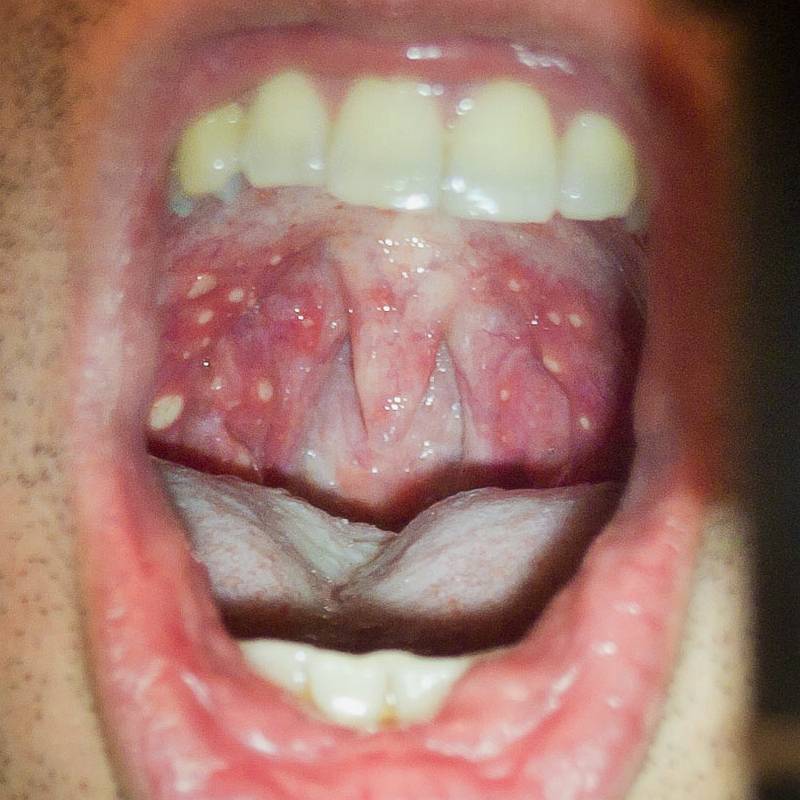
Distinguishing HFMD from other vesicular/exanthematous illnesses
The combination of oral ulcers plus a palm/sole/buttock-distribution rash is genuinely distinctive, but three other conditions are worth actively ruling out, particularly when the presentation is incomplete or the child appears more unwell than typical HFMD would suggest.
| Condition | Cause | Key distinguishing features |
|---|---|---|
| Hand-foot-and-mouth disease | Coxsackievirus A16, enterovirus A71, coxsackievirus A6 (among other enteroviruses) | Oral ulcers plus a rash on the palms, soles, and often the buttocks; low-grade fever; generally well-appearing |
| Herpangina | Also caused by coxsackieviruses — a closely related illness, not a separate virus family | Oral-only involvement — painful ulcers confined to the back of the mouth and throat (soft palate, tonsillar pillars, uvula); no hand/foot/buttock rash; tends to cause a higher, more sudden fever than typical HFMD |
| Varicella (chickenpox) | Varicella-zoster virus | Widespread, intensely pruritic vesicular rash in different stages of healing simultaneously (papule/vesicle/crust), affecting the trunk and scalp as well as extremities — not confined to palms/soles |
| Herpetic gingivostomatitis | Herpes simplex virus (usually type 1), typically a first infection | Sudden, widespread, very painful oral ulcers with diffuse gingival inflammation and a high fever — no palm/sole/buttock rash; a genuinely different, systemic illness from a first HFMD episode |
Risk Factors
- Age is the dominant factor: HFMD mostly affects young children, most often those under 5 years of age and especially those in daycare or preschool settings, though it can occur at any age, including in adults (most often parents or caregivers of an affected child).[3][1]
- Close-contact childcare and school settings are the classic setting for outbreaks, given how efficiently the virus spreads through saliva, shared toys and surfaces, and stool contamination.[3]
- Seasonality: outbreaks are most often described as a summer/fall phenomenon in Canadian sources; international surveillance data more often describes a late-spring/early-summer peak, with a positive correlation between HFMD incidence and warmer, more humid conditions.[3][1]
- Causative strain matters for severity, not just diagnosis: coxsackievirus A16 causes the clear majority of typical, mild Canadian cases, while enterovirus A71 is specifically associated with the rare but more severe neurologic and cardiopulmonary complications discussed under Red Flags/Refer, and coxsackievirus A6 has increasingly been recognized as a cause of more extensive or atypical-appearing rashes.[1]
- Transmission occurs through direct contact with saliva, blister fluid, or stool; through respiratory droplets; and via contaminated hands, shared utensils, or surfaces — all genuinely relevant to the hygiene counselling in Non-Pharmacologic Management.[3][1]
- Immunocompromised status is not a risk factor for acquiring HFMD specifically, but does lower the threshold for medical assessment if a child does become infected (see Special Populations).
Red Flags & Refer
Escalate beyond routine reassurance and OTC symptomatic-care counselling for any of the following:
- Signs of dehydration — noticeably decreased urination, absent tears when crying, a dry mouth or lips, sunken eyes, or lethargy. This is genuinely the most common reason a child with HFMD needs medical evaluation, and it results from painful oral ulcers reducing fluid intake, not from the virus itself.[2]
- High or persistent fever that is not improving with appropriate antipyretic dosing, or a fever that returns after resolving.
- New lethargy, unusual irritability, unsteady gait or ataxia, or myoclonic-type jerking movements (sudden, brief muscle jerks, sometimes most noticeable as a child is falling asleep) — these are the specific warning signs associated with the rare but more severe neurologic complications (encephalitis, acute cerebellar ataxia, aseptic meningitis) seen with enterovirus A71-associated disease; a child with any of these needs urgent medical assessment rather than continued reassurance.[1]
- Rapid or laboured breathing, which can reflect the rare cardiopulmonary complications (myocarditis, pulmonary edema) described with severe enterovirus A71 disease.[1]
- Rare complications to keep in mind, even though this chapter deliberately does not over-emphasize them for the typical benign Canadian presentation: meningitis and encephalitis are specifically named as rare HFMD complications by a Canadian source, and international outbreak data (predominantly from the Asia-Pacific region, and predominantly linked to enterovirus A71) describes an estimated case-fatality rate of roughly 1.7% among identified severe/complicated cases — a figure that reflects specific outbreak strains and settings, not routine Canadian HFMD.[2][1]
- Immunocompromised children — a lower threshold for medical assessment is appropriate given the potential for a more prolonged or severe course.
Assessment & Diagnosis
Diagnosis is clinical
HFMD is diagnosed clinically, based on the characteristic combination of oral ulcers and a palm/sole (often also buttock) rash, together with a compatible history (young child, daycare/school exposure, 3-6 day incubation period). Laboratory testing is not routinely needed.[1]
When testing is actually used
Real-time PCR of a lesion swab can identify coxsackievirus or another enterovirus, and light microscopy of a lesion scraping can help distinguish HFMD from varicella-zoster or herpes simplex virus when the presentation is genuinely ambiguous — but in practice, these tools are reserved for atypical presentations, diagnostic uncertainty, immunocompromised patients, suspected severe/enterovirus A71-type disease, or outbreak/public-health surveillance purposes, rather than for a typical, well-appearing child with the classic distribution.[1] Serology is not a sensitive diagnostic tool but can be used to monitor recovery in specific clinical or research contexts.[1]
Differential diagnosis
See Recognize the Condition for the full herpangina/varicella/herpetic-gingivostomatitis comparison table. In practice, the most useful bedside discriminators are: oral-only involvement (favours herpangina), a widespread pruritic rash in mixed stages of healing across the trunk and scalp (favours varicella), and diffuse gingival inflammation with a high fever and no palm/sole rash (favours herpetic gingivostomatitis).[1]
Treatment Targets
- Provide effective symptomatic relief from fever and oral pain using medications that are actually appropriate for a young child.
- Protect and monitor hydration status as the central practical goal — this is the single factor most likely to determine whether a child needs to be seen medically.
- Avoid genuinely harmful or age-inappropriate self-care choices: aspirin, and topical oral anesthetics used outside their age-appropriate cautions.
- Give accurate, realistic expectations about the self-limited, roughly 7-10 day course.
- Counsel correctly on Canadian daycare/school attendance guidance, rather than defaulting to unnecessarily strict exclusion.
- Reinforce hand hygiene and surface/toy cleaning, given how contagious HFMD is and how long viral shedding in stool continues after symptoms resolve.
- Recognize and escalate the specific red flags — dehydration and the enterovirus A71-type neurologic warning signs — that fall outside routine self-care.
Choose Initial Treatment
Hydration status drives the plan
Eating/drinking reasonably well acetaminophen or ibuprofen at a correct weight-based dose for fever and mouth-pain relief; offer cool, soft, bland foods and fluids and avoid acidic, spicy, or salty foods that irritate the oral ulcers.[4][2] Declining oral intake because of mouth pain prioritize analgesia to enable intake: acetaminophen is appropriate; hold off starting or continuing ibuprofen until intake genuinely improves, since Canadian guidance specifically advises against ibuprofen when a child is not drinking reasonably well.[4] Offer cold fluids, ice chips, or popsicles frequently in small amounts — cold, bland liquids are specifically preferred, and fruit juice should be avoided given its acidity.[3] Signs of dehydration develop despite these measures arrange prompt medical assessment rather than continuing to manage at home — dehydration is the most common complication of this illness.[2]
Medications and products to avoid
Do not use aspirin (acetylsalicylic acid, ASA) to treat a child's fever from HFMD or any other viral illness — this specifically increases the risk of Reye syndrome, a rare but serious condition that can damage the liver and brain.[4] Use caution with topical oral anesthetics for the mouth ulcers: benzocaine oral gels are not authorized for children under 2 years of age in Canada given a risk of methemoglobinemia, and viscous lidocaine 2% has been specifically linked by Health Canada to serious side effects — including seizures, severe brain injury, cardiac effects, and death — in infants and young children, and should not be used for teething or general mouth pain in this age group.[5]
When ibuprofen is an option
Ibuprofen may be used in children 6 months of age and older, at a correct weight-based dose, once oral intake has genuinely stabilized; do not give ibuprofen to infants under 6 months without first speaking to a doctor or health care provider.[4]
Non-Pharmacologic Treatment
Comfort and feeding measures
- Offer cold, soft, bland foods and liquids — yogurt, applesauce, cold soup, milk, ice chips, and popsicles are generally well tolerated; avoid citrus fruit/juice, tomato-based foods, and anything spicy, salty, or crunchy that can irritate the oral ulcers.[3][2]
- Offer fluids frequently in small amounts rather than expecting a child to drink a normal volume at once — this is often the single most effective practical strategy for maintaining hydration through a painful mouth.
- Do not attempt to pop, lance, or otherwise manipulate the skin blisters — they heal better left alone, and manipulating them adds infection risk without any benefit.[2]
- A cool compress can offer comfort for uncomfortable skin lesions if the child tolerates it; loose, breathable clothing avoids friction over the rash.
Hand hygiene and household/childcare hygiene
- Frequent handwashing with soap and water — for the affected child, caregivers, and household or classroom contacts — is the single most effective prevention strategy for limiting HFMD transmission.[1]
- Clean and disinfect commonly touched surfaces and shared toys with soap and water, followed by a disinfecting (e.g., bleach) solution where appropriate.[2]
- Remember that viral shedding in stool continues for weeks after symptoms resolve (up to about 4 weeks per one Canadian source), so hand hygiene — especially after diaper changes and toileting — remains genuinely important even once the rash and fever are gone.[3]
Daycare and school attendance — genuinely permissive Canadian guidance
Routine exclusion from daycare or school is not required for HFMD in Canadian public health guidance: a child may continue to attend if they feel well enough to take part in normal activities, and the risk to other children is limited where reasonable hygiene practices are followed.[2] Two Ontario public health units independently describe the same approach — one specifically notes that routine exclusion is not indicated since this is not a reportable disease, while the other suggests keeping a child home specifically if they are drooling with mouth blisters, or have a weeping (open, draining) rash on the hands, as a practical way to reduce transmission during the most contagious early days, without treating this as a mandatory public-health exclusion. Counsel families accordingly, rather than defaulting to a stricter chickenpox-style exclusion that this illness does not actually call for.
Special Populations
Infants under 6 months
Antipyretic/analgesic options are narrower in this group: acetaminophen can be used at a correct weight-based dose, but ibuprofen should not be given without first speaking to a doctor or health care provider.[4] Because this age group also cannot reliably communicate symptoms, and benzocaine oral products are specifically not authorized under 2 years of age in Canada, non-pharmacologic comfort measures and closer hydration monitoring should be emphasized over reaching for a topical product.[5]
Immunocompromised children
A lower threshold for medical assessment is appropriate — the illness can be more prolonged or, rarely, more severe in this group, and typical reassurance-focused counselling should be adjusted accordingly.
Daycare- and school-age children
This is the population in which HFMD is most often seen and most often transmitted. Reinforce the genuinely permissive Canadian attendance guidance described in Non-Pharmacologic Management, alongside real hand-hygiene and surface-cleaning counselling, since this combination — rather than exclusion — is what Canadian public health sources actually recommend for limiting outbreak spread.[2]
Adults
HFMD can occur at any age, most often in parents or other caregivers of an affected child. Presentation is generally similar to that in children, though atypical or more extensive rashes have increasingly been reported with certain strains such as coxsackievirus A6.[1] The same symptomatic-care principles apply, with aspirin avoidance specifically relevant to children and teenagers rather than adults.
Monitoring & Follow-Up
- Reassess hydration status daily while symptoms are active — reduced urination, absent tears, or increasing lethargy should prompt medical reassessment rather than simply continuing home care.[2]
- Expect resolution of fever, oral ulcers, and rash within about 7-10 days; a course meaningfully longer than this, or a new fever after apparent resolution, should prompt reassessment of the diagnosis rather than assuming a slow but normal course.[3][2]
- Continue hand hygiene and surface/toy cleaning for at least several weeks after symptoms resolve, given ongoing fecal viral shedding — this is a genuinely useful piece of counselling that families often do not expect, since it runs well past the point the child looks and feels well.[3]
- Confirm families understand the specific "watch for" list (dehydration signs; new lethargy, irritability, ataxia, or myoclonic jerking; laboured breathing) rather than leaving follow-up entirely to their own judgment.
- For a family using a topical oral anesthetic despite counselling against it in a young child, confirm they understand correct minimal dosing and the specific warning signs of methemoglobinemia (pale, grey, or bluish skin color; unusual fatigue; shortness of breath) or of lidocaine toxicity (confusion, seizure-like activity), and to seek immediate care if these occur.[5]
Common Errors to Avoid
- Recommending or allowing aspirin for a child's or teenager's fever — this specifically increases Reye syndrome risk and should never be a self-care recommendation for a viral illness.[4]
- Reaching for an OTC benzocaine oral gel in a child under 2 years of age, or viscous lidocaine 2% in any young child, for teething- or HFMD-related mouth pain — both carry specific, genuine safety concerns in this age group.[5]
- Starting or continuing ibuprofen in a child who is not drinking reasonably well, or in an infant under 6 months without medical advice.[4]
- Popping or lancing the skin blisters — this adds infection risk without speeding healing.[2]
- Defaulting to strict, chickenpox-style daycare/school exclusion — Canadian public health guidance for HFMD is genuinely more permissive, and over-restrictive advice is not what current sources recommend.[2]
- Underestimating how much oral pain can reduce a young child's fluid intake — dehydration, not the rash itself, is the most common reason this illness ends up needing medical care.[2]
- Assuming every case is uniformly mild and missing the specific neurologic warning signs (lethargy, ataxia, myoclonic jerking) that would suggest a more severe enterovirus A71-type presentation.[1]
- Ordering or requesting viral testing routinely for a typical, well-appearing child — this is a clinical diagnosis in the great majority of cases.[1]
Clinical Decision Algorithm
Drug Tables
How to use this table: Doses are adult doses and require patient-specific confirmation (renal/hepatic function, weight, allergy history). Pediatric dosing is weight-based per the current product monograph unless stated. Drug pricing is intentionally omitted. Select any drug name to open its complete Pharmasist Drug Database page.
Antipyretics/Analgesics — First-Line Symptomatic Relief
Appropriate for fever and oral-lesion pain at any point in the illness. Hydration status determines whether ibuprofen is appropriate.
| Drug | Dosage | Adverse effects | Drug interactions | Comments |
|---|---|---|---|---|
| Acetaminophen | Children, all ages: Weight-based dosing per the current product monograph, typically every 4-6 hours as needed | Hepatotoxicity with overdose or in significant hepatic impairment | None significant at standard doses | Safer default when oral intake is uncertain; give consistently to support intake rather than only as a last resort. |
| Ibuprofen | Children 6 months and older: Weight-based dosing per the current product monograph, typically every 6-8 hours as needed | GI upset; renal effects with dehydration | Avoid combining with other NSAIDs | Do not give under 6 months without medical advice; only give if the child is drinking reasonably well. |
Topical Oral Comfort Measures — Use With Real Caution in Young Children
Symptomatic relief of painful oral ulcers. Both agents below carry specific, genuine pediatric safety concerns; favour systemic analgesia and non-pharmacologic comfort measures as the first reach in young children.
| Drug | Dosage | Adverse effects | Drug interactions | Comments |
|---|---|---|---|---|
| Benzocaine (oral gel) | Children 2 years and older: Apply per the product label; no more often than directed | Methemoglobinemia — a serious, potentially life-threatening reduction in the blood's oxygen-carrying capacity | None significant at standard topical doses | Not authorized for use in children under 2 years of age in Canada; use only the smallest effective amount, no more often than directed, in older children. |
| Viscous lidocaine 2% | Young children: Not recommended — discuss any pediatric use with a physician or pharmacist first | Seizures, severe brain injury, cardiac effects, and death have been reported in infants and young children with over-dosing or accidental ingestion | Additive risk with other sources of systemic lidocaine exposure | Health Canada specifically advises against use for teething or general mouth pain in infants and young children; not a routine HFMD self-care recommendation in this age group. |
Avoid in Children and Teenagers
A standing pediatric fever-management rule, not specific to HFMD.
| Drug | Dosage | Adverse effects | Drug interactions | Comments |
|---|---|---|---|---|
| Acetylsalicylic acid (ASA / aspirin) | Children and teenagers: Do not use | Reye syndrome — a rare but serious, potentially fatal condition affecting the liver and brain | Not applicable | Never recommend aspirin for a child's or teenager's fever from HFMD or any other viral illness. |
References
- Hand, Foot, and Mouth Disease — StatPearls, NCBI Bookshelf (Rondinelli MI, Bhatt PT, Ondrejka JE, Wilkes DS). StatPearls Publishing, last updated 2024 Jan (Bookshelf ID NBK431082)
- Hand, foot and mouth disease — HealthLinkBC (British Columbia Ministry of Health). HealthLinkBC File
- Hand, foot and mouth disease — Canadian Paediatric Society, Caring for Kids. Canadian Paediatric Society, Caring for Kids
- Fever and temperature taking — Canadian Paediatric Society, Caring for Kids. Canadian Paediatric Society, Caring for Kids
- Summary Safety Review - Viscous Lidocaine 2% - Assessing the Potential Risk of Severe Side Effects in Infants and Young Children — Health Canada, MedEffect Canada. Health Canada, MedEffect Canada Summary Safety Review, published 2016 Aug 29
Professional reference only. Apply clinical judgment and verify patient-specific decisions against current authoritative guidance and product information.