Breast Pain (Mastalgia)
Clinical Snapshot
Mastalgia (breast pain, mastodynia) is extremely common — up to 70% of women experience it at some point in their lives, roughly 30% seek clinical consultation for it, and about a fifth of those describe it as severe.[1] It is classified into three patterns that point toward different causes and different management: cyclical mastalgia (about two-thirds of cases), tied to the menstrual cycle, typically bilateral, diffuse, and worst in the days before a period; non-cyclical mastalgia (about a third of cases), unrelated to the cycle and more often unilateral and localized, with a broader differential that includes breast cysts, mammary duct ectasia, mastitis, and medication effects; and extramammary (chest wall) pain that only feels like it is coming from the breast — costochondritis, Tietze syndrome, intercostal neuralgia, and referred cardiac, pulmonary, or gastrointestinal pain all belong here.[1]
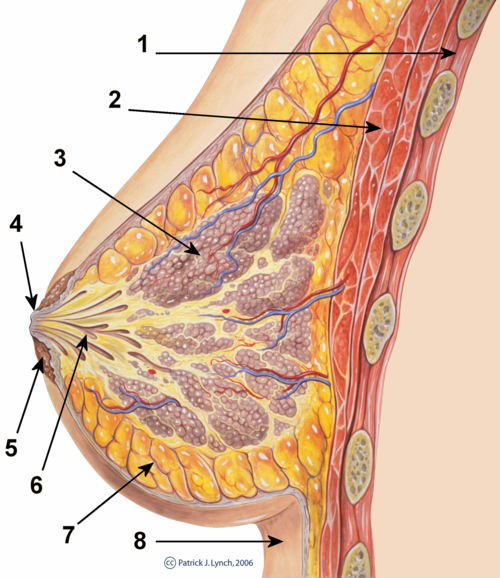
The single most important reassurance point for this chapter: breast pain alone, without a palpable mass, skin change, or nipple discharge, is rarely a symptom of breast cancer — malignancy is found in only about 2-7% of women presenting with mastalgia as their sole complaint, and reassurance itself, once a normal examination has been confirmed, resolves symptoms in a large majority of patients.[1][2] Pharmacists are frequently the first point of contact for this symptom and are well positioned to deliver that reassurance, screen for a medication cause, and counsel on the modest, genuinely evidence-based non-prescription options before anything stronger is considered.
Recognize the Condition
Cyclical mastalgia
Linked to normal hormonal fluctuation across the menstrual cycle — pain typically builds through the luteal phase (progesterone-driven lobular and stromal swelling) and eases with or shortly after the onset of menses.[1] Typical features: bilateral, diffuse, a dull ache or heaviness, often radiating to the axilla or upper arm, frequently with associated breast swelling, nodularity, or tenderness on palpation. It peaks in the 20s-30s, is more common in women who have not yet reached menopause, and usually resolves at menopause.[1][3]
Non-cyclical mastalgia
Unrelated to the menstrual cycle, more often unilateral, localized to a specific area, and constant or erratic rather than following a monthly pattern. It peaks a decade later than cyclical pain (30s-40s) and has a broader structural, inflammatory, and pharmacologic differential — breast cysts, fibroadenomas, mammary duct ectasia, mastitis or breast abscess, macromastia (large, heavy breasts placing tension on the Cooper ligaments), postsurgical or scar-related pain, and medication effects.[1] It generally responds less well to the non-pharmacologic and hormonal measures that work for cyclical pain.
Extramammary (chest wall) pain
Pain that is genuinely musculoskeletal, cardiac, pulmonary, or gastrointestinal but is perceived as coming from the breast. Costochondritis and its localized variant Tietze syndrome (costochondritis with visible swelling at one or more costochondral junctions, most often the 2nd or 3rd rib) are the most common musculoskeletal mimics — pain here is reproduced by direct palpation of the costochondral junction or by chest wall movement, a finding that is not present in true breast tissue pain.[1] Other extramammary sources include intercostal neuralgia, herpes zoster (before the rash appears), pectoralis muscle strain, and referred pain from ischemic heart disease, pleuritis, or gastroesophageal reflux — features suggesting a very lateral or medial location, or pain clearly reproduced by chest wall pressure rather than breast palpation, point away from a true breast cause.[1]
Medications that cause or worsen mastalgia — a pharmacist-specific focus
Recognizing a medication cause is one of the most direct ways a pharmacist adds value in this presentation — before reaching for a treatment, ask what the patient is taking.
- Hormonal contraceptives (combined oral contraceptives, the contraceptive patch or ring, and progestin-only methods) — breast tenderness is a common, usually self-limiting effect in the first few cycles after starting or changing a method.[1]
- Hormone replacement therapy (estrogen, with or without a progestin) — dose-related breast tenderness is a recognized effect, particularly with higher estrogen doses or early in treatment.[1]
- SSRIs and certain antipsychotics — several of these agents (notably the dopamine-antagonist antipsychotics — risperidone, and other first- and second-generation agents to a lesser degree) elevate serum prolactin, and hyperprolactinemia commonly produces breast tenderness and can cause galactorrhea in both sexes; SSRIs are also independently reported to cause breast tenderness.[1][4]
- Spironolactone — its anti-androgenic, mildly estrogenic activity at the mineralocorticoid and androgen receptors produces breast tenderness (mastodynia) and gynecomastia in a dose-related fashion; this is well described even at the doses used for resistant hypertension or heart failure, and is more pronounced than with the more receptor-selective eplerenone.[5]
- Digoxin — a recognized, less common cause of breast tenderness, plausibly related to its structural similarity to steroid hormones.[1]
For any of these, confirm the temporal relationship to the start or dose change of the suspected drug, and weigh a dose reduction, an alternative agent, or simply the reassurance that this is a known, usually self-limiting effect against the reason the drug was started before recommending any change to the prescriber.
Risk Factors
- Premenopausal status — cyclical mastalgia by definition requires an intact menstrual cycle, and most non-cyclical mastalgia also occurs before menopause.
- Age 20-40 years for the peak incidence of clinically significant mastalgia, with cyclical pain peaking earlier (20s-30s) and non-cyclical pain peaking later (30s-40s).
- Recent initiation or dose change of a hormonal contraceptive, hormone replacement therapy, an SSRI, an antipsychotic, spironolactone, or digoxin.
- Macromastia (large, heavy breasts) — mechanical tension on the Cooper ligaments and supporting chest wall structures.
- A poorly fitting or unsupportive bra, including during exercise.
- Underlying anxiety or depression — psychological distress is associated with both higher reported pain severity and reduced response to reassurance alone.
- Pregnancy and lactation, through breast engorgement, milk stasis, and hormonal change.
- Perimenopause, through fluctuating and sometimes erratic hormone levels.
Red Flags & Refer
Breast pain alone, with a normal examination, is not itself a red flag — but any of the following findings on history or examination warrant prompt referral for imaging and/or specialist assessment rather than reassurance and first-line management:
- A new, discrete, palpable mass — pain in this setting does not lower the priority of standard breast-mass workup.
- Skin changes over the breast — dimpling, peau d'orange (thickened, pitted skin resembling an orange peel), erythema, or a new skin retraction.
- Nipple changes — new nipple retraction/inversion, or nipple/areolar skin changes.
- Spontaneous nipple discharge, especially if unilateral, from a single duct, or blood-stained.
- Focal, non-cyclical, persistent pain that does not resolve over one or more menstrual cycles — this pattern specifically warrants dedicated breast imaging rather than reassurance alone, per current Canadian imaging guidance (see Investigations).[6]
- Erythema, warmth, fever, or a tender fluctuant area suggesting mastitis or a breast abscess, particularly peripartum — see Investigations for the imaging pathway if there is no improvement with antibiotics.
- Pain with systemic features (fever, unintended weight loss, or diffuse skin erythema/edema across the breast) — raises concern for inflammatory breast cancer or a significant infection and needs urgent assessment; inflammatory breast cancer is rare but is one of the few breast cancers that classically does present with pain.[1]
- A patient whose pain, despite a normal workup, is not reassured and continues to significantly affect daily function, sleep, sexual activity, or mental health — refer for a structured pain-management or breast-clinic assessment rather than repeating reassurance indefinitely.
Assessment & Diagnosis
History
- Characterize the pain: onset, duration, unilateral or bilateral, focal or diffuse, and its relationship to the menstrual cycle (a pain diary kept across one or two cycles can clarify a genuinely cyclical pattern).[1]
- Ask specifically about a palpable lump, skin change, or nipple discharge — these change the priority of the workup regardless of how the pain itself behaves.
- Take a full medication history, screening specifically for the causes above (hormonal contraceptives, hormone replacement therapy, SSRIs, antipsychotics, spironolactone, digoxin), including any recent start or dose change.
- Ask about reproducibility with chest wall pressure or movement, to help separate true breast pain from a musculoskeletal or other extramammary source.
- Screen for anxiety and mood symptoms, and ask directly about the pain's effect on sleep, exercise, sexual activity, and daily function — this both guides management and identifies a patient who needs more than reassurance alone.
Examination
A bilateral breast examination in good light, covering all quadrants, the nipple-areolar complex, and the axillary, infraclavicular, and supraclavicular lymph node basins, looking specifically for a mass, skin change, nipple retraction, or discharge. Palpate the chest wall separately (with the breast tissue gently displaced) to reproduce or rule out a musculoskeletal source, and correlate the area of maximal tenderness with the patient's own description of where the pain is worst.[1]
Investigations — when imaging is, and is not, indicated
Imaging decisions for mastalgia are guided by whether the pain is cyclical/diffuse or focal/non-cyclical, per the Canadian Association of Radiologists' current (2024) breast imaging referral guideline — a GRADE-based national guideline whose recommendations below carry a strong ("recommend") or conditional ("suggest") grading as marked.[6]
- Cyclical breast pain, intermittent breast pain, or diffuse non-cyclical breast pain — recommend against imaging, beyond the patient's usual age-based screening recommendations (strong recommendation). A normal examination plus this pattern of pain is a genuine indication for reassurance, not investigation.[6]
- Focal, non-cyclical, persistent breast pain, age under 30 — suggest targeted ultrasound as the initial imaging technique (conditional recommendation).[6]
- Focal, non-cyclical, persistent breast pain, age 30 and older — recommend bilateral mammography/digital breast tomosynthesis plus targeted ultrasound as the initial imaging techniques (strong recommendation).[6]
Age-appropriate screening mammography context
Breast pain itself, in the absence of a mass or other red-flag finding, is not a reason to move up or intensify a patient's routine screening schedule — but it is a natural moment to confirm the patient is otherwise up to date. Per the same Canadian guideline's average-risk screening recommendations: screening mammography is not routinely recommended under age 40; for ages 40-49, the decision to begin annual mammography/DBT screening is made through shared decision-making between patient and provider, weighing benefits, risks, and preference; for age 50 and older, mammography/DBT every 1-2 years is recommended, with the frequency and stopping point again individualized through shared decision-making.[6] Confirm the patient knows this is a separate decision from the diagnostic imaging pathway above, which is triggered by the pain pattern itself, not by age.
Treatment Targets
- Confirm, through history and examination, that no red-flag feature (mass, skin change, nipple discharge, focal persistent pain) is present before treating mastalgia as benign.
- Provide clear, specific reassurance once malignancy has been reasonably excluded — this alone resolves symptoms for a large share of patients and should be treated as an active intervention, not a placeholder before "real" treatment.
- Identify and address a medication cause before adding a new treatment on top of it.
- Reduce pain to a level that no longer meaningfully interferes with sleep, exercise, sexual activity, or daily function — complete elimination of cyclical pain is not always achievable and should not be the stated goal.
- Use the lowest-risk effective option first (reassurance and supportive measures, then topical therapy) before escalating to a systemic hormonal agent with a meaningful side-effect burden.
- Set explicit expectations and a time-limited trial for any therapy, given that spontaneous remission is common and most benign mastalgia is self-limiting over months.
Choose Initial Treatment
Stepwise approach
1st line, every patient with a normal exam reassurance that the evaluation shows no evidence of cancer, plus the supportive measures below (a well-fitting, supportive bra; discussing dietary caffeine reduction, evidence for which is weak but the intervention is low-risk) — this resolves symptoms in a large majority of patients and should be delivered explicitly, not assumed.[1][2]
2nd line, pain persisting despite reassurance and support a topical NSAID, applied directly over the painful area — this is the best-evidenced pharmacologic first step, with a favourable safety profile from minimal systemic absorption, and is reasonable for both cyclical and non-cyclical pain.[7][1]
Reasonable adjunct trial evening primrose oil, if the patient wishes to try it — counsel honestly that the best current evidence (a 2021 meta-analysis of 13 randomized trials, 1,752 patients) shows no benefit over placebo, though it is low-risk and some patients still choose it; set a defined stopping point (4-6 months) if there is no improvement.[8][1]
3rd line, specialist-initiated — severe, refractory cyclical or non-cyclical mastalgia tamoxifen or danazol, reserved for pain that is genuinely severe, has persisted for at least 6 months, and has not responded to the measures above — both carry a meaningful adverse-effect burden and are not primary-care or pharmacist-initiated therapies; a pharmacist's role here is counseling on the regimen, side effects, and required monitoring once a specialist has started one.[1][7]
Medication-induced mastalgia
Where a temporal relationship to a hormonal contraceptive, hormone replacement therapy, an SSRI, an antipsychotic, spironolactone, or digoxin is identified (see Recognize the Condition), discuss with the prescriber whether a dose reduction, a formulation/agent switch, or simply continued reassurance (many cases are mild and improve after the first few cycles) is the more appropriate next step, weighed against the reason the drug was started — do not recommend stopping a psychiatric, contraceptive, hormone, or cardiovascular medication solely for mastalgia without that discussion.
Non-Pharmacologic Treatment
- Reassurance — explicitly stating that the clinical evaluation shows no findings suspicious for cancer is itself an effective intervention; a large share of patients with cyclical or diffuse non-cyclical pain and a normal exam improve substantially with reassurance alone.[1][2]
- A well-fitting, supportive bra — a large proportion of women wear an incorrectly sized bra, and proper fitting (including a supportive sports bra during exercise, and consideration of a soft support bra overnight for more severe pain) is a genuinely low-risk, reasonable first recommendation, particularly for macromastia-related or exercise-related pain.[1]
- Caffeine and dietary fat reduction — commonly counseled and low-risk, but the trial evidence for methylxanthine (coffee, tea, chocolate, cola) restriction and reduced dietary fat intake improving mastalgia is inconsistent and generally weak; frame this to patients as "reasonable to try, not proven," not as an established remedy.[1][3]
- Regular physical activity in a supportive bra — proposed to help through an endorphin-mediated mechanism; evidence is limited, but the intervention itself has broad health benefit independent of mastalgia.[1]
- Relaxation techniques (yoga, meditation, structured relaxation therapy) — may help by reducing the anxiety that amplifies perceived pain severity; evidence is limited but the risk is minimal.[1]
- Evening primrose oil and vitamin E — frequently used and low-risk, but current best evidence (a 2021 meta-analysis of 13 RCTs) shows no benefit over placebo for evening primrose oil; counsel accordingly rather than actively recommending it, while not discouraging a patient who wants a low-risk trial with a defined stopping point.[8]
- For a musculoskeletal (chest wall) pain pattern specifically — heat, gentle stretching, and standard musculoskeletal analgesia are more appropriate than breast-directed therapy; confirm the diagnosis with reproducible chest wall tenderness before treating it as such.
Special Populations
Pregnancy
Breast tenderness and fullness are common, expected features of early pregnancy from rapid hormonal change and glandular proliferation, and generally need only reassurance and a well-fitting supportive bra. New focal, persistent, or unilateral pain in pregnancy still warrants the same red-flag assessment as in a non-pregnant patient — pregnancy does not lower the priority of investigating a genuine focal finding. Tamoxifen and danazol are contraindicated in pregnancy.
Breastfeeding (lactation)
Engorgement, milk stasis, and nipple trauma are the most common causes of breast pain in this setting and are managed with lactation-specific measures (effective latch, frequent feeding/expression, cool or warm compresses as appropriate) rather than the general approach in this chapter. Mastitis and breast abscess need their own assessment and antibiotic pathway (imaging is added specifically if there is no clinical improvement after antibiotics for suspected mastitis).[6] Topical diclofenac should be applied away from the nipple/areola and wiped off before feeding if used during lactation; tamoxifen and danazol are not appropriate choices while breastfeeding.
Perimenopause and menopause
Cyclical mastalgia typically eases and resolves as periods become irregular and stop, though perimenopausal hormonal fluctuation can itself produce erratic, less predictable breast pain in the transition. New breast pain presenting for the first time after true menopause is not typical cyclical mastalgia and should prompt a more careful non-cyclical/red-flag assessment, particularly if the patient is on hormone replacement therapy.
Patients on hormone replacement therapy
Dose-related breast tenderness is expected, especially in the first few months or with a higher estrogen dose. Reasonable options before stopping therapy altogether include reassurance through an expected adjustment period, a lower-estrogen-dose formulation, or a transdermal route — discuss any change with the prescriber given the reason HRT was started.[1]
Adolescents
Breast pain and tenderness during breast development (thelarche) and early menstrual cycles is common and typically needs only reassurance; malignancy is exceedingly rare in this age group, and the same red-flag findings (mass, skin change, discharge) still warrant assessment if present.
Renal and hepatic impairment
Use topical and oral NSAIDs cautiously, or avoid, in significant renal impairment given the risk of NSAID-related renal injury even with topical use in a patient with reduced renal reserve. Danazol and tamoxifen are hepatically metabolized — use with caution and specialist input in significant hepatic impairment.
Monitoring & Follow-Up
For cyclical or diffuse mastalgia managed with reassurance and supportive measures, no specific follow-up test is needed — arrange a follow-up conversation (in person or by phone) in 1-2 menstrual cycles to confirm the pain is improving as expected and that no new red-flag feature has developed. Because most benign mastalgia resolves spontaneously over months to a few years, a patient whose pain is stable or improving does not need escalating therapy simply because it has not disappeared entirely.
- For a topical NSAID trial, reassess at 2-4 weeks; if there is no meaningful improvement, this is the point to reconsider the diagnosis (has a red-flag feature been missed?) and, if appropriate, discuss referral for a specialist-initiated hormonal option.
- For a patient on tamoxifen or danazol, confirm they remain under active specialist follow-up for the specific monitoring each requires (for example, VTE and endometrial symptoms with tamoxifen; lipid and liver monitoring with danazol) — this chapter's role is counseling and adherence support, not initiating or independently managing that monitoring.
- For suspected medication-induced mastalgia, follow up after any dose or agent change to confirm the pain has actually improved before attributing ongoing pain to something else.
- Document the pattern (cyclical, non-cyclical, or extramammary), what has been tried, and what response was seen, so escalation decisions are not repeated unnecessarily at a later visit.
Common Errors to Avoid
- Ordering or requesting diagnostic imaging for typical cyclical or diffuse non-cyclical breast pain with a normal examination — current Canadian imaging guidance specifically recommends against this, beyond the patient's usual age-based screening.
- Treating breast pain as a likely cancer symptom and building the counseling conversation around ruling out malignancy, rather than leading with the accurate reassurance that pain alone, without a mass or other red-flag finding, is rarely cancer-related.
- Missing a straightforward medication cause (a hormonal contraceptive, hormone replacement therapy, an SSRI, an antipsychotic, spironolactone, or digoxin) by not asking a focused medication history before reaching for a new treatment.
- Recommending or reinforcing evening primrose oil as an evidence-based treatment — current meta-analysis evidence shows no benefit over placebo; it is reasonable as a low-risk patient choice, not as a recommended therapy.
- Suggesting tamoxifen or danazol, or implying they are reasonable first steps, rather than recognizing them as specialist-initiated options reserved for severe, refractory disease given their adverse-effect burden.
- Treating a discrete, reproducible chest wall tenderness (costochondritis/Tietze syndrome) as breast pain and pursuing breast-directed workup or treatment instead of a musculoskeletal approach.
- Missing a red flag by attributing a new mass, skin change, or nipple discharge to "just mastalgia" because the patient already has a known pattern of benign breast pain.
- Recommending a patient stop a psychiatric, contraceptive, hormonal, or cardiovascular medication solely for mastalgia without involving the prescriber in that decision.
- Leaving reassurance implicit rather than stating explicitly that the evaluation shows no findings of concern — this is itself a large part of what makes reassurance effective.
Clinical Decision Algorithm
Drug Tables
How to use this table: doses are adult doses and require patient-specific confirmation, including renal/hepatic adjustment. Select any drug name to open its complete Pharmasist Drug Database page.
Topical and Oral Analgesics — First-Line Pharmacotherapy
Try a topical NSAID before an oral one for a localized symptom, given minimal systemic absorption.
| Drug | Dosage | Adverse effects | Drug interactions | Comments |
|---|---|---|---|---|
| Diclofenac diethylamine gel | Adults: Apply a thin layer 3-4 times daily per product labeling | Local skin irritation, rash; minimal systemic NSAID exposure at recommended topical use | Low systemic absorption limits interaction risk, but avoid combining with an oral NSAID without reason | Apply directly over the painful area; avoid broken skin, the nipple/areola during breastfeeding, and application under an occlusive dressing. |
| Ibuprofen | Adults: 200-400 mg PO every 6-8 hours PRN, per product labeling | GI upset/bleeding, renal impairment, fluid retention, cardiovascular risk with regular use | Increased bleeding risk with anticoagulants/antiplatelets; may reduce antihypertensive/diuretic efficacy; avoid combining with another NSAID | Reasonable if topical therapy is impractical or insufficient; use the lowest effective dose for the shortest duration. |
| Acetaminophen | Adults: 500-1000 mg PO every 6 hours PRN, maximum 4 g/day (lower in hepatic impairment) | Hepatotoxicity with overdose or in significant hepatic impairment | None significant at standard doses | A reasonable NSAID-sparing option, particularly if NSAIDs are contraindicated. |
Specialist-Initiated Hormonal Therapy — Severe Refractory Mastalgia Only
Reserved for pain that is severe, has persisted 6 months or more, and has not responded to reassurance, supportive measures, and topical/oral analgesia. Not a pharmacist- or primary-care-initiated therapy — confirm active specialist follow-up before counseling a patient already started on either agent.
| Drug | Dosage | Adverse effects | Drug interactions | Comments |
|---|---|---|---|---|
| Tamoxifen | Adults: 10-20 mg PO daily, generally for no more than 6 months | Hot flashes, nausea, menstrual irregularity, venous thromboembolism, endometrial hyperplasia/cancer risk, cataracts, mood changes | CYP2D6 inhibitors (e.g., paroxetine, fluoxetine, bupropion) may reduce conversion to the active metabolite and blunt efficacy; increased INR with warfarin | Most effective prescription option in trial data; courses are generally limited to 6 months given the adverse-effect burden; confirm effective non-hormonal contraception if premenopausal. |
| Danazol | Initial: 200 mg PO daily during the luteal phase Maintenance: Reduce to 100 mg PO daily once improved | Weight gain, menstrual irregularity, hot flashes, acne, voice deepening (can be irreversible), androgenic effects, hepatotoxicity with prolonged use | May increase levels of warfarin (increased INR), insulin/oral hypoglycemics (altered glucose control), and cyclosporine | Contraindicated in pregnancy, lactation, and thromboembolic disease; confirm effective non-hormonal contraception given teratogenic risk; taper dose once symptoms improve. |
Low-Risk, Weakly-Evidenced Adjunct
Reasonable for a patient who wants to try a low-risk option, with honest counseling that current evidence does not show benefit over placebo.
| Drug | Dosage | Adverse effects | Drug interactions | Comments |
|---|---|---|---|---|
| Evening primrose oil | Adults: Per product labeling | GI upset, headache; rare interaction with anticoagulants/antiplatelets (theoretical, from linoleic acid content) | Theoretical additive bleeding risk with anticoagulants/antiplatelets | A 2021 meta-analysis of 13 randomized trials (1,752 patients) found no benefit over placebo; set a defined 4-6 month stopping point if used. |
References
- Mastalgia — StatPearls [Internet], StatPearls Publishing (Tahir MT, Vadakekut ES, Shamsudeen S). StatPearls, updated 2025-02-06
- Breast pain — Canadian Cancer Society. cancer.ca, accessed 2026
- Breast Pain (Mastalgia) — HealthLink BC, British Columbia Ministry of Health. HealthLink BC, accessed 2026
- Psychotropic-induced hyperprolactinemia: a clinical review — Psychosomatics (Ajmal A, Joffe H, Nachtigall LB). Psychosomatics 2014;55(1):29-36
- Eplerenone Versus Spironolactone in Resistant Hypertension: an Efficacy and/or Cost or Just a Men's Issue? — Current Hypertension Reports (Manolis AA, Manolis TA, Melita H, Manolis AS). Curr Hypertens Rep 2019;21(3):22
- Canadian Association of Radiologists Breast Disease Imaging Referral Guideline — Canadian Association of Radiologists Journal (Hamel C, Avard B, Flegg C, Freitas V, Hapgood C, Kulkarni S, Lenkov P, Seidler M). Can Assoc Radiol J 2024;75(2):287-295
- A systematic review of current understanding and management of mastalgia — Indian Journal of Surgery (Kataria K, Dhar A, Srivastava A, Kumar S, Goyal A). Indian J Surg 2014;76(3):217-222
- A Systematic Review and Meta-Analysis of the Efficacy of Evening Primrose Oil for Mastalgia Treatment — International Journal of Environmental Research and Public Health (Ahmad Adni LL, Norhayati MN, Mohd Rosli RR, Muhammad J). Int J Environ Res Public Health 2021;18(12):6295
- Practice Bulletin No. 164: Diagnosis and Management of Benign Breast Disorders — American College of Obstetricians and Gynecologists. Obstet Gynecol 2016;127(6):e141-e156
Professional reference only. Apply clinical judgment and verify patient-specific decisions against current authoritative guidance and product information.