Measles
Clinical Snapshot
Measles is caused by the measles (rubeola) virus, a member of the Paramyxoviridae family, and remains one of the most highly communicable infectious diseases known, with a secondary attack rate exceeding 90% among susceptible household contacts.[1] It spreads through the air via inhalation of infectious respiratory particles — which can remain suspended for up to 2 hours after an infected person has left a space — and through direct contact with infectious nasal or throat secretions; less commonly it spreads via contaminated surfaces or objects.[1] The illness follows a genuinely distinctive timeline: a several-day prodrome of fever, cough, coryza, and conjunctivitis, the pathognomonic enanthem of Koplik spots appearing 2-3 days after symptom onset, and finally a generalized maculopapular rash that begins on the face and spreads cephalocaudally to the trunk and limbs.[1]
This chapter is being authored against the backdrop of a genuinely active Canadian outbreak. After achieving and sustaining measles elimination status since 1998, Canada recorded more than 5,200 measles cases in 2025 in a multi-jurisdictional outbreak that began in New Brunswick in October 2024 and spread through Ontario, Alberta, Manitoba, British Columbia, and Quebec — and in November 2025, the Pan American Health Organization confirmed that Canada had lost its measles elimination status after more than 12 months of sustained transmission of the same virus strain.[2] Every pharmacist has a genuinely active role in the current environment: recognizing suspected cases, understanding airborne isolation and reporting obligations, navigating time-critical post-exposure prophylaxis windows, and closing immunization gaps before the next exposure occurs.
Measles is nationally notifiable in Canada, and health care providers are required to report suspected cases to their local public health authority on an urgent basis — without waiting for laboratory confirmation.[1] There is no specific antiviral treatment; management is entirely supportive, with vitamin A supplementation considered for children with acute measles per World Health Organization guidance. The real clinical priority is preventing transmission through airborne precautions and prompt isolation, and identifying complications early, since the disease carries genuine risk of otitis media, pneumonia, encephalitis, and — rarely, but devastatingly — the fatal, delayed complication of subacute sclerosing panencephalitis (SSPE).[1]
Recognize the Condition
Incubation period and the phases of illness
The incubation period from exposure to the onset of prodromal symptoms averages about 10 days, ranging from 7 to 18 days; the interval from exposure to rash onset averages 14 days and can extend as late as 21 days.[1][3]
| Phase | Typical timing | Features |
|---|---|---|
| Incubation | Exposure to symptom onset (average 10 days; range 7-18 days) | Asymptomatic — virus replicating in respiratory epithelium and regional lymph nodes |
| Prodrome | Begins 7-21 days after exposure; lasts a few days before the rash appears | Fever, malaise, cough, coryza, and conjunctivitis — the classic combination that should raise suspicion together with a compatible exposure history |
| Enanthem | 2-3 days after symptom onset, typically just before the rash | Koplik spots — irregularly-shaped, bright red spots, often with a bluish-white central dot, on the buccal mucosa. Pathognomonic for measles and classically precedes the rash |
| Exanthem (rash) | About 14 days after exposure, or 3-7 days after prodromal symptoms begin; lasts 4-7 days | Generalized maculopapular rash beginning on the face, then advancing to the trunk and finally the arms and legs, becoming confluent (red and blotchy) at its peak in more severe cases; resolves with a fine desquamation that can be more pronounced on darker skin tones |
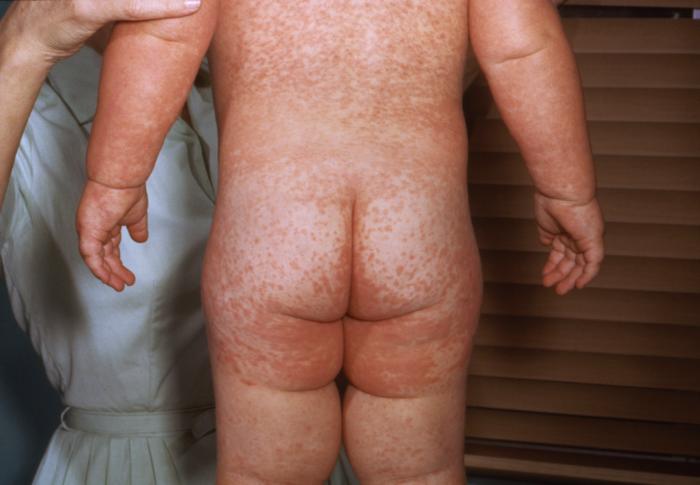
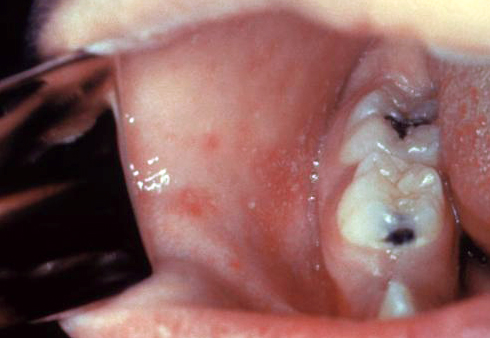
Atypical presentations — do not let a mild illness or an absent rash lower suspicion
Two genuinely important atypical patterns can present without the classic picture above:
- Breakthrough (modified) measles — a positive test with a history of vaccination at least 14 days prior, or previous serologic evidence of immunity. Generally milder, with less fever, cough, coryza, or conjunctivitis than a primary infection — but the person is still contagious and the case is still reportable.[1]
- Immunocompromised patients — often present with more severe disease, and may present without a rash at all, or with an atypical rash. This is precisely the group most likely to be missed if a rash is treated as a diagnostic requirement.[1]
Differential diagnosis
| Condition | Key distinguishing features from measles |
|---|---|
| Rubella | Milder prodrome, a fainter and faster-resolving (typically 3-day) rash, prominent posterior auricular/suboccipital lymphadenopathy, and no Koplik spots |
| Roseola infantum (sixth disease) | High fever for 3-5 days that resolves abruptly just as a faint, non-confluent rash appears — the sequence is reversed compared with measles, where fever and prodrome precede the rash by days |
| Scarlet fever | A fine, sandpaper-textured rash with circumoral pallor and strawberry tongue, accompanying streptococcal pharyngitis rather than a viral coryzal prodrome |
| Parvovirus B19 (fifth disease) | A "slapped cheek" facial erythema followed by a lacy, reticular rash on the extremities; minimal prodrome and no Koplik spots |
| Kawasaki disease | Fever ≥5 days plus mucocutaneous features, but with bilateral non-exudative conjunctivitis, strawberry tongue/cracked lips, and extremity changes rather than a cephalocaudally-spreading exanthem, and no Koplik spots or coryza-dominant prodrome |
| Drug hypersensitivity reaction | Rash timing linked to a new medication rather than a viral prodrome; no Koplik spots; systemic viral symptoms typically absent or mild |
| Mpox | A more nodular/vesiculopustular rash evolving through defined stages, often with lymphadenopathy, rather than a flat-to-slightly-raised maculopapular exanthem |
Risk Factors
- Unvaccinated or incompletely vaccinated status is the dominant risk factor — among Canadian measles cases reported between 2015 and 2024 with known vaccination status, the large majority (72%) were unvaccinated.[4]
- Age under 5 years, and particularly infants under 12 months — Canadian surveillance from this same period found the highest measles rate was in infants under 1 year of age (0.8 cases per 100,000).[4]
- International travel to, or contact with a traveller returning from, a region with ongoing measles transmission — most Canadian cases and outbreaks originate this way, since Canada has no endemic transmission of its own outside of active outbreak periods.[1]
- Household or other close, prolonged contact with a case — measles transmission occurs more frequently after exposures at close distance or for a prolonged period, such as sharing a home or a classroom, though transient or more distant exposures can also transmit the virus.[3]
- Healthcare, childcare, school, congregate living, or workplace settings during an active outbreak, given the ease of airborne spread in enclosed indoor spaces.[3]
- Pregnancy — with distinct maternal and fetal complication risks described in Special Populations.[4]
- Immunocompromising conditions — both a risk factor for infection in the unimmunized or under-protected, and a risk factor for atypical, more severe disease if infection occurs.[1]
- Living in a community or region where vaccination coverage has fallen below the roughly 95% threshold needed for herd immunity — this is explicitly identified as a current risk in parts of Canada despite generally high national coverage.[1]
- Birth year and country of birth inform, but do not guarantee, presumed natural immunity: in Canada, those born before 1970 are generally presumed immune due to high measles circulation before routine vaccination, though this cutoff differs by country (1957 in the United States) and does not apply to individuals in higher-risk roles such as healthcare workers, who should have documented 2-dose immunity regardless of birth year.[1][4]
Red Flags & Refer
Escalate beyond routine reassurance and supportive-care counselling for any of the following:
- Any suspected case at all — report immediately to the local public health authority; do not wait for laboratory results before reporting, and call ahead before bringing a suspected case into a pharmacy, clinic, or emergency department waiting area so airborne precautions can be arranged before arrival.[1]
- Signs suggesting encephalitis — new lethargy or irritability out of proportion to the illness, seizure, or altered level of consciousness. Encephalitis occurs in roughly 1 of every 1,000 reported measles cases and can cause permanent neurologic sequelae — this is an emergent referral, not a "monitor at home" situation.[1]
- Respiratory distress or signs of pneumonia — laboured or rapid breathing, hypoxia, or a markedly worsening cough. Respiratory failure is a leading cause of measles-related death.[1]
- Any pregnant patient with a suspected exposure or confirmed infection — measles in pregnancy carries real risk of pneumonitis, hepatitis, and premature labour for the pregnant person, and low birth weight, spontaneous abortion, or congenital measles for the infant; involve obstetrics and infectious disease promptly.[1][4]
- An immunocompromised patient with fever and a known exposure, even without a classic rash — an atypical or absent rash is expected in this group and should not be reassuring.[1]
- An infant under 12 months with a suspected exposure or infection, given the narrower post-exposure prophylaxis options and generally higher vulnerability in this age group.[4]
- A breakthrough (modified, milder) case in a healthcare worker or other high-contact role — still infectious and still reportable, regardless of vaccination history.[1]
Assessment & Diagnosis
National case classification
Measles case status is defined by the following classification, applied by public health following notification.
| Case classification | Definition |
|---|---|
| Laboratory-confirmed case | Laboratory confirmation by PCR detection of measles virus RNA, viral isolation, seroconversion/a significant (e.g. fourfold) rise in IgG titre between acute and convalescent sera, or a positive IgM result in a person with compatible clinical illness who is epidemiologically linked to a confirmed case or to an area/community with known measles activity |
| Clinically-confirmed case | Compatible clinical illness in a person with an epidemiologic link to a laboratory-confirmed case |
| Probable case | Compatible clinical illness, in the absence of appropriate laboratory testing and without an epidemiologic link to a laboratory-confirmed case, in a person linked to an area/community with known measles activity or to a clinically-confirmed case |
[5] The clinical illness required for these definitions is fever together with at least one of cough, coryza, or conjunctivitis, plus a generalized maculopapular rash; clinical judgment should be applied more flexibly for breakthrough or immunocompromised cases, who may not present this classically.[5]
Laboratory testing — collect specimens promptly, but never let testing delay reporting or isolation
When measles is suspected, collect a nasopharyngeal or throat swab for PCR viral detection, a urine specimen for PCR, and blood for serology as soon as possible — viral detection supports diagnosis, genotyping to help trace the source of infection, and the surveillance needed to monitor measles elimination status.[1] IgM serology can be falsely negative if collected less than 3 days after rash onset; if an early specimen tests negative and suspicion remains, a second serum specimen collected more than 3 days after rash onset should be sent for retesting.[5] Serologic testing is not recommended to check susceptibility before vaccination or response after vaccination.[1] Recent MMR immunization can itself cause fever with or without a mild rash, typically 6-23 days after the dose — vaccine strain can be distinguished from wild-type virus by genotyping, and vaccination history should be considered when interpreting an ambiguous presentation.[5]
Reporting is not optional and does not wait for lab confirmation
Measles is nationally notifiable. Health care providers are required to report suspected cases to their local public health authority on an urgent basis and should not wait for laboratory results before doing so — specimen collection and reporting proceed in parallel.[1]
Treatment Targets
- Prevent onward transmission through prompt isolation, airborne precautions, and rapid public health reporting — the single most protective action available once measles is suspected, given how efficiently this virus spreads.[1]
- Provide effective supportive symptomatic care, since no specific antiviral treatment for measles exists.[1]
- Identify vitamin-A-eligible patients and dose correctly per World Health Organization guidance, to reduce the severity of complications and mortality risk.[1][6]
- Detect and manage complications early — otitis media, pneumonia, encephalitis, and dehydration — rather than assuming a uniformly mild course.
- Deliver time-critical post-exposure prophylaxis (MMR vaccine within 72 hours, or immunoglobulin within 6 days) to eligible susceptible contacts, matched correctly to age, pregnancy, and immunocompromise status.[4]
- Support routine and catch-up MMR vaccination to close immunity gaps, and correct common counselling misconceptions, particularly during active outbreak periods.
- Meet public-health reporting and contact-management obligations promptly and completely, rather than treating them as optional once a diagnosis feels clinically obvious.
Choose Initial Treatment
Active infection: supportive care is the entire treatment
Every confirmed or strongly suspected case: isolate immediately using airborne precautions (see Non-Pharmacologic Treatment), report to public health without delay, and manage supportively — acetaminophen or ibuprofen at a correct age/weight-based dose for fever and malaise, and adequate oral hydration. There is no specific antiviral therapy for measles.[1]
Vitamin A: consider vitamin A supplementation for children diagnosed with acute measles, since vitamin A deficiency is linked to delayed recovery and greater measles complications, and measles infection can itself precipitate a deficiency. The World Health Organization recommends 2 doses on consecutive days, dosed by age:
- Under 6 months: 50,000 IU once daily for 2 days
- 6-11 months: 100,000 IU once daily for 2 days
- 12 months and older: 200,000 IU once daily for 2 days
A third, age-specific dose is given 2-6 weeks later specifically to children with clinical signs and symptoms of vitamin A deficiency. Two doses of 200,000 IU vitamin A reduced measles mortality risk by roughly 64% compared with placebo in the evidence underlying this recommendation.[6][1]
Post-exposure prophylaxis for susceptible contacts — genuinely time-critical
For a contact who does not meet the criteria for expected measles immunity (see Risk Factors), the correct product and timing depend on time since exposure and the contact's age, pregnancy status, and degree of immunocompromise. A measles-containing vaccine is expected to be effective when given within 72 hours of exposure; immunoglobulin (Ig) can be given up to 6 days after exposure and is used where vaccine is not appropriate or the 72-hour window has passed for someone at meaningfully higher risk. MMR vaccine and immunoglobulin should never be given at the same visit — Ig blunts the vaccine's immune response.[4]
| Population | Recommended measles PEP strategy |
|---|---|
| Infants under 6 months | IMIg 0.5 mL/kg IM (maximum 15 mL, over multiple injection sites), as soon as possible and within 6 days of exposure — MMR vaccine is not used at this age |
| Unvaccinated, immunocompetent infants 6 to under 12 months | MMR vaccine as soon as possible if within 72 hours of exposure; IMIg 0.5 mL/kg IM (maximum 15 mL) if 73 hours to 6 days have passed. Two further doses of a measles-containing vaccine, given at least 4 weeks apart after 12 months of age, are still required for long-term protection |
| Immunocompetent individuals 12 months and older without expected immunity | MMR vaccine as soon as possible. A measles-containing vaccine is not known to protect once more than 72 hours have passed, but should still be given without delay for long-term protection rather than withheld |
| Pregnant, unvaccinated or known measles-IgG-negative | IVIg 400 mg/kg IV, as soon as possible and within 6 days of exposure (serologic testing is not required first). MMR vaccine is contraindicated in pregnancy — administer it postpartum instead |
| Severely immunocompromised (e.g. within 12 months of allogeneic or autologous HSCT, CAR-T therapy within 12 months, HIV with CD4 <200 cells/mm3, significant primary immunodeficiency, or high-dose immunosuppressive therapy) | IVIg 400 mg/kg IV if >30 kg, or IMIg 0.5 mL/kg IM if ≤30 kg, as soon as possible and within 6 days of exposure — regardless of prior vaccination history |
If immunoglobulin is given, MMR vaccination must be deferred afterward — not given at the same visit, and not given too soon after. Per the Canadian Immunization Guide, the standard deferral interval is 6 months after IMIg 0.5 mL/kg, or 8 months after IVIg 400 mg/kg, before a measles-containing vaccine will produce a reliable immune response.[7] See Monitoring & Follow-Up to ensure this deferred dose is actually tracked and completed rather than lost to follow-up.
Non-Pharmacologic Treatment
Isolation of confirmed or suspected cases
- Isolate immediately using airborne precautions once measles is suspected — this is the single highest-value action available, given the virus's extraordinarily high transmissibility.[1]
- Home isolation for a confirmed or strongly suspected case should continue for 4 days after rash onset (with the first day of rash counted as day zero); for a person who does not develop a rash, isolate for 10 days after first symptom onset.[1]
- Immunocompromised patients, with or without a rash, may have prolonged viral shedding and can remain contagious for the entire duration of their illness — extend isolation accordingly on public health direction rather than applying the standard timeline automatically.[1]
Airborne precautions in healthcare and pharmacy settings
- Use an airborne infection isolation room (a negative-pressure room) where available, and a fit-tested N95 (or equivalent or higher) respirator for anyone caring for a patient with suspected or confirmed measles — regardless of that health care worker's own immunization or immunity status.[1]
- Only staff with presumptive immunity should enter the room of a patient with suspected or confirmed measles where this can be arranged.[1]
- Call ahead before a suspected case arrives at a pharmacy, clinic, or emergency department, so airborne precautions can be set up before the patient enters a shared waiting area — this is exactly how airborne outbreaks propagate in healthcare settings when skipped.[1]
Contact management
- A contact is defined as anyone who shared a space with a probable or confirmed case during that case's infectious period, or who entered an enclosed indoor space within 2 hours after the case left it.[3]
- Contacts who do not meet criteria for expected immunity should self-monitor for symptoms from 5 days after their first exposure to 21 days after their last exposure to the case, regardless of whether they received post-exposure prophylaxis, and should isolate immediately and contact their health care provider or local public health authority if symptoms develop.[3]
- At public health's discretion, these same contacts may be excluded from daycare, school, or work for that same window (5 days after first exposure to 21 days after last exposure), or until 4 days after rash onset if they go on to develop measles.[3]
- Advise contacts who do not meet expected-immunity criteria to avoid contact with others who also lack expected immunity or who are at high risk of complications, and to wear a well-fitting mask in shared indoor spaces or when accessing public spaces for essential reasons such as seeking medical care.[3]
General supportive care
- Adequate fluids and rest; a cool, dim environment can help with the photophobia that often accompanies measles-related conjunctivitis.
- Reinforce hand hygiene, though airborne transmission — not surfaces — is this virus's dominant transmission route.[1]
- Support timely public health contact tracing, including providing accurate information about the case's own recent contacts and locations.
Special Populations
Infants under 12 months
This is the age group with the narrowest post-exposure prophylaxis options and, per recent Canadian surveillance, the highest measles rate of any age group (0.8 cases per 100,000 among infants under 1 year).[4] Infants under 6 months are not candidates for MMR vaccine — placentally transferred maternal antibody wanes over the first several months of life, and vaccine effectiveness/safety has not been established this young, so immunoglobulin is the only PEP option.[4] During an active outbreak, MMR vaccine may be given as early as 6 months of age; if given between 6 and under 12 months, 2 further doses after the child turns 12 months old (at least 4 weeks apart) are still required for durable, long-term protection.[1]
Pregnancy
MMR vaccine is generally contraindicated in pregnancy given a theoretical risk to the fetus, though inadvertent immunization is not itself grounds for recommending termination of pregnancy.[4] For a pregnant contact who is unvaccinated or known to be measles-IgG-negative, IVIg 400 mg/kg IV within 6 days of exposure is the recommended strategy, with MMR vaccination deferred to the postpartum period.[4] Measles infection during pregnancy carries real risk: pneumonia, hepatitis, and death for the pregnant person, and low birth weight, premature labour, spontaneous abortion, or congenital measles (which can itself cause pneumonia, encephalitis, and death in the infant).[1]
Immunocompromised patients
Current Canadian guidance stratifies immunocompromised contacts into three risk tiers rather than treating "immunocompromised" as a single category. Individuals with an absent or near-absent immune system — for example within 12 months of allogeneic HSCT or CAR-T therapy, active acute lymphoblastic leukemia treatment, HIV with a CD4 count under 200 cells/mm3, or a significant primary immunodeficiency — are treated as susceptible to measles regardless of prior vaccination history, and should receive Ig-based PEP within 6 days of any exposure without waiting on serology.[4] Those with a more moderate degree of immunocompromise may retain measles antibody-mediated protection from earlier vaccination or infection; specialist consultation and rapid serologic testing (where results are available within 24 hours) can help target Ig appropriately in this group.[4] Those with only low-level immunocompromise, for whom a measles-containing vaccine is not contraindicated, are managed using the same expected-immunity criteria as immunocompetent contacts. Clinically, immunocompromised patients who do become infected often have more severe disease and may present without a rash at all, or with an atypical rash — a genuinely dangerous pattern to miss — and may remain contagious for the full duration of their illness rather than the standard 4-day post-rash window.[1]
Healthcare workers
A fit-tested N95 (or equivalent or higher) respirator is required when caring for a patient with suspected or confirmed measles regardless of the health care worker's own immunization or immunity status, and only staff with presumptive immunity should enter the patient's room where this can be arranged.[1] Given their elevated occupational exposure risk and their potential to spread infection to vulnerable patients, health care workers should maintain documented 2-dose MMR immunity (or other evidence of expected immunity) regardless of birth year, rather than relying on the general pre-1970 presumption used for the broader Canadian population.[1][4]
Travellers and newcomers to Canada
Presumptive immunity based on birth year is country-specific: the pre-1970 cutoff applies within Canada, but a 1957 cutoff applies for those born in the United States, and many other countries achieved measles elimination after 1970 or have not yet achieved it at all, so country of birth should be considered when this information is available.[4] Recommend catch-up MMR vaccination before travel to any region with ongoing measles transmission, and for anyone newly arrived in Canada with an uncertain or incomplete immunization record.[1]
Monitoring & Follow-Up
- Confirmed or suspected cases: monitor through the full infectious period — 4 days after rash onset, or 10 days after symptom onset if no rash develops — watching specifically for the respiratory and neurologic red flags described above; immunocompromised patients may remain contagious for the entire illness and need individualized public-health direction on when isolation can end.[1]
- Contacts: self-monitor for symptoms from 5 days after first exposure to 21 days after last exposure to the case, regardless of whether post-exposure prophylaxis was given; public health may also conduct active monitoring when feasible.[3]
- After immunoglobulin-based PEP: routine MMR vaccination must still be completed, but only after the correct deferral interval — 6 months after standard IMIg (0.5 mL/kg), or 8 months after IVIg (400 mg/kg) — since giving MMR too soon after Ig blunts the vaccine response. Document and actively schedule this deferred dose rather than leaving it to the patient to remember.[7]
- Confirm that anyone who received MMR-based PEP before 12 months of age, or who has received only 1 dose earlier in infancy, goes on to complete the full 2-dose series (at least 4 weeks apart, after 12 months of age) — a single early dose is not considered adequate for long-term protection.[1][4]
- From a public health perspective, an outbreak is not considered concluded until at least 46 days after the rash-onset date of the last outbreak-associated case, reflecting the maximum measles incubation period plus a margin for reporting delays and undiagnosed cases — a useful context point when counselling anxious patients about when "it's really over."[3]
- Counsel on the rare, delayed risk of SSPE — onset can occur years after the original infection, there is no current monitoring test or intervention that prevents it, and this is primarily useful as a vaccination-motivation and informed-counselling point rather than an actionable surveillance task.[1]
Common Errors to Avoid
- Waiting for laboratory confirmation before reporting a suspected case to public health — report immediately, and let specimen collection proceed in parallel rather than gating the report on lab results.[1]
- Walking a patient with a compatible fever-and-rash history straight into a shared waiting room without calling ahead — this is exactly how airborne outbreaks propagate in healthcare and pharmacy settings.[1]
- Assuming a single prior dose of MMR, or an uncertain/undocumented vaccination history, equals full protection — the criteria for expected immunity require 2 documented doses given at least 4 weeks apart, after 12 months of age.[4]
- Administering MMR vaccine and immunoglobulin at the same visit, or too close together in either direction — Ig blunts the vaccine's immune response, and the correct deferral interval (6 months after IMIg, 8 months after IVIg) must be observed.[7]
- Giving MMR vaccine to a pregnant contact, or to a severely immunocompromised contact for whom it is contraindicated, instead of the correct immunoglobulin-based strategy.[4]
- Missing an atypical, mild, or rash-free presentation in a breakthrough or immunocompromised case — measles is not "ruled out" by the absence of a classic rash in these groups.[1]
- Assuming every Canadian-born adult is presumptively immune — the pre-1970 birth-year presumption does not apply to anyone born in 1970 or later, and should not be relied on at all for higher-risk roles such as healthcare workers, who should have documented 2-dose immunity regardless of birth year.[1][4]
- Reaching for antibiotics for uncomplicated measles — there is no antibacterial (or antiviral) role in a straightforward case; reserve them for a confirmed or strongly suspected secondary bacterial complication.[1]
- Overlooking vitamin A in an eligible child, or dosing it incorrectly — it is a short, age-specific 2-dose course tied to the acute illness, not an open-ended supplement.[6]
- Losing track of the two different "clocks" in this disease: the 21-day contact self-monitoring/exclusion window (5 days after first exposure to 21 days after last exposure) versus the much shorter 4-day isolation period that applies once a contact actually develops the rash.[3]
Clinical Decision Algorithm
Drug Tables
How to use this table: Doses are adult doses and require patient-specific confirmation (renal/hepatic function, weight, allergy history). Pediatric dosing is weight-based per the current product monograph unless stated. Drug pricing is intentionally omitted. Select any drug name to open its complete Pharmasist Drug Database page.
Post-Exposure and Routine Immunizing Agents
Product and timing depend on time since exposure and the contact's age, pregnancy status, and degree of immunocompromise — see the Post-Exposure Prophylaxis table in Choose Initial Treatment.
| Drug | Dosage | Adverse effects | Drug interactions | Comments |
|---|---|---|---|---|
| MMR vaccine | Post-exposure prophylaxis / catch-up dose: Single dose per the current product monograph; a 2-dose series at least 4 weeks apart (after 12 months of age) is required for long-term protection | Fever and/or mild rash 6-23 days after the dose; rare anaphylaxis | Should not be given at the same visit as immunoglobulin, or within the CIG-specified deferral interval after Ig | Effective as PEP only within 72 hours of exposure, but should still be given afterward for long-term protection; contraindicated in pregnancy and significant immunocompromise. |
| Immunoglobulin (Human) | IMIg (≤30 kg): 0.5 mL/kg IM, maximum 15 mL, over multiple injection sites, within 6 days of exposure IVIg (>30 kg, pregnant, or severely immunocompromised): 400 mg/kg IV, within 6 days of exposure | Injection-site reactions (IMIg); rare anaphylaxis in IgA-deficient patients | Blunts the immune response to a measles-containing vaccine given too soon afterward — observe the CIG deferral interval before MMR | Provides only short-term passive protection; MMR vaccination must still follow after the correct deferral interval. |
Supportive Symptomatic Care
First-line management for the fever and malaise of active measles infection — there is no specific antiviral treatment.
| Drug | Dosage | Adverse effects | Drug interactions | Comments |
|---|---|---|---|---|
| Acetaminophen | All ages: Weight-based dosing per the current product monograph | Hepatotoxicity with overdose or in significant hepatic impairment | None significant at standard doses | The default choice when hydration or GI tolerance is uncertain. |
| Ibuprofen | Children 6 months and older: Weight-based dosing per the current product monograph | GI upset; renal effects with dehydration | Avoid combining with other NSAIDs | Ensure adequate hydration first. |
Vitamin A Supplementation — Acute Measles (WHO-Recommended, Age-Based Dosing)
Vitamin A deficiency is linked to delayed recovery and greater measles complications; two doses on consecutive days reduced measles mortality by roughly 64% versus placebo in the trial evidence underlying this recommendation. Not a Drug Database catalogue item — dosed strictly by age.
| Drug | Dosage | Adverse effects | Drug interactions | Comments |
|---|---|---|---|---|
| Vitamin A (retinol) — under 6 months | Dose: 50,000 IU once daily for 2 days | Hypervitaminosis A with excess dosing (vomiting, bulging fontanelle in infants) | None significant at recommended doses | Two consecutive daily doses; a third age-specific dose is given 2-6 weeks later only if the child has clinical signs of vitamin A deficiency. |
| Vitamin A (retinol) — 6 to 11 months | Dose: 100,000 IU once daily for 2 days | Hypervitaminosis A with excess dosing (vomiting, headache) | None significant at recommended doses | Two consecutive daily doses; a third age-specific dose is given 2-6 weeks later only if the child has clinical signs of vitamin A deficiency. |
| Vitamin A (retinol) — 12 months and older | Dose: 200,000 IU once daily for 2 days | Hypervitaminosis A with excess dosing (vomiting, headache) | None significant at recommended doses | Two consecutive daily doses; a third age-specific dose is given 2-6 weeks later only if the child has clinical signs of vitamin A deficiency. |
Antibiotics — Confirmed or Strongly Suspected Secondary Bacterial Complications Only
No role in uncomplicated measles. Reserve for a confirmed or strongly suspected secondary bacterial complication such as otitis media or bacterial pneumonia.
| Drug | Dosage | Adverse effects | Drug interactions | Comments |
|---|---|---|---|---|
| Amoxicillin / clavulanic acid | Dose: Weight-based dosing per the current product monograph | GI upset, diarrhea, rash | Reduced efficacy of estrogen-containing contraceptives has been reported anecdotally; otherwise limited significant interactions at standard doses | First-line option for a confirmed secondary bacterial otitis media or pneumonia. |
| Azithromycin | Dose: Weight-based dosing per the current product monograph | GI upset; QT prolongation | Additive QT-prolongation risk with other QT-prolonging drugs | Reasonable alternative for secondary bacterial pneumonia, e.g. in penicillin allergy. |
References
- Measles: For health professionals — Public Health Agency of Canada. Public Health Agency of Canada, Government of Canada
- Statement from the Public Health Agency of Canada on Canada's Measles Elimination Status — Public Health Agency of Canada. Public Health Agency of Canada news statement, published 2025-11-10
- Guidance for the public health management of measles cases, contacts and outbreaks in Canada — Public Health Agency of Canada. Public Health Agency of Canada, Government of Canada
- Updated recommendations on measles post-exposure prophylaxis — National Advisory Committee on Immunization, Public Health Agency of Canada. NACI statement, published 2025-02-13; addendum published 2025-06-04
- National case definition: Measles — Public Health Agency of Canada. Public Health Agency of Canada, last revised May 2025
- Measles vaccines: WHO position paper – April 2017 — World Health Organization. Weekly Epidemiological Record 2017;92(17):205-227
- Blood products, human immunoglobulin and timing of immunization: Canadian Immunization Guide — Public Health Agency of Canada. Canadian Immunization Guide, Part 1
Professional reference only. Apply clinical judgment and verify patient-specific decisions against current authoritative guidance and product information.