Necrotizing Fasciitis
Clinical Snapshot
Necrotizing fasciitis is a rapidly progressive infection of fascia and surrounding soft tissue that causes tissue necrosis and systemic toxicity. It is a surgical emergency. Antibiotics are essential but are supportive to source control; survival depends on immediate recognition and aggressive debridement.[1] The teaching rule is absolute: when necrotizing infection is suspected, do not "try oral antibiotics and reassess tomorrow."
Recognize the Condition
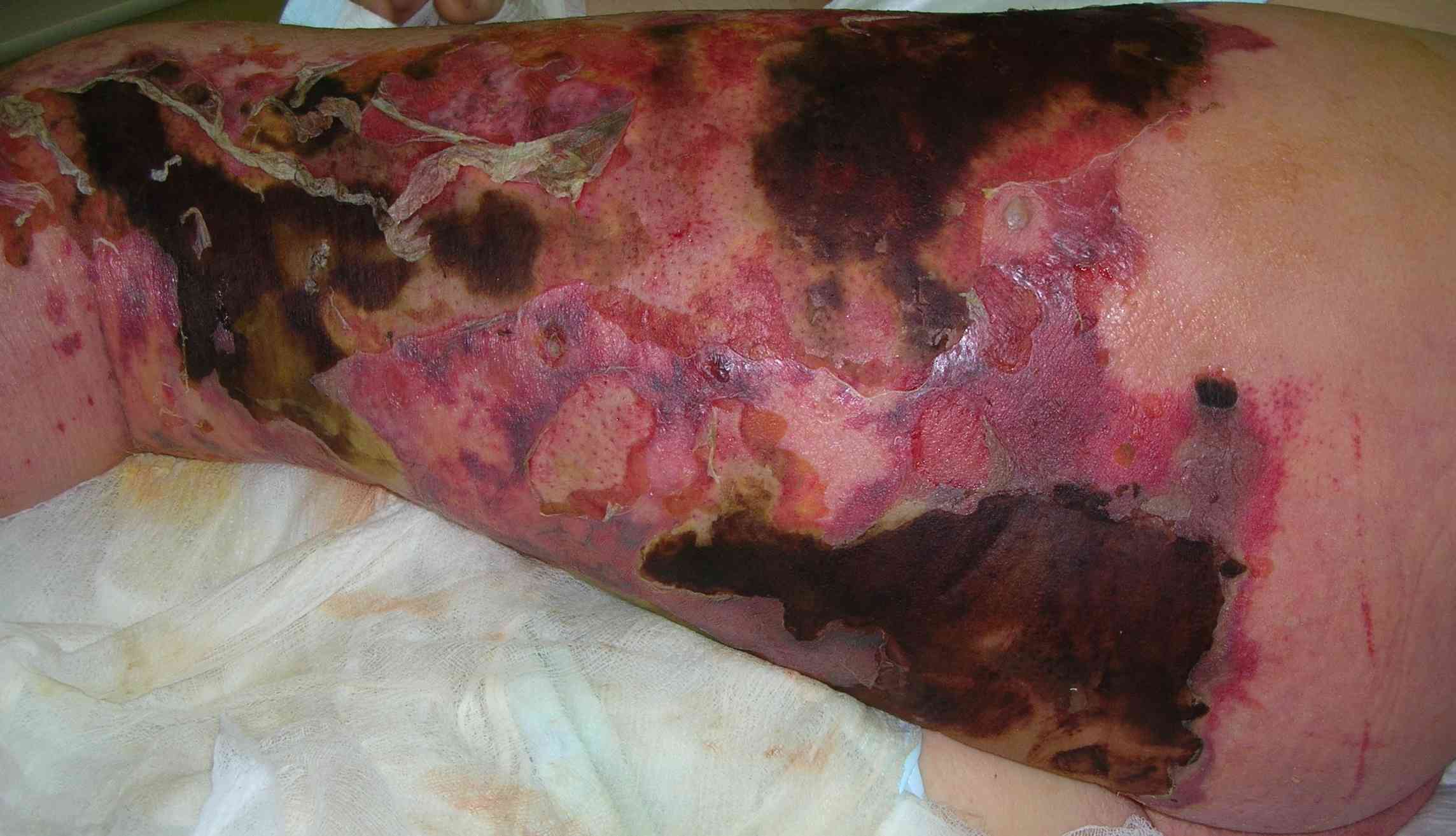
- Severe pain out of proportion to visible skin findings.
- Rapid progression over hours.
- Dusky, grey, violaceous, or necrotic skin.
- Bullae, anesthesia/numbness, crepitus (subcutaneous gas), or thin foul drainage.
- Systemic toxicity, confusion, hypotension, or organ dysfunction.
- Early disease may have deceptively mild erythema — do not let a benign-looking surface mislead the assessment.
Risk Factors
- Recent trauma, surgery, injection, or wound.
- Diabetes, vascular disease, obesity, or immunosuppression.
- Injection drug use.
- Water exposure for Vibrio/Aeromonas-type infections.
- Abdominal/perineal source for polymicrobial/Fournier gangrene.
- However, invasive group A streptococcal disease can occur without major comorbidity — do not exclude the diagnosis based on an otherwise-healthy patient.
Red Flags & Refer
Every suspected case is an emergency — any of the following requires immediate emergency transfer and surgical assessment, without waiting for imaging or a trial of therapy:
- Severe pain out of proportion.
- Rapid spread.
- Bullae.
- Necrosis.
- Crepitus.
- Skin anesthesia.
- Hemodynamic instability.
- Systemic toxicity.
Assessment & Diagnosis
Diagnosis is primarily clinical and operative. Laboratory scores and imaging can support assessment but must never delay surgery when suspicion is high. Obtain blood cultures and deep operative cultures when feasible — superficial swabs are insufficient. Surgical exploration confirms fascial necrosis and provides source control.[2]
The four necrotizing fasciitis types
Type I
Polymicrobial aerobic/anaerobic infection.
Type II
Often group A streptococcus, sometimes with S. aureus.
Type III
Clostridial or gram-negative organisms such as Vibrio, typically after relevant water exposure.
Type IV
Fungal necrotizing infection, mainly in profoundly immunocompromised hosts.
Treatment Targets
- Immediate surgical source control.
- Broad empiric antimicrobial coverage within the emergency resuscitation pathway.
- Hemodynamic stabilization and organ support.
- Narrow therapy to operative culture results once adequate coverage is established.
Choose Initial Treatment
Immediate surgery + broad IV antibiotics, simultaneously — neither waits for the other.
Broad empiric backbone
Piperacillin/tazobactam OR meropenem, plus an MRSA-active agent (vancomycin).
When group A streptococcus or clostridial toxin-mediated disease is suspected
Add clindamycin for toxin suppression.
Once group A streptococcus is confirmed
Narrow to penicillin G + clindamycin.
Non-Pharmacologic Treatment
- Immediate aggressive surgical debridement is the definitive treatment.
- Repeat operative exploration/debridement until all necrotic tissue is removed.
- ICU-level fluid, vasopressor, and organ support as needed.
- Wound reconstruction occurs only after infection is controlled.
- Invasive group A streptococcal disease requires public-health notification and assessment of close contacts per current public-health guidance.[3]
Special Populations
Pregnancy
Maternal life-saving surgery and broad IV antimicrobials take priority. Choose pregnancy-compatible agents where alternatives are equally effective, but do not delay definitive treatment for that reason.
Water exposure
Salt/brackish-water exposure raises concern for Vibrio; freshwater exposure raises concern for Aeromonas. Obtain infectious-diseases input immediately for additional Gram-negative coverage.
Fournier gangrene
Perineal necrotizing infection requires immediate urologic/general-surgical source control plus broad polymicrobial antibiotics.
Monitoring & Follow-Up
Monitoring is continuous in hospital/ICU: hemodynamics, lactate/organ function, wound progression, operative findings, renal function, and antimicrobial toxicity. Lack of stabilization after initial debridement is a trigger for immediate repeat surgical assessment, not simply broader antibiotics.
Common Errors to Avoid
- Waiting for CT/MRI before calling surgery when the clinical picture is convincing.
- Trying oral antibiotics first.
- Treating antibiotics as the definitive therapy instead of debridement.
- Omitting clindamycin in suspected invasive GAS/clostridial disease.
- Using a narrow regimen before operative cultures clarify a life-threatening polymicrobial infection.
Clinical Decision Algorithm
Drug Tables
How to use this table: Doses are adult doses and require patient-specific confirmation (renal/hepatic function, weight, allergy history). Pediatric dosing is weight-based per the current product monograph unless stated. Drug pricing is intentionally omitted. Select any drug name to open its complete Pharmasist Drug Database page.
Broad empiric backbone
| Drug | Dosage | Adverse effects | Comments |
|---|---|---|---|
| Piperacillin/tazobactam | Adults: 3.375 g IV Q6H (institutional severe-infection protocols may use 4.5 g Q6H) Children: 240-300 mg/kg/day (piperacillin component) divided Q6-8H IV (max 16 g/day) | Hypersensitivity, GI effects, cytopenias, renal/electrolyte effects | Renal adjustment required. |
| Meropenem | Adults: 500 mg IV Q6H (severe-infection dosing per institutional/ID protocol) Children: 10 mg/kg Q8H IV (max 500 mg/dose); severe-infection protocols may dose more frequently | GI effects, hypersensitivity; markedly lowers valproate levels | Reserve-listed alternative.<cite data-reference-id="a1916f47-12cd-4b78-b846-3e3020c0a76d"></cite> |
Toxin suppression and definitive GAS therapy
| Drug | Dosage | Adverse effects | Comments |
|---|---|---|---|
| Clindamycin | Adults: 600-900 mg IV Q8H Children: 25-40 mg/kg/day divided Q8H IV (max 900 mg/dose in severe invasive infection) | C. difficile infection risk; hepatic considerations | Add for suspected GAS/clostridial infection. |
| Penicillin G | Adults: 2-4 million units IV Q4-6H (severe-infection dosing per protocol) Children and adolescents: 60,000-100,000 units/kg/dose Q6H IV (max 4 million units/dose) | Hypersensitivity; electrolyte load at high doses | Definitive therapy once GAS confirmed, with clindamycin. |
MRSA and anaerobic coverage
| Drug | Dosage | Adverse effects | Comments |
|---|---|---|---|
| Vancomycin | Adults: 1 g Q12H (or 15 mg/kg Q8-12H) IV, institutional AUC monitoring Children: 45-60 mg/kg/day divided Q6-8H IV | Nephrotoxicity, infusion reaction | Add empirically until MRSA is excluded. |
| Linezolid | Adults and children 12+: 600 mg IV/PO Q12H Infants and children under 12: 10 mg/kg/dose Q8H IV/PO (max 600 mg/dose) | Myelosuppression, serotonin syndrome, MAOI interactions | Selected severe Gram-positive infection under ID direction.<cite data-reference-id="a1916f47-12cd-4b78-b846-3e3020c0a76d"></cite> |
| Metronidazole | Adults: 500 mg IV/PO Q8-12H Children: 15-30 mg/kg/day divided Q8-12H (max 500 mg/dose; up to 1000 mg/dose in severe infection) | GI upset, neuropathy with prolonged therapy | Add when the broad regimen otherwise lacks anaerobic coverage. |
References
- Necrotizing soft-tissue infections — New England Journal of Medicine (Stevens DL, Bryant AE). N Engl J Med 2017;377(23):2253-2265
- Practice guidelines for the diagnosis and management of skin and soft tissue infections: 2014 update by the Infectious Diseases Society of America — Clinical Infectious Diseases (Stevens DL, Bisno AL, Chambers HF, et al.). Clin Infect Dis 2014;59(2):e10-e52
- Invasive Group A Streptococcal Disease — Guidelines for public health management — Public Health Agency of Canada. Public health guidance
- Reserve list for antimicrobial drugs — Public Health Agency of Canada. Updated November 2024
Professional reference only. Apply clinical judgment and verify patient-specific decisions against current authoritative guidance and product information.