Pinworm Infection
Clinical Snapshot
Pinworm infection (enterobiasis, oxyuriasis) is caused by Enterobius vermicularis, a small white thread-like roundworm and the most common intestinal helminth infection in Canada, the United States, and other industrialized countries.[1][2] Global prevalence estimates vary enormously with methodology and setting — a pooled review of the literature cites figures from roughly 30% of children worldwide up to about 60% in some developing-country settings, the Merck Manual cites over 1 billion people infected worldwide, and a United States-specific estimate puts the number at roughly 40 million — but every source agrees on the same basic epidemiology: children aged roughly 5-14 carry the highest burden, transmission is fastest in crowded close-contact settings such as households, daycares, and schools, and adult household members and caregivers of an infected child are themselves at genuinely elevated risk simply by living with them.[3][4][5]
Two facts should anchor every counselling conversation. First, pinworm infection is not a marker of poor hygiene — as the Canadian Paediatric Society's own patient handout puts it plainly, "children can get pinworms no matter how often they take a bath," and having pinworms does not mean a family or child is "dirty."[6] Second, the single biggest determinant of whether treatment actually works is not which drug is chosen but whether the diagnostic tape test is timed correctly, whether the scheduled second (and, per the Canadian mebendazole product monograph, third) dose is actually taken, and whether the entire household — not just the symptomatic child — is treated at the same time. A pharmacist who leads with these three points, rather than simply dispensing a single dose of medication, meaningfully improves the odds of the family's very first treatment attempt actually working.
Recognize the Condition
Life cycle — the timeline that drives every dosing decision in this chapter
Infection begins with the ingestion of microscopic pinworm eggs, most often carried to the mouth on contaminated fingers. Swallowed eggs hatch in the small intestine, and the resulting larvae migrate to the cecum and ascending colon, where they mature into adult worms over roughly one to two months (some sources describe a somewhat faster 2-6 week window) — a genuinely important stretch of time, because it is exactly what makes a single dose of medication insufficient on its own (see Choose Initial Treatment).[1][5][3] Adult female worms are 8-13 mm long; males are smaller (2-5 mm), are rarely seen, and typically die shortly after mating.[5] At night, while the host is asleep and body temperature has dropped slightly, a gravid female migrates out through the anus and deposits her eggs — potentially 10,000 or more of them — in the sticky, gelatinous folds of perianal skin, a process that itself provokes the intense itching that is the hallmark symptom of this infection.[5][4] Eggs become infective within just a few hours of being laid, and can survive on skin, clothing, bedding, and other surfaces for roughly 2-3 weeks at room temperature — long enough to explain why reinfection is so persistent even after a technically successful treatment course.[6][1][4]

The autoinoculation loop — why one infected child can become a whole infected household
Scratching the itchy perianal area transfers sticky eggs directly onto fingers and under fingernails. From there, the eggs reach a new host — or reinfect the same one — in two ways: directly, when contaminated fingers touch the mouth (a especially common route in young children who suck their thumbs or bite their nails), or indirectly, when eggs are deposited onto shared objects — toys, toilet seats, bathtubs, clothing, or bedding — and picked up by someone else's hands before being carried to their own mouth.[6][1] A less common but real third route, retroinfection, occurs when larvae that have already hatched at the anus migrate back through the anus into the rectum without ever being swallowed at all.[5] Because a single infected person can restart this cycle in themselves and in every close contact who shares their bathroom, bedding, or toys, pinworm spreads with striking efficiency through households, daycares, and classrooms — which is exactly why treatment of the index patient alone is not an effective strategy (see Choose Initial Treatment and Non-Pharmacologic Treatment).[6][1]
Symptoms
The dominant, classic symptom is intense perianal itching that is characteristically worse at night, driven directly by nocturnal female migration and egg-laying; in girls, eggs and migrating worms can also cause vulvar itching and, less commonly, vulvovaginitis.[1][3] Nighttime itching frequently disrupts sleep, producing restlessness, irritability, and daytime fatigue in a child even when no other symptom is present.[6][1] A substantial minority to a genuine majority of infections are asymptomatic — cited figures range from roughly one-third asymptomatic to 30-40% — which matters clinically because an asymptomatic household member can still be actively infected and shedding eggs, reinforcing why household treatment does not depend on every family member having symptoms.[5][3]
Risk Factors
- Age: children roughly 5-14 years old carry the highest prevalence of any age group, though infection occurs at any age.[3][5]
- Any household member or regular caregiver of a child with confirmed pinworm infection — living with, sharing a bathroom with, or providing routine care for an infected person meaningfully raises risk, independent of that person's own symptoms.[4][6]
- Daycare, preschool, and elementary-school attendance, and any other setting with sustained close contact among young children.[6][1]
- Thumb-sucking and nail-biting — both meaningfully increase autoinoculation risk by moving contaminated fingers directly to the mouth, and are a specific reason young children are disproportionately affected.[5]
- Residence in a long-term care facility or other congregate institutional setting, which can behave epidemiologically much like a household or daycare outbreak.[4]
- Anal-oral sexual contact with an infected partner, in adults.[4]
- Crowded living conditions and, at a population level, lower-sanitation settings are associated with higher community prevalence, though pinworm infection occurs across every socioeconomic group and is not a marker of poor personal hygiene in an individual child or family.[3][6]
Red Flags & Refer
The great majority of pinworm infection is appropriate for pharmacist-guided self-care and OTC treatment. Escalate beyond routine counselling for any of the following:
- Fever or abdominal pain accompanying suspected or confirmed pinworm infection — do not assume these reflect the pinworms themselves; evaluate for another cause, including appendicitis, before attributing the presentation to enterobiasis.[7][5]
- Redness, tenderness, or swelling in the genital area, or pain with urination, frequent urination, or loss of bladder control — evaluate for a urinary tract infection or vulvovaginitis, both of which can result from aberrant worm migration in girls and need assessment beyond antiparasitic therapy alone.[7][3]
- Signs of secondary bacterial skin infection from scratching — spreading redness, warmth, swelling, or purulent drainage of excoriated perianal skin — needs antimicrobial management (see Pharmacologic Treatment Options), not antiparasitic therapy alone.
- Persistent or recurrent infection despite two correctly timed, correctly dosed treatment courses with genuine household treatment and adequate hygiene measures already in place — this pattern warrants reassessment rather than simply repeating the same plan a third time (see Treatment Failure/Next Step).
- Symptomatic infection in a child younger than 2 years, or younger than 1 year — standard antiparasitic options carry real age restrictions in this group (see Special Populations) and treatment decisions should involve a prescriber.
- Diagnostic uncertainty — persistent perianal or vulvar symptoms with no worm or egg ever identified despite a properly performed tape test warrants reconsidering the differential (see Assessment & Diagnosis) rather than continuing to treat empirically for pinworms indefinitely.
Assessment & Diagnosis
History and visual inspection
Ask specifically about nocturnal perianal or vulvar itching, sleep disruption, and whether anyone else in the household, daycare, or classroom has had similar symptoms or a confirmed diagnosis — a positive household or close-contact history is itself a meaningful clue.[6][1] A live adult worm is sometimes visible to the naked eye on the perianal skin roughly 1-2 hours after the person falls asleep, or first thing in the morning before waking fully — a thin, white, thread-like, sometimes actively moving worm about the size described in Recognize the Condition.[5]
The cellophane tape test — the actual diagnostic gold standard, and a genuinely easy-to-get-wrong procedure
Because eggs are microscopic and worms are not reliably seen on casual inspection, the standard diagnostic test is the cellophane (Scotch) tape test, sometimes performed with a proprietary paddle device instead of tape.[5][1] The single most important instruction to give a patient or caregiver is timing: the sample must be collected first thing in the morning, before the person bathes, showers, or has a bowel movement — either of these will wash or wipe away the very eggs the test is trying to detect, and doing the test later in the day after normal hygiene produces a false negative.[2][1] A Quebec regional laboratory-medicine patient instruction sheet documents a genuinely useful alternative for a family that cannot manage a first-thing-in-the-morning collection: the sample can instead be collected a few hours after the person has gone to bed, specifically between about 9 p.m. and midnight, and — because the female worm actively avoids light — the collection should be done in the dark, without turning on the bedroom light, spreading the buttocks and firmly pressing the sticky surface around (never inserted into) the anus before promptly resealing the collection device.[8] Whichever timing is used, thorough handwashing immediately follows sample collection.[8]
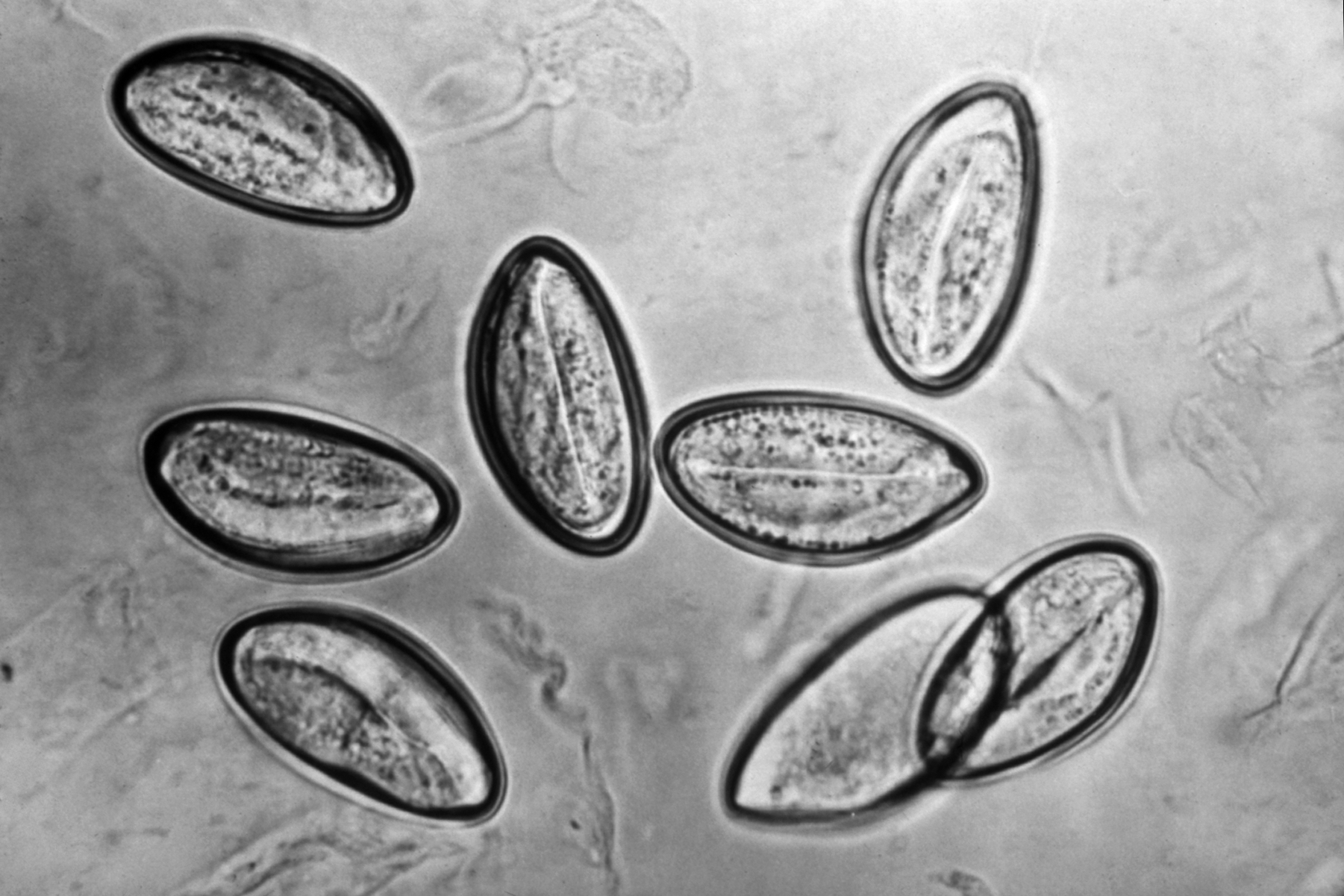
In the lab or clinic, the tape (or paddle) is pressed sticky-side-down onto a glass slide and examined under low-power microscopy for the characteristic pinworm ova: oval, roughly 50 by 30 microns, with one side distinctly flattened and a thin shell often showing a visibly curled larva inside; a drop of toluene can be added to dissolve the tape's adhesive and clear air bubbles that might obscure a true positive.[5] A single tape test is genuinely insensitive on its own — reported sensitivity is only around 50% for one sample — so the accepted standard is to repeat the test on three separate consecutive mornings, which raises combined sensitivity to roughly 90%; if suspicion remains high with three negative results, some protocols extend to as many as five consecutive mornings before excluding the diagnosis.[3][8][5] When testing on more than one occasion, each specimen should be individually labelled with its own collection date and time rather than assuming one label covers the set.[8]
Where else to sample, and where not to look
For a patient with vulvovaginal symptoms specifically, a swab of the vaginal introitus can also identify eggs or worms that have migrated there; fingernail scrapings can likewise be examined in a patient where autoinoculation is a specific concern.[5] A routine stool ova-and-parasite examination is a poor and unreliable way to diagnose pinworm — because the female worm deposits her eggs on perianal skin rather than inside the bowel lumen, eggs are not reliably present in a random stool sample, and ordering a stool O&P instead of a properly timed tape test is a recognized diagnostic pitfall (see Common Errors to Avoid).
Differential diagnosis
| Condition | Distinguishing features |
|---|---|
| Pruritus ani (non-parasitic) | Multifactorial perianal itching (irritant contact, excess moisture, dietary triggers) without nocturnal predominance and with a negative tape test on repeat testing. |
| Candidal or bacterial perianal/perineal dermatitis | Visible erythema, satellite lesions, or exudate on examination; no worms or ova on tape test. |
| Contact or atopic dermatitis | Distribution and morphology match a specific irritant/allergen exposure or an atopic pattern rather than being confined to the perianal/perineal fold. |
| Hemorrhoids or anal fissure | Pain, visible fissure or hemorrhoidal tissue, and often bleeding, rather than isolated nocturnal itch. |
| Vulvovaginitis from another cause (in girls) | Bacterial, irritant, or foreign-body vulvovaginitis can mimic pinworm-related vulvar itch; a tape test and, where relevant, a vaginal swab help distinguish them. |
| Another sexually transmitted infection (in a sexually active adult with anal-oral exposure) | Consider alongside pinworm rather than assuming pinworm explains every anogenital symptom in this population. |
Treatment Targets
- Confirm the diagnosis where practical — by history, visible worm, or a correctly timed tape test — rather than treating indefinitely on symptoms alone when the picture is genuinely uncertain.
- Eradicate adult worms with a correctly dosed antiparasitic agent, and plan the second (and, per the Canadian mebendazole product monograph, third) dose from the outset rather than as an afterthought.
- Treat the entire household and close contacts at the same time as the diagnosed patient, not only the symptomatic individual, given how efficiently pinworm spreads between people who share a home.
- Break the autoinoculation cycle through nail hygiene, morning bathing, and laundering measures that actually interrupt egg transmission, not exhaustive or anxiety-driven decontamination of the entire home.
- Relieve perianal/vulvar itch and treat any secondary bacterial skin infection from scratching.
- Actively destigmatize the diagnosis — pinworm infection reflects how easily this parasite spreads between close contacts, not a family's hygiene standards.
- Recognize genuine treatment failure or reinfection versus the far more common causes of apparent failure — a missed second dose, an untreated household contact, or incomplete hygiene measures — and escalate appropriately.
Choose Initial Treatment
First line in Canada: mebendazole, dosed twice — and, per its own Canadian label, a third time
1st line mebendazole 100 mg, a single oral dose, available without a prescription in Canadian pharmacies. Alternative pyrantel pamoate 11 mg/kg (maximum 1 g), a single oral dose, in tablet form only in Canada (see below). Every source agrees on the minimum standard: a second dose 2 weeks after the first for whichever drug is used.[1][2][3] The Canadian product monograph for VERMOX (mebendazole) — the only anthelmintic in this platform's own Drug Database — goes a step further and directs a third dose at 4 weeks as well: "the dose is 1 tablet (100 mg) as a single dose, repeated after 2 and 4 weeks because reinfection is common, especially in eradication programs." Always follow the specific Canadian product's own labelling rather than assuming a single repeat dose at 2 weeks is sufficient for every mebendazole product.
Why the second dose is not optional — and why timing, not drug choice, is what actually determines success
None of the standard antiparasitic agents reliably kills pinworm eggs already deposited in the perianal folds or scattered through the household environment at the moment the first dose is taken — they act on the worm, not the egg.[5] Because the full cycle from a newly swallowed egg to a mature, egg-laying adult female takes roughly one to two months, any egg present anywhere in the environment, under a fingernail, or in the perianal skin at the time of the first dose can still go on to hatch and mature over the following days to weeks, effectively restarting the infection in a patient and household that believed treatment had already worked.[1][5] StatPearls frames this plainly: "young pinworms tend to be resistant to treatment and hence two doses of medication, two weeks apart are recommended" — the second dose is timed specifically to catch this cohort of newly matured worms before they themselves become egg-laying adults.[5] A missed or mistimed second (or, for mebendazole in Canada, third) dose is a well-recognized and entirely avoidable cause of a family reporting that "the medicine didn't work," and should be the very first thing checked before assuming resistance or misdiagnosis (see Treatment Failure/Next Step).
Household-wide treatment is not optional either
Because pinworm spreads so efficiently between people who share a bathroom, bedding, or toys, and because a genuine minority-to-majority of infected household members are themselves asymptomatic, treating only the diagnosed, symptomatic individual is not an effective strategy. Standard guidance is to treat the entire household and regular caregivers of the diagnosed patient at the same time, on the same schedule, regardless of whether each individual member has symptoms or a positive tape test of their own — testing every household member before treating them is neither necessary nor practical.[2][6] This single point is worth stating explicitly to every family: the goal is not to cure one child, but to break the transmission cycle across everyone who shares that child's environment.
Pyrantel pamoate — a genuine Canadian availability nuance
Alternative, OTC pyrantel pamoate remains available in Canada as Combantrin 125 mg tablets (Kenvue Canada Inc.), confirmed currently Marketed on the Health Canada Drug Product Database.[9] The pediatric-friendly 50 mg/mL oral suspension formulation, however, is Cancelled Post Market as of March 3, 2026, per the same database.[9] In practice, this means a Canadian pharmacist recommending pyrantel pamoate today is generally offering a tablet-only product — a real, current limitation for a young child who cannot swallow a tablet, and one more reason mebendazole (available as a chewable or swallowable tablet, per its own monograph) is the more practical Canadian first-line choice for most families. Dosing, when used, is 11 mg/kg up to a maximum of 1 g, as a single dose repeated 2 weeks later, matching the standard second-dose principle above.[3][5]
Albendazole — presented for awareness, not as a practical Canadian option
Not routinely accessible in Canada American and international sources typically present albendazole (400 mg single dose, repeated at 2 weeks) as a third co-equal first-line agent alongside mebendazole and pyrantel pamoate.[3][5] Albendazole is not marketed or Health Canada-approved in Canada and is accessible only through the federal Special Access Programme, a mechanism reserved for genuinely difficult clinical situations and not something a pharmacist can simply dispense or a routine prescriber can simply prescribe. It is included in this chapter's drug table for completeness and so a pharmacist recognizes the name when it appears in American-sourced literature or a patient's own research, but it should not be presented to a Canadian family as an equally available option alongside mebendazole or pyrantel pamoate.
Symptomatic relief
Perianal/vulvar irritation from scratching a short course of low-potency topical hydrocortisone can relieve local inflammation and excoriation while the antiparasitic treatment and hygiene measures do the actual work of clearing the infection. Itch, particularly nocturnal a non-sedating oral antihistamine (cetirizine) for daytime use, or diphenhydramine at bedtime specifically because the classic itch pattern is worst at night — though sedation alone should not be relied on as a substitute for the physical barriers (snug nightwear, gloves) described in Non-Pharmacologic Treatment for a young child who scratches in their sleep. Secondary bacterial infection treat per the usual localized (topical mupirocin) or spreading (oral cephalexin) skin and soft tissue infection pathway if excoriation has become infected.
Non-Pharmacologic Treatment
Environmental and hygiene measures — what actually breaks the autoinoculation cycle
- Bathe or shower every morning, rather than bathing at night, since morning bathing physically removes eggs deposited overnight before they can be transferred to fingers, food, or other surfaces; a shower is generally preferred over a bath, since bathwater itself can become contaminated with eggs washed off the perianal area.[6][1]
- Change underwear and sleepwear daily (or more often if soiled), and consider snug-fitting underwear or sleepwear overnight, which helps reduce direct skin scratching and limits eggs falling loose onto bedding.
- Keep fingernails short and clean, and actively discourage nail-biting and thumb-sucking — this is the single most direct way to interrupt the finger-to-mouth autoinoculation route described in Recognize the Condition, and is a particularly important teaching point for young children, for whom gloves or mittens at night can help if scratching in sleep is a persistent problem.[5]
- Wash bedding, pajamas, and towels in hot water, especially on the first day or two of treatment, and dry with a hot dryer cycle; do not shake out laundry before washing — doing so can scatter eggs into the air and onto other surfaces rather than containing them in the wash.
- Wash hands frequently and thoroughly, especially after using the toilet, after changing a diaper, and always before preparing or eating food — described directly by the Merck Manual as "the most successful way" to interrupt transmission, and reinforced by Canadian handouts as the measure every household member should follow, not only the diagnosed patient.[4][6]
- Avoid sharing towels, washcloths, bedding, or clothing among household members during the treatment period.
- Clean shared toys, toilet seats, and bathroom surfaces regularly during active treatment.
- A Canadian patient handout also suggests opening blinds or curtains in bedrooms during the day, since pinworm eggs do not tolerate light and drying well.[6]
- Continue these measures for at least 2-3 weeks after the final dose of medication, not just the first day or two — eggs already in the environment before treatment began can remain viable for roughly 2-3 weeks, and a treated patient may continue shedding some viable eggs for up to about a week after treatment, so hygiene measures need to outlast the medication itself.[1][4]
What environmental cleaning is not required
Because transmission is driven by direct hand-to-mouth contact and a relatively short list of high-touch fomites (bedding, underwear, toys, toilet seats), exhaustive whole-home decontamination — treating furniture, carpets, or every surface in the house — is not necessary and is not what the evidence-based hygiene measures above actually target; focus counselling on the specific, high-yield measures above rather than open-ended anxiety-driven cleaning.
Special Populations
Pregnancy
The Canadian VERMOX (mebendazole) product monograph directs that it "should not be used during pregnancy, particularly in the first trimester, unless the potential benefit outweighs the possible risk to the fetus," reflecting embryotoxic and teratogenic effects seen in animal studies; the safety of mebendazole in pregnant patients has not been established. Because pyrantel pamoate is very poorly absorbed systemically from the gut, it is generally regarded as the preferred antiparasitic option if treatment is genuinely needed during pregnancy.[2][5] Given that pinworm infection itself is uncomfortable but not dangerous to a pregnant patient or the pregnancy, and that reinfection is common regardless of when treatment is given, many mild or minimally symptomatic cases can reasonably be managed with the hygiene and environmental measures in Non-Pharmacologic Treatment alone, deferring pharmacologic treatment until after delivery where clinically appropriate — this should be an individualized discussion with the patient's prescriber rather than a default pharmacist-initiated recommendation in pregnancy.
Breastfeeding
Small amounts of mebendazole pass into human breast milk, so the Canadian product monograph advises caution when it is used in a breastfeeding patient; involve the prescriber in an individualized risk/benefit discussion rather than assuming routine OTC use is automatically appropriate.
Pediatrics — age cutoffs are genuinely restrictive at the youngest ages
Per the Canadian mebendazole (VERMOX) product monograph: it is not used in children under 1 year of age; in children 1 to 2 years, it should be used only when the infestation is significant enough to affect the child's nutrition or physical development, since safety data in this age group remain limited; and it is authorized from 2 years of age onward for standard pinworm dosing. Convulsions, including in infants, have been reported in post-marketing use — a safety signal worth being aware of, though clearly rare, when treating a very young child. Pyrantel pamoate is generally not recommended under 2 years of age by American guidance either.[2] In a symptomatic child younger than 2, involve a prescriber rather than reflexively recommending an OTC antiparasitic, and lean more heavily on the hygiene measures in Non-Pharmacologic Treatment — nail hygiene and discouraging thumb-sucking are especially important in this age group, since autoinoculation via thumb-sucking is a major driver of persistent infection in toddlers.[5]
Household and close contacts
Treat every household member and regular caregiver on the same schedule as the diagnosed patient, regardless of whether they have symptoms of their own (see Choose Initial Treatment) — this is not optional given how efficiently pinworm spreads within a shared living environment.[2][6]
Long-term care and other congregate settings
Outbreaks can occur in long-term care facilities and other institutional congregate settings through the same close-contact mechanisms seen in households and daycares; the same diagnostic and treatment approach applies, extended to affected residents and their direct caregivers within the facility.[4]
Renal and hepatic impairment
The Canadian mebendazole monograph provides no specific dose adjustment for renal or hepatic impairment but advises monitoring liver and kidney function during treatment, avoiding co-administration with metronidazole (a documented association with severe skin reactions), and using caution with cimetidine, which can raise mebendazole blood levels.
Monitoring & Follow-Up
- Before the encounter ends, confirm the family understands — and has actually scheduled — the second dose at 2 weeks (and, for Canadian mebendazole specifically, the third dose at 4 weeks) rather than assuming a single dose is the complete course.
- Reassure explicitly that some residual perianal itching can persist for up to about a week after treatment even when the infection has been successfully cleared, reflecting ongoing local irritation rather than treatment failure.
- Reinforce that hygiene and environmental measures need to continue for at least 2-3 weeks past the final dose, since a treated patient may continue shedding some viable eggs for roughly a week after treatment, and eggs already present in the environment before treatment began can remain infective for 2-3 weeks on their own.[4][1]
- No routine repeat tape test is needed once the treatment course is complete and symptoms have resolved as expected; reserve repeat testing for symptoms that persist beyond the expected window or that recur after apparent resolution.
- At any follow-up contact, confirm that every household member was actually treated on schedule, since an untreated close contact is the most common source of apparent reinfection.
Common Errors to Avoid
- Performing the tape test after the person has already bathed or had a bowel movement, rather than first thing in the morning (or, per the Quebec laboratory-medicine protocol, 9 p.m.-midnight in the dark) — either washes away the eggs the test is meant to detect and produces a false negative.[2][8]
- Ordering a routine stool ova-and-parasite examination to diagnose pinworm — this is an unreliable test for this specific parasite because eggs are deposited on perianal skin, not reliably shed into stool; use the tape test instead.
- Treating only the symptomatic child and not the rest of the household — the single most common reason a family experiences prompt reinfection after an apparently successful individual treatment.[2][6]
- Stopping after a single dose and skipping (or mistiming) the second dose at 2 weeks — this, far more often than drug resistance, is why a family reports that "the medicine didn't work."[5]
- For mebendazole specifically, assuming a single repeat dose at 2 weeks is the complete Canadian regimen rather than checking the specific product's own label, which for VERMOX directs a third dose at 4 weeks as well.
- Shaking out bedding or laundry before washing it, which can scatter eggs into the air rather than containing them.
- Attributing fever, significant abdominal pain, or urinary symptoms in an infected child to the pinworms themselves without evaluating for another cause, including appendicitis or a urinary tract infection.[7]
- Recommending mebendazole or albendazole in early pregnancy, particularly the first trimester, without first involving the prescriber, given the documented animal-study embryotoxicity/teratogenicity signal.
- Presenting albendazole as a routinely available Canadian option on the strength of American literature, without flagging that it is not marketed or Health Canada-approved in Canada outside the Special Access Programme.
- Using stigmatizing or hygiene-blaming language when discussing the diagnosis with a family, rather than leading with the fact that pinworm spreads easily between close contacts regardless of how clean a household is.[6]
Clinical Decision Algorithm
Drug Tables
How to use this table: doses are adult doses and require patient-specific confirmation (renal/hepatic function, weight, allergy history, pregnancy status). Pediatric dosing is weight-based per the current product monograph unless otherwise stated. Drug pricing is intentionally omitted. Select any drug name to open its complete Pharmasist Drug Database page.
Anthelmintic Therapy
None of these agents reliably kills eggs already present in the environment — a correctly timed 2nd dose (and, per the Canadian mebendazole label, a 3rd dose at 4 weeks) is expected for every patient, not a sign that the first dose failed. Treat the entire household on the same schedule.
| Drug | Dosage | Adverse effects | Drug interactions | Comments |
|---|---|---|---|---|
| Mebendazole | Standard course: 100 mg single dose; Canadian label repeats at 2 and 4 weeks | Abdominal pain/cramps (esp. with a high worm burden), diarrhea, nausea, headache, dizziness; rare hepatotoxicity, neutropenia, or agranulocytosis with prolonged/high-dose use | Cimetidine may raise mebendazole levels; avoid combining with metronidazole (association with severe skin reactions) | OTC in Canada (VERMOX). Age ≥2 years for standard pinworm dosing; not used under 1 year; 1-2 years only if the infestation significantly affects nutrition/growth. Avoid in pregnancy, particularly the first trimester, unless benefit outweighs risk. |
| Pyrantel pamoate | Standard course: 11 mg/kg PO, max 1 g, single dose, repeat in 2 weeks | GI upset (nausea, vomiting, cramps, diarrhea), headache, dizziness | None significant at standard doses | OTC in Canada as Combantrin 125 mg tablets; the pediatric oral suspension is Cancelled Post Market in Canada. Minimal systemic absorption makes it the generally preferred option if treatment is needed in pregnancy or in a child under 2. Not present in this Drug Database; presented as plain text. |
| Albendazole | Standard course (where accessible): 400 mg PO single dose, repeat in 2 weeks | GI upset, headache; rare hepatotoxicity | None significant at standard doses | Not marketed or Health Canada-approved in Canada; accessible only through the federal Special Access Programme. Listed for awareness given its prominence in American literature, not as a routine Canadian recommendation. Not present in this Drug Database; presented as plain text. |
Symptomatic Relief
For perianal/vulvar itch and irritation while the antiparasitic course and hygiene measures clear the underlying infection.
| Drug | Dosage | Adverse effects | Drug interactions | Comments |
|---|---|---|---|---|
| Hydrocortisone (topical) | Adults/children: Apply a thin layer 1-2 times daily, short course | Local skin thinning with prolonged use | None significant with short-term topical use | Short course only, for irritation/excoriation from scratching — not a substitute for antiparasitic treatment. |
| Cetirizine | Adults: 10 mg PO once daily | Mild sedation, dry mouth | Additive sedation with other CNS depressants | Non-sedating option preferred for daytime pruritus. |
| Diphenhydramine | Adults: 25-50 mg PO at bedtime PRN | Sedation, anticholinergic effects | Additive sedation with other CNS depressants | Reserve for nocturnal itching disrupting sleep; pair with nail hygiene/snug nightwear in young children rather than relying on sedation alone. |
Secondary Bacterial Infection of Excoriated Skin
Reserve for genuine impetiginization or cellulitis arising from scratching-related skin breakdown; escalate to systemic therapy if infection is spreading.
| Drug | Dosage | Adverse effects | Drug interactions | Comments |
|---|---|---|---|---|
| Mupirocin (topical) | Adults/children: Apply 3 times daily for 5-10 days | Local irritation, burning | None significant with topical use | For limited, localized superinfection. |
| Cephalexin | Adults: 500 mg PO 4 times daily for 7 days | GI upset, hypersensitivity reactions | May increase INR with warfarin (uncommon) | First-line oral choice for infection needing systemic therapy. |
References
- Pinworms — HealthLinkBC (British Columbia Ministry of Health). HealthLinkBC Healthwise health file
- About Pinworm Infection / Diagnosing Pinworm Infection — Centers for Disease Control and Prevention (CDC). CDC, Pinworm Infection
- Pinworm (Enterobius Vermicularis) Infestation: An Updated Review — Current Pediatric Reviews (Leung AKC, Lam JM, Barankin B, Wong AHC, Leong KF, Hon KL). Curr Pediatr Rev 2025;21(4):333-347
- Pinworm Infestation — Merck Manual Professional Edition (Marie C, Petri WA). Merck Manual Professional Edition, reviewed/revised January 2025
- Enterobius Vermicularis — StatPearls, National Library of Medicine. StatPearls [Internet]
- Pinworms — Canadian Paediatric Society, Caring for Kids. Canadian Paediatric Society, Caring for Kids patient handout
- Pinworms in Children: Care Instructions — MyHealth Alberta (Alberta Health Services). MyHealth Alberta, care instructions
- Pinworm Test (Tape Test) — User Instructions — CISSS du Bas-Saint-Laurent / CISSS de la Gaspésie, Clinical Department of Laboratory Medicine. OPTI-DE-005 v2, status approved 2024-12-05
- Product information — COMBANTRIN TAB 125MG (pyrantel pamoate) — Health Canada, Drug Product Database. Health Canada Drug Product Database, record queried 2026
Professional reference only. Apply clinical judgment and verify patient-specific decisions against current authoritative guidance and product information.