From typewriters to global drug supply: retired CAF pharmacist Chris Mandin looks back
A November 19 National Defence retrospective follows military pharmacy’s technological transformation and the leadership responsibilities that endure.
In this article & details
Retired Lieutenant-Colonel Chris Mandin recalls a military dispensary run with typewritten labels, handwritten patient files and inventory cards in a National Defence retrospective published November 19. Computers and more advanced clinical training have transformed that work; the obligation to lead as an officer has endured.
Manual records, slower supply
Mandin describes Cold War and peacekeeping practice serving mainly healthy young men, without trained pharmacy assistants. Central purchasing could delay supplies, although military hospitals supported care. He also remembers patient encounters without concerns over patients’ payments.
Electronic records, interaction checks and temperature-controlled transport now support a more clinical service. Mandin entered the Forces in 1964, graduated from UBC pharmacy in 1968 and held pharmacy, supply and command posts before retiring in 1996. He later practised community pharmacy.
Clinical care reaches beyond the dispensary
The CAF’s current occupation profile describes pharmacists advising on emergency and intensive care, infections and pain, alongside complex medication problems. Their workplaces include Canadian clinics, medical depots and field units supporting operations overseas.
Captain Christopher Sherman, speaking in the CAF’s career presentation, describes clinics where pharmacists share a building with physicians and nurses, participate in case conferences and join medical rounds. He also outlines responsibilities at the central equipment depot in Petawawa, field hospitals, disaster-response teams and policy offices.
Medical supply responsibilities extend to procurement contracts and maintaining cold-chain transport with other military personnel. The occupation combines patient care with responsibility for equipment and supplies reaching personnel wherever they serve.
Training described by the CAF includes officer preparation and a pharmacy course at Borden covering military practice, administration and supply. A six-month civilian-hospital placement may be available. Regular Force postings can require relocation; reservists normally serve through a local unit and may volunteer for deployments.
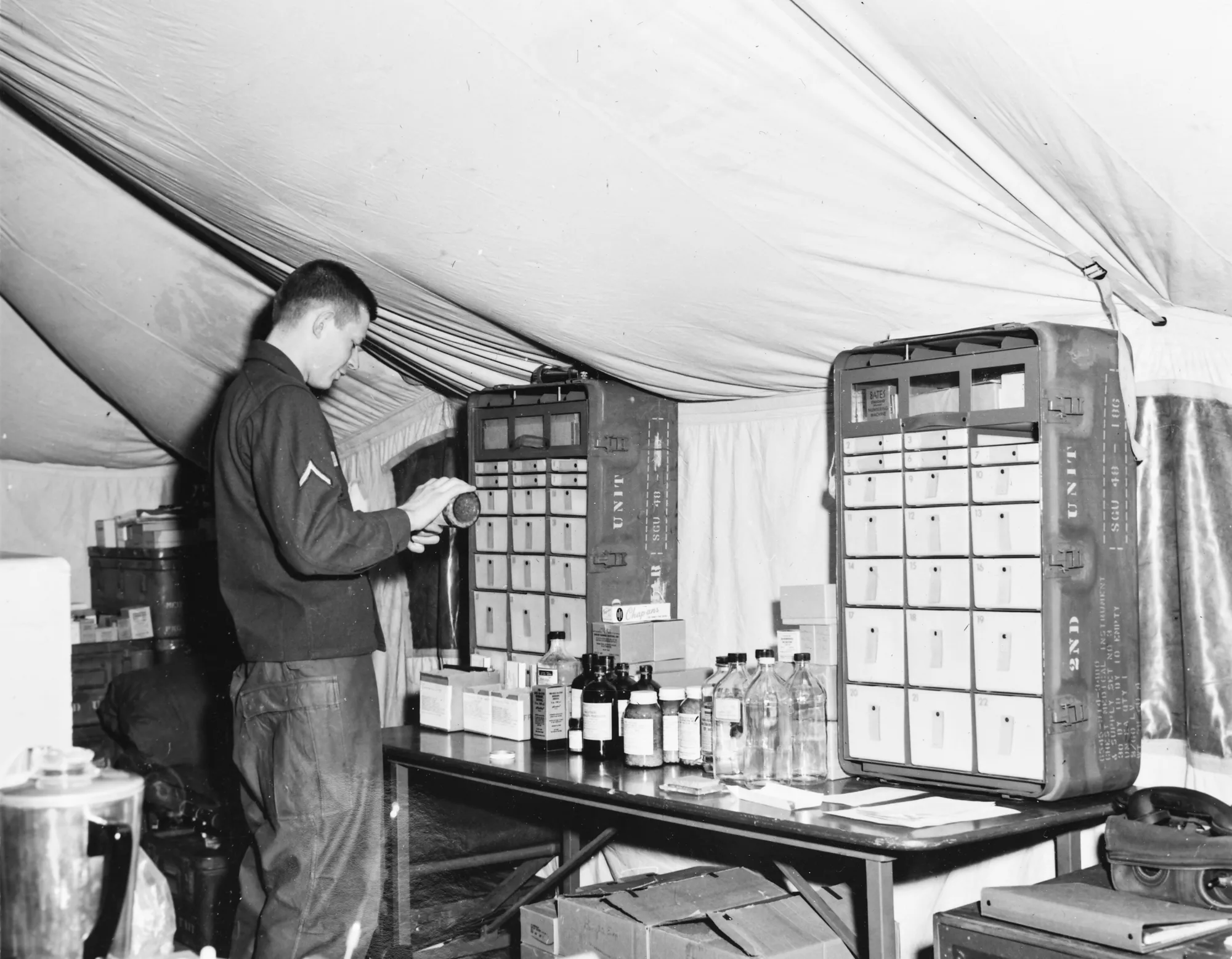
A Cold War field pharmacy, preserved on camera
The archival photograph above shows U.S. pharmacist Glenn Reecy working in a tent pharmacy in Alaska on January 20, 1962. Exercise Great Bear involved Canadian and American troops. The image depicts another pharmacist, six years before Mandin’s graduation, and illustrates the manual field-pharmacy setting of that period.
Mandin’s retrospective returns to the qualities technology cannot replace: integrity, relationships and leadership developed through service. He continues to recommend the profession’s combination of clinical work and military responsibility.
References
- Military pharmacy – Then and now — National Defence — Chris Mandin, November 19, 2026 (accessed Nov 22, 2026)
- Pharmacy Officer — Canadian Armed Forces, Current occupation profile; accessed November 21, 2026 (accessed Nov 22, 2026)
- Exercise Great Bear — field pharmacy, January 20, 1962 — U.S. Army / Joint Base Elmendorf-Richardson; Wikimedia Commons, Public-domain archival photograph (accessed Nov 22, 2026)
Discussion
0 commentsJoin the discussion. Anyone can read the comments. To comment, log in or create a free individual account.
No comments yet.