Zepbound KwikPen Click Counting: The Chart, the Arithmetic and the Safety Limits
What published Zepbound click charts calculate, why they are off-label, and how Canadian KwikPen dose settings and discard rules differ from the arithmetic.
In this article & details
Educational review — November 4, 2026. A Zepbound click chart can look like a simple conversion table. Its apparent precision hides a more important question: is it describing the manufacturer’s dose selector, or doing arithmetic for an off-label technique? For the Canadian multi-dose KwikPen, those are not the same thing.
The banner above explains the numbers reported in a clinical handout. It is not a prescription, a manufacturer-approved conversion chart or a suggestion to buy a higher-strength pen. Anyone considering a different dose needs a plan agreed with their prescriber and pharmacist for the exact product in hand.
The essential distinction
- A labelled dose is not a click count. The Canadian KwikPen uses the “1” setting for its full dose.
- The table is conditional arithmetic. It assumes the handout’s convention of 60 clicks per full dose; it does not establish accuracy at partial settings.
- Mathematical supply is not usable shelf life. Dividing the contents into smaller portions does not extend the manufacturer’s discard instructions.
What the Canadian device instructions actually say
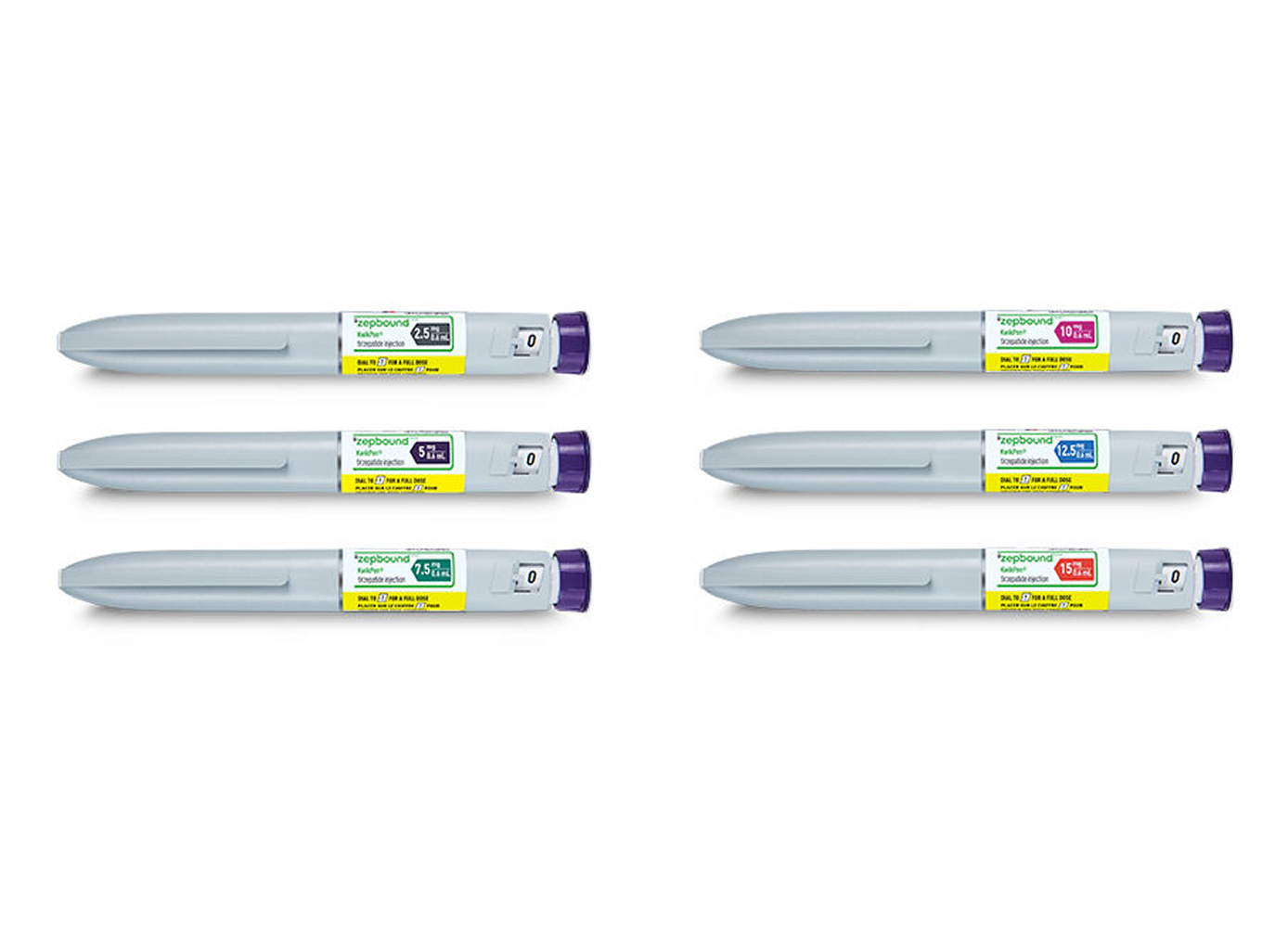
Lilly’s Canadian product monograph lists six KwikPen strengths, from 2.5 to 15 mg per 0.6 mL. Each contains four fixed weekly doses. The “1” in its window means one full labelled dose, not 1 mg. The instructions also mention two clicks when positioning the pen for priming. That is a different step, not a method of selecting a treatment dose.
Lilly’s official how-to resource separates preparation, priming and injection. Readers should use the instructions supplied with their own pen, not combine steps from different brands or countries. A video demonstrating an injection does not validate a separate internet conversion chart.
How to read the arithmetic table
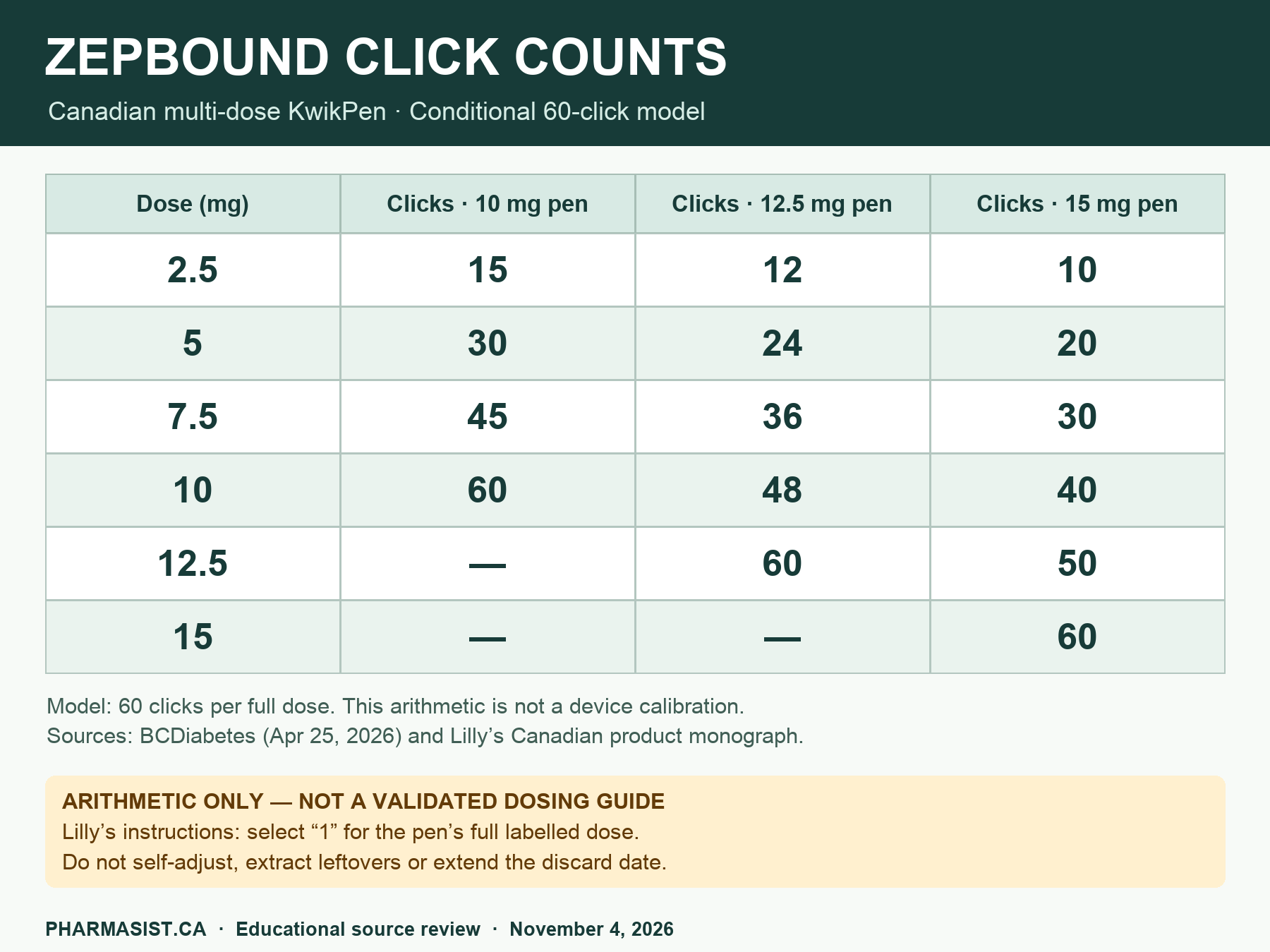
The BCDiabetes tirzepatide handout dated April 25, 2026 discusses Mounjaro and Zepbound and gives a 60-click convention. It reports 10, 20, 30, 40, 50 and 60 clicks for targets from 2.5 to 15 mg using a 15 mg pen, with scaling for 10 and 12.5 mg pens. Our table presents that arithmetic in a new layout, without reproducing its price or extended-use claims.
Modelled clicks = 60 × target amount ÷ labelled full-dose strength. For example, the model gives 30 for a 7.5 mg target in the 15 mg column, but 45 in the 10 mg column. This explains why a number detached from its column heading is incomplete information. A dash means the target exceeds that column’s full-dose amount; it is not an instruction to combine injections.
| Dose (mg) | Clicks · 10 mg pen | Clicks · 12.5 mg pen | Clicks · 15 mg pen |
|---|---|---|---|
| 2.5 | 15 | 12 | 10 |
| 5 | 30 | 24 | 20 |
| 7.5 | 45 | 36 | 30 |
| 10 | 60 | 48 | 40 |
| 12.5 | — | 60 | 50 |
| 15 | — | — | 60 |
Model: 60 clicks per full dose. This arithmetic is not a device calibration.Sources: BCDiabetes (Apr 25, 2026) and Lilly’s Canadian product monograph.
ARITHMETIC ONLY — NOT A VALIDATED DOSING GUIDE. Lilly’s instructions: select “1” for the pen’s full labelled dose.
These calculations are exact within the stated model. Whether a device reliably delivers a partial dose is a separate measurement question. We have not bench-tested the pen, and the cited Canadian instructions do not supply a partial-dose click calibration. A mathematically tidy result should not be described as a clinically validated setting.
Where a cost-saving calculation stops being evidence
A pen’s total nominal medicine content, the amount intended per injection and its allowed time in use are three different quantities. A spreadsheet can divide one by another; it cannot establish sterility or stability after repeated use. The clinic handout also contains a volume description that is inconsistent with Lilly’s 0.6 mL per dose specification. That is why the manufacturer, not the handout, is our source for volume and handling.
Lilly’s Instructions for Use require disposal after four weekly doses or 30 days after first use, even if medicine remains. They caution that attempting to use leftovers can produce an incomplete dose. Do not transfer leftover medicine into a syringe or treat visible liquid as an extra validated dose. Refrigeration does not authorize extending the in-use period.
Practice guidance for pharmacists
ISMP’s medication-safety discussion describes errors when spoken click instructions, the dispensing label and the medication record disagree. It is a US publication: its description of single-use Zepbound devices must not be substituted for the Canadian KwikPen. Its communication warning is nevertheless relevant.
- Identify the exact brand, country-specific presentation, dose strength and device before discussing any chart.
- Ask the patient to explain what they are actually injecting; compare it with the prescribed dose in milligrams and frequency.
- Resolve conflicting verbal and written instructions with the prescriber before supplying an improvised conversion.
- Record first-use and discard dates and ensure the patient has appropriate single-use needles.
- Use teach-back to distinguish priming, selecting a full dose and completing an injection.
The next conversation
Cost and tolerability deserve a practical response, not a dismissive answer or an unqualified chart. Bring the pen, carton and current directions to the pharmacy. The useful outcome is one clear, documented treatment plan. This article explains why click-count numbers circulate; it does not make them a substitute for that plan.
References
- Zepbound Canadian product monograph and KwikPen Instructions for Use — Eli Lilly Canada, Authorization June 11, 2026 (accessed Nov 4, 2026)
- Tirzepatide: Mounjaro & Zepbound — BCDiabetes, Clinical handout, April 25, 2026 (accessed Nov 4, 2026)
- How to use Zepbound KwikPen — Eli Lilly Canada, Official device instructions (accessed Nov 4, 2026)
- Errors Possible When Microdosing (Counting Clicks) to Dose Weight Loss Medicines — Institute for Safe Medication Practices (US), January 6, 2025; device-market limitations noted (accessed Nov 4, 2026)